I find myself in the company of woo, and as a skeptic it is bringing me some grief.
It's all about homebirth - planning to deliver a baby at home, attended by a midwife, rather than in a hospital.
Deena and I came to homebirth through an examination of the evidence. (Here's a discussion I participated in on the Bad Science forums before Kaia's birth.) We were convinced, by scientific studies and analyses, that planning a home birth here in the UK was at least as safe as planning a hospital birth, given a competent attendant and a handy hospital in the event of complications. So we went for it.
However, many people choose homebirth for less evidence-based reasons. They cite personal intuition, or the "naturalness" of it. Not just as reasons to prefer homebirth, but as evidence of its safety.
At Edinburgh's Pregnancy and Parents Centre (a haven for various types of woo, as well as useful support groups and great toddler activities), when we went to the "home birth support group" to relate our experiences and our evidence-based approach, it was alongside others promoting woo of various flavours as part of their support of homebirth.
A recent post on homebirth at Science-Based Medicine has stirred up an epic-length discussion, with passionate defenders on both sides. I've participated, but fear that just being on the homebirth side has made me, in some people's eyes, an advocate of woo.
This is the problem: I agree with the woo-birthers that homebirth can be safe, but I disagree (passionately, vigorously) about why this is a legitimate position. And the disagreement isn't immaterial. At the homebirth meeting, someone recommended homeopathy to treat post-partem haemorrhage. One of the most serious and potentially life-threatening complications of pregnancy, and she advised drinking high-priced water. That is dangerous advice, and I wish I'd been quick-thinking enough to respond persuasively (rather than sitting like a lump and grinding my teeth).
What is a skeptic to do? On the one hand, having someone agree with me in one breath, and back me up with an appeal to intuition in the next, makes me want to revisit and question my beliefs that much more carefully. (That's something a skeptic should be doing anyway, for all their beliefs, but who has the time?) On the other hand, to adapt Niven's 16th law, "There is no belief so true that one cannot find a fool believing it." Just because someone agrees with you for bad reasons doesn't mean you're wrong. I came to my belief about homebirth on the basis of the science, and I'm determined that only science will dissuade me.
But there's also the whole social side. Just as many of my fellow atheists wrinkle their brows at me when I say I go to church, many skeptics seem to do the same when I talk about homebirth. Atheists often assume that the word "church" is synonymous with supernatural beliefs and submission to a holy text, things that would feel alien in our Unitarian church. Similarly, many skeptics assume that, because it's associated with modern medicine, hospital-based birth is inherently safer.
I'm tempted to close by declaring, evangelist-style, that skeptics must beware of this tendency to take association as evidence. Its association with woo-birthers says nothing about the safety of homebirth; nor does its association with high-tech hospitals demonstrate the superiority of hospital birth.
But perhaps a more humble conclusion is in order. Here goes:
I promise to keep vigilant for evidence that might contradict my current beliefs.
I promise to honestly communicate any changes of position that such evidence might lead me to.
I promise to avoid being swayed by other people's assumptions (whether or not they are skeptics).
I promise to make every effort to pin my beliefs to the evidence, and nothing else.
Showing posts with label science. Show all posts
Showing posts with label science. Show all posts
Tuesday, 29 December 2009


Wednesday, 2 December 2009
Homeopathy at Boots: an open letter
In a move reminiscent of the very successful Australian Skeptics open letter to pharmacists, the Merseyside Skeptics Society has issued an open letter to Boots pharmacies.
This is in the wake of a parliamentary subcommittee meeting on the status and labelling of homeopathic remedies sold in pharmacies ("chemists" in this country). If you have time, check out the transcript here - a long but interesting read. (Thanks to Mike for the heads-up.) Here's Ben Goldacre's summary, as one of the people who gave evidence at the meeting.
Boots sells homeopathic products. By association, it lends medical authority to these products - which have been demonstrated, so far as good research is able to demonstrate, to be medically indistinguishable from placebos. That is, they are not real medicine, and do not replace real medicine. The will not protect you from malaria; they will not protect you from H1N1. They won't even cure your headache. If your headache does get better after homeopathy, there are three much more likely explanations: (1) it was a random coincidence (unsatisfying, but sometimes the world works that way), (2) it was going to get better anyway (you can't tell this from a single case, but a large study of many people could), or (3) your belief in the treatment had a real effect on your malady (a very cool possibility - see Ben Goldacre's book Bad Science for more, or go read his blog).
Though they sell them, the Boots representative who spoke to the committee admitted that homeopathic treatments have no good evidence supporting their effectiveness in dealing with any health complaint. His best argument for selling homeopathy comes out in this excerpt from the start of the transcript:
I include the open letter below. I will also be contacting Boots. If you are interested in this issue, I encourage you to do the same.
This is in the wake of a parliamentary subcommittee meeting on the status and labelling of homeopathic remedies sold in pharmacies ("chemists" in this country). If you have time, check out the transcript here - a long but interesting read. (Thanks to Mike for the heads-up.) Here's Ben Goldacre's summary, as one of the people who gave evidence at the meeting.
Boots sells homeopathic products. By association, it lends medical authority to these products - which have been demonstrated, so far as good research is able to demonstrate, to be medically indistinguishable from placebos. That is, they are not real medicine, and do not replace real medicine. The will not protect you from malaria; they will not protect you from H1N1. They won't even cure your headache. If your headache does get better after homeopathy, there are three much more likely explanations: (1) it was a random coincidence (unsatisfying, but sometimes the world works that way), (2) it was going to get better anyway (you can't tell this from a single case, but a large study of many people could), or (3) your belief in the treatment had a real effect on your malady (a very cool possibility - see Ben Goldacre's book Bad Science for more, or go read his blog).
Though they sell them, the Boots representative who spoke to the committee admitted that homeopathic treatments have no good evidence supporting their effectiveness in dealing with any health complaint. His best argument for selling homeopathy comes out in this excerpt from the start of the transcript:
They don't have good evidence that they work, but people want to spend money on them. This is a disgustingly cynical attitude toward the public, and toward Boots pharmacists' own responsibility as front-line dispensers of medicine.Mr Bennett: We do indeed sell them and there is certainly a consumer demand for those products.
Q4 Chairman: I did not ask you that question. I said do they work beyond the placebo effect?
Mr Bennett: I have no evidence before me to suggest that they are efficacious, and we look very much for the evidence to support that, and so I am unable to give you a yes or no answer to that question.
Q5 Chairman: You sell them but you do not believe they are efficacious?
Mr Bennett: It is about consumer choice for us. A large number of our consumers actually do believe they are efficacious, but they are licensed medicinal products and, therefore, we believe it is right to make them available.
Q6 Chairman: But as a company you do not believe that they necessarily are?
Mr Bennett: We do not disbelieve either. It is an evidence issue.
I include the open letter below. I will also be contacting Boots. If you are interested in this issue, I encourage you to do the same.
An Open Letter to Alliance Boots
The Boots brand is synonymous with health care in the United Kingdom. Your website speaks proudly about your role as a health care provider and your commitment to deliver exceptional patient care. For many people, you are their first resource for medical advice; and their chosen dispensary for prescription and non-prescription medicines. The British public trusts Boots.
However, in evidence given recently to the Commons Science and Technology Committee, you admitted that you do not believe homeopathy to be efficacious. Despite this, homeopathic products are offered for sale in Boots pharmacies – many of them bearing the trusted Boots brand.
Not only is this two-hundred-year-old pseudo-therapy implausible, it is scientifically absurd. The purported mechanisms of action fly in the face of our understanding of chemistry, physics, pharmacology and physiology. As you are aware, the best and most rigorous scientific research concludes that homeopathy offers no therapeutic effect beyond placebo, but you continue to sell these products regardless because “customers believe they work”. Is this the standard you set for yourselves?
The majority of people do not have the time or inclination to check whether the scientific literature supports the claims of efficacy made by products such as homeopathy. We trust brands such as Boots to check the facts for us, to provide sound medical advice that is in our interest and supply only those products with a demonstrable medical benefit.
We don’t expect to find products on the shelf at our local pharmacy which do not work.
Not only are these products ineffective, they can also be dangerous. Patients may delay seeking proper medical assistance because they believe homeopathy can treat their condition. Until recently, the Boots website even went so far as to tell patients that “after taking a homeopathic medicine your symptoms may become slightly worse,” and that this is “a sign that the body’s natural energies have started to counteract the illness”. Advice such as this directly encourages patients to wait before seeking real medical attention, even when their condition deteriorates.
We call upon Boots to withdraw all homeopathic products from your shelves. You should not be involved in the sale of ineffective products, because your customers trust you to do what is right for their health. Surely you agree that your commitment to excellent patient care is better served by supplying only those products whose claims can be substantiated by rigorous scientific research? Or do you really believe that Boots should be in the business of selling placebos to the sick and the injured?
The support lent by Boots to this quack therapy contributes directly to its acceptance as a valid medical treatment by the British public, acceptance it does not warrant and support it does not deserve. Please do the right thing, and remove this bogus therapy from your shelves.
Yours sincerely,
Merseyside Skeptics Society
-----
Other blogs and websites have noted this, including Skepchick, The Not Quite So Friendly Humanist, Bruce Hood, Bad Science, A Glasgow Skeptic, RichardDawkins.net, Bad Homeopathy, and New Humanist.
Also, various newspapers have picked up on Boots' strange position: The Telegraph, Daily Express, Daily Mail, Guardian (and Ben Goldacre again, and their liveblog of the meeting), Times, and Mirror.
Feel free to comment and link to any I've missed.
Friday, 20 November 2009
Some science news
In a recent issue of Psychological Science (to which I am subscribed), three of the five research articles were on topics that I thought would be interesting to a general audience.
(I'm afraid the links are only to abstracts - you need to be an APS member or browse from a university which has a subscription in order to see the full article. If you think this is unfair, or contrary to the scientific spirit of open inquiry, I agree. See here or here for some discussion of the issue of open-access academic publishing.)
I should open with a warning: none of these articles is in my field of expertise, so my interpretation of the results and their applicability to life in general may be inaccurate. But I think some extrapolation is warranted.
Passersby
First, there's an article examining how we decide which side we'll go on when we approach an oncoming pedestrian on the sidewalk. Apparently, we use the direction their looking in as a cue to which side they'll go on, and we choose the other side. Not life-changing, I know, but interesting.
Now for the caveat: this is a single scientific study, and as such was very limited scope. Gaze direction was the only cue they looked at. Body language, social conventions (such as "always pass on the left"), and other factors may also influence how such encounters are resolved.
Nevertheless, next time I'm unsure which side to pass someone on, I'll consciously fix my gaze on one side and go that way, to see if that helps avoid that awkward mambo of mutual indecision.
Affirmation and persuasion
Second, there's one about how self-affirmation affects our attention to persuasive messages. Moderate drinkers who participated in a self-affirmation exercise (in this case, writing about one of their best traits) were more likely than the control group to attend to threatening aspects of an article about the dangers of moderate to heavy drinking.
They did not find the same effect in heavy drinkers. Also, they just measured attention. That is, they did not follow up to see if the affirmation group changed their behaviour as a result of their increased attention.
However, I can remember several times when I've tuned out a message because it seemed mainly to be trying to persuade me out of some belief or activity I was attached to. Perhaps if I were to engage in some sort of affirmation, I would be more able and willing to hear such messages through. If the message contains a good reason to change, then my increased attention might enable me to take that reason on board. If not, then I'll still be free to reject the message - but I'll do it because of the content and not because it's threatening to me.
Self-restraint and Impulsive Behaviour
Third, there's an article examining the connection between perceived self-restraint and actual impulsive behaviour. Briefly, if we think that we have great self-restraint, then we are more likely to put ourselves in situations which will test us, and ultimately we are more likely to engage in impulsive behaviour.
I'm not sure how broadly this can be extrapolated, but the "moral" that I draw from this study is that I should try to avoid overconfidence when it comes to my vices. The most pernicious of these, for me, is a desire to remain connected to the Internet. If I need to pay attention to something else (parenting, say, or dealing with bills), then an open laptop on the table is a bad idea.
I love science. I love cosmology, biology, physics, chemistry - the whole bunch. Every science I've come across has something to inspire awe, wonder, and delight. But nothing beats psychology for churning out knowledge with direct relevance to the way we live our lives.
Deena and I recently bought Richard Wiseman's new book, 59 Seconds, which promises to be a delicious exploration of just this sort of thing. A science-based self-help book. Awesome.
(I'm afraid the links are only to abstracts - you need to be an APS member or browse from a university which has a subscription in order to see the full article. If you think this is unfair, or contrary to the scientific spirit of open inquiry, I agree. See here or here for some discussion of the issue of open-access academic publishing.)
I should open with a warning: none of these articles is in my field of expertise, so my interpretation of the results and their applicability to life in general may be inaccurate. But I think some extrapolation is warranted.
Passersby
First, there's an article examining how we decide which side we'll go on when we approach an oncoming pedestrian on the sidewalk. Apparently, we use the direction their looking in as a cue to which side they'll go on, and we choose the other side. Not life-changing, I know, but interesting.
Now for the caveat: this is a single scientific study, and as such was very limited scope. Gaze direction was the only cue they looked at. Body language, social conventions (such as "always pass on the left"), and other factors may also influence how such encounters are resolved.
Nevertheless, next time I'm unsure which side to pass someone on, I'll consciously fix my gaze on one side and go that way, to see if that helps avoid that awkward mambo of mutual indecision.
Affirmation and persuasion
Second, there's one about how self-affirmation affects our attention to persuasive messages. Moderate drinkers who participated in a self-affirmation exercise (in this case, writing about one of their best traits) were more likely than the control group to attend to threatening aspects of an article about the dangers of moderate to heavy drinking.
They did not find the same effect in heavy drinkers. Also, they just measured attention. That is, they did not follow up to see if the affirmation group changed their behaviour as a result of their increased attention.
However, I can remember several times when I've tuned out a message because it seemed mainly to be trying to persuade me out of some belief or activity I was attached to. Perhaps if I were to engage in some sort of affirmation, I would be more able and willing to hear such messages through. If the message contains a good reason to change, then my increased attention might enable me to take that reason on board. If not, then I'll still be free to reject the message - but I'll do it because of the content and not because it's threatening to me.
Self-restraint and Impulsive Behaviour
Third, there's an article examining the connection between perceived self-restraint and actual impulsive behaviour. Briefly, if we think that we have great self-restraint, then we are more likely to put ourselves in situations which will test us, and ultimately we are more likely to engage in impulsive behaviour.
I'm not sure how broadly this can be extrapolated, but the "moral" that I draw from this study is that I should try to avoid overconfidence when it comes to my vices. The most pernicious of these, for me, is a desire to remain connected to the Internet. If I need to pay attention to something else (parenting, say, or dealing with bills), then an open laptop on the table is a bad idea.
----
I love science. I love cosmology, biology, physics, chemistry - the whole bunch. Every science I've come across has something to inspire awe, wonder, and delight. But nothing beats psychology for churning out knowledge with direct relevance to the way we live our lives.
Deena and I recently bought Richard Wiseman's new book, 59 Seconds, which promises to be a delicious exploration of just this sort of thing. A science-based self-help book. Awesome.
Tuesday, 3 November 2009
Healthy newsreading
Very closely connected with humanism is scientific skepticism. I doubt there are many (secular) humanists who wouldn't also identify with the skeptical movement, exemplified in popular science blogs like Bad Science, podcasts like the Skeptics Guide to the Universe, and books by folks like Simon Singh.
Keep in mind, I'm not talking skepticism as in "kneejerk doubt". I'm talking skepticism as in "I'll believe it if you show me good evidence" - the definition most self-described skeptics would give. Much of skepticism involves learning how to tell good evidence from bad evidence.
One of the greatest day-to-day benefits of being a skeptic is having the skills to filter the claims we're exposed to. Particularly those that get uncritically spread by journalists (and by friends and family). To that end, in addition to recommending the above sources, I'd like to pass on an article that was passed on by Ben Goldacre at Bad Science:
How to read articles about health, by Dr Alicia White
I'll take this opportunity to point out that it is simple little strategies like the ones Dr White outlines that make up most of scientific literacy. People often tell me that they would never be able to understand things like quantum physics, evolution, or acoustics, because they're not scientifically trained.
Rubbish. The only barrier to most people understanding the key points of any science is lack of interest.*
And, when it comes to health, that's a rather strange barrier to erect around yourself. What possible excuse could anyone have for cultivating disinterest in their own well-being? (I know, I know - whole psychological schools of thought are devoted to answering this question.)
Anyway, enjoy the article.
Footnote:
* Okay, that was a very strong claim. But I stand by it, with one caveat: one must have a teacher (or book) with some competence to communicate the science.
Keep in mind, I'm not talking skepticism as in "kneejerk doubt". I'm talking skepticism as in "I'll believe it if you show me good evidence" - the definition most self-described skeptics would give. Much of skepticism involves learning how to tell good evidence from bad evidence.
One of the greatest day-to-day benefits of being a skeptic is having the skills to filter the claims we're exposed to. Particularly those that get uncritically spread by journalists (and by friends and family). To that end, in addition to recommending the above sources, I'd like to pass on an article that was passed on by Ben Goldacre at Bad Science:
How to read articles about health, by Dr Alicia White
The most important rule to remember: “Don’t automatically believe the headline”.Of course, there's much more - read the full article to see what else she has to say. Skeptics will already be familiar with her points, but other people may find them useful. Pass on the link, or download and print off the PDF and pass that out.
I'll take this opportunity to point out that it is simple little strategies like the ones Dr White outlines that make up most of scientific literacy. People often tell me that they would never be able to understand things like quantum physics, evolution, or acoustics, because they're not scientifically trained.
Rubbish. The only barrier to most people understanding the key points of any science is lack of interest.*
And, when it comes to health, that's a rather strange barrier to erect around yourself. What possible excuse could anyone have for cultivating disinterest in their own well-being? (I know, I know - whole psychological schools of thought are devoted to answering this question.)
Anyway, enjoy the article.
Footnote:
* Okay, that was a very strong claim. But I stand by it, with one caveat: one must have a teacher (or book) with some competence to communicate the science.
Tuesday, 20 October 2009
We are animals
Erich Vieth at Dangerous Intersection tells us "Why it matters that humans are animals". An interesting and clear expression of the consequences of our biological and medical understanding of humanity's place in the pageant of life. The only point I'd strongly quibble with is where he echoes Johnson's claim that there are no absolute truths. I think most of science, and indeed of human pursuit of understanding, presupposes the existence of absolute truths. It's probably true that we can never be sure that we have apprehended those truths perfectly, but I think it's important to act as if they exist nevertheless.
Thursday, 8 October 2009
I have an idea ...
 At work, I recently came across an amazing resource: CiteULike. It's a free website where you can build up a list of citations. I use it to manage the long list of papers and books I read and cite as a researcher. I can label citations, like I label blog entries on this site, according to common themes.
It also has social features: sharing citations between users, getting automated recommendations based on common research interests. And there are Groups.
Which gives me an idea.
There are loads of skeptical blogs out there. There are the science-based parenting folks (such as SBP themselves, Rational Moms), the science-based medicine gang (SBM, Ben Goldacre, etc), and of course the general skeptics (Bruce Hood, Massimo Pigliucci, Richard Wiseman, and loads more).
These blogs often bring up new or interesting research that bears on our lives - as parents, as users (and taxpaying supporters) of health care, and just as people trying to navigate the modern world. But finding a particular study that I remember reading about on some skeptical blog can be a real pain.
So it occurs to me - why not set up a group, or a set of groups, on CiteULike, where skeptics could post scientific articles of interest to the community? You can put notes on each article - for example, pointing to reviews on skeptical blogs. You can talk about the articles (and the body of evidence around given topics, like acupuncture or spanking) in forums. You can associate informative tags with articles. Or you can simply hang out and see what other people have dug up. The resource could be used by bloggers who like to check original research, and also by skeptical consumers of new and traditional media claims.
It's not something I can do on my own. I don't have the time or the expertise to dig up all the relevant papers.
So this is a call to all you skeptics out there who have a little bit of time or expertise. Are you willing to help get things started?
I've taken the first step: I've created a CiteULike group, Skeptical Parenting, to pilot this idea. I chose parenting partly because that's where I am closest to having some substantive expertise, and partly because my second child is due to arrive any day now.
The next step is up to you. Here is what I ask of anyone who is interested:
- Join me as a member of the group, or start another group. "Paranormal Research", "Science-Based Medicine Users" - whatever you're most into as a skeptic. If you start another group, let us know in the comments here. (Do a search on CiteULike before starting the group to make sure someone hasn't already started one.)
- Blog about this yourself - not many people read my blog, but some of you have very widely-read blogs. The more people read about this idea, the sooner we'll reach a sustainable number of participants.
- Tell your friends. We don't all have blogs, but we all have skeptical acquaintances on- and off-line that we can share cool new ideas with.
- Comment here, so I know that I'm not just talking to myself.
Tuesday, 6 October 2009
Entitled to our own opinions
From his book Looking in the Distance (pages 101-102), here is Richard Holloway on the intersection of religion and science (emphasis mine):
It is embarrassing when theologians try to conflate the Christian story with the current scientific narrative; and it is a mistake, however understandable, when scientists try to disprove the Christian story as though it were just another set of outdated scientific claims. The scientific attack on Christianity is excusable, however, because fundamentalist groups insist on marketing Christianity as a science rather than as myth. While we are all entitled to our own opinions, we are not entitled to our own facts, which is why scientists cannot avoid getting drawn into the quagmire of the science versus religion debate.That last sentence contains the real money quote for me here:
While we are all entitled to our own opinions, we are not entitled to our own facts.This is why scientists and fans of science get so het up when people deny things like the well-established and exhaustively-tested effectiveness and safety of vaccines, or the copious and consistent evidence for evolution.
Saturday, 26 September 2009
Defending Dawkins
I recently came across Bettynoirbettyblanc's blog, and this post in particular, where she discusses her problem with Richard Dawkins. I was composing a response to post in the discussion, but it grew into something a little long for a comment. Here it is, with relevant excerpts from her post.
In the post, Betty discusses her take on Richard Dawkins - a man who, for good or ill, is the first person people think of when atheism is mentioned in Britain, especially in connection with evolution. I encourage you to read what she writes before continuing here, as I will not cover all of what she says, nor present her thoughts in the order she does.
For someone in Dawkins' position - someone who has spent his life working to learn more about our biological origins - it is certainly understandable that he will view creationists as the enemy. He feels passionately about his work. Every one of his books that I have read (even, at times, The God Delusion) bursts with enthusiasm about what we, as a species, have learned about our origins through dogged scientific effort. He has committed his life to this pursuit. He has submitted himself to the scientific community, which tends to be ruthless in its attempts to disprove new ideas, and which only accepts them after repeated failures to disprove them. (One prominent example is the idea introduced in the mid-19th-century that the diversity of species is due to the accumulation of small changes accumulated over time and channelled by natural selection.)
Not only that, but for much of Dawkins' career he has also engaged in the admirable task of sharing this wonder and these discoveries with the public, in his very readable and accessible books of science.
Creationists belittle not only Dawkins' work, but the careful work of hundreds (thousands?) of scientists leading back to Darwin. They belittle it without any good arguments, without any good evidence, and usually with a complete failure to grasp the evidence they're trying to refute.
They are not interested in submitting themselves to the rigours of science. They are not interested in letting the evidence rule on which answer is right. Their actions suggest that they are only interested in convincing everyone that the scientists are wrong (and/or evil) and that we should set science aside in favour of their ideological commitment to a disproven belief. (I'm referring there to young-earth creationism and ID, not religion in general.)
On the other side of the issue, I have read creationist apologists like Lee Strobel and John Blanchard argue for an evolution-denying ideology. They consistently fail to accurately represent the case for evolution, and then inexpertly demolish the straw men they have invented. (I've discussed Blanchard's attempt here. Strobel is being taken apart in exquisite detail by Ebonmuse here.)
So, the supporters of evolution rely on the evidence, occasionally spending some time pointing out the flaws in the deniers' arguments. The deniers of evolution paint caricatures of the evidence, attack the caricatures, and pretend that they're doing science too. They don't do real science: they don't make falsifiable predictions, and they certainly don't do experiments to test them.
When I read Dawkins, I can trust that most of what he says about science is based on the scientific method. He's reporting conclusions that have been carefully tested, which qualified people have tried and failed to disprove. I take what he says at face value because I trust the procedure that has been followed to arrive at those conclusions. When I look further, the people who are qualified to understand the evidence all tend to agree with him.
On the other hand, he clearly isn't speaking as a scientist in many of his comments about religion, and so I don't take them at face value. In fact, I often disagree with him, vocally, in settings where that sets me apart (ie, among other humanists). I'm not treated as stupid for questioning because my humanist acquaintances - like Dawkins, like most atheists and humanists - value questioning. We believe that any claim should be open to question, no matter how popular it is. If the question has nothing to back it up - no evidence to motivate a shift in our beliefs, then we set it aside. But if the questioner has a sound reason for dissenting from popular opinion and solid evidence to back up their dissent, then that dissent spreads.
It was that sort of questioning that led to Darwin's great breakthroughs. It is that sort of questioning that has led to every refinement and revision in the theory of evolution since then. It is that sort of questioning that has driven science for the past few centuries, with countless concrete benefits as proof of the process.
And, although religion is not uniformly anti-knowledge or anti-progress, the opponents of science have almost uniformly been religious.
Recent centuries and decades have seen a dramatic reduction in institutional discrimination against the non-religious. Keep in mind, however, that "victimhood" is not always an inappropriate feeling. Sometimes you are a victim, and you need to be aware of it. Some laws favouring religious over non-religious belief still remain, even in the enlightened West (even in uber-secular Finland). Dawkins is a scientist, and as Betty says, 40% of Americans deny the evidence that is at the foundation of his field. To the extent that they try to challenge the teaching of that science in schools, and seek to warp people's perceptions of it in universities (for example, see this development), there is a concerted attack on precisely the field of knowledge Dawkins has devoted his life to. It's worth noticing and acknowledging that scientists (and everyone who benefits from their work) are victims of the creationists' campaign of science-denial. That way we can do something constructive to counter it.
I really don't like my first mention of such an apparently pleasant person as Betty to come off so negative and critical. (I enjoyed this post of hers, and this one.) I hope that I have made it clear that Dawkins has by no means a free pass to my credulity, particularly when he talks about religion. Whether that helps encourage her to look deeper into the whole evolution/creation thing is up to her.
I hope Betty will respond to what I've said, either in the comments here or on her own blog post (where I'll point her to this post). And of course, anyone else who agrees or disagrees with either of us is invited to comment too.
* From the same list of publications, using just the titles as a guide, I count no more than 8 of 16 popular articles dealing with religion (at least 11 of the 16 have a scientific slant), and only 3 of 30 academic articles can plausibly be said to be about religion, the remainder being biological. So, out of 56 items listed, no more than 12, or about 21%, are about religion - most of these being popular articles. At least 48, or about 86%, deal primarily or exclusively with science. (Totals exceed 100% because some articles seem to deal with both science and religion. Also note that I think one or two articles appear both in the scientific and the popular list.) Readers can decide whether this amounts to a "dogged obsession with religion". Perhaps the dogged obsession belongs to those apologists who wish to diminish his influence, Dawkins being a well-known and widely-respected public figure.
In the post, Betty discusses her take on Richard Dawkins - a man who, for good or ill, is the first person people think of when atheism is mentioned in Britain, especially in connection with evolution. I encourage you to read what she writes before continuing here, as I will not cover all of what she says, nor present her thoughts in the order she does.
Why do I find him interesting? I just wonder about his dogged obsession with religion and with those that practice it. He is a scientist and yet he seems to spend [much] of his time trying to argue that following a religion is at best ridiculous and at worst positively harmful. I just don’t understand why.I've read several of Dawkins' books, and I think that this misrepresents him. While I think his tone regarding religion is not particularly helpful, it's worth noting that of the ten popular books he has written, only one is about religion (yes, it's The God Delusion).* Not exactly a dogged obsession. More of an unavoidable side-note for someone in his field who wishes to engage the public.
A whopping 40% of Americans are creationists and Dawkins compares them to holocaust deniers. This is highly offensive. A holocaust denier is someone who twists the facts of the historical record in order to bolster a racist agenda. These people are motivated by their hatred of Jews. The facts do not matter. For a creationist, evolution has not been proven beyond reasonable doubt. There are questions about the theory that they believe have not been adequately answered. They believe the story of creation not in order to further a hate campaign, but as part of a belief system.While I wouldn't personally choose to compare evolution-deniers to Holocaust-deniers, I understand Dawkins' choice of such an analogy. First, it is accurate inasmuch as both holocaust-deniers and evolution-deniers reject the overwhelming preponderance of evidence in favour of a position that is based entirely on ideology. As Betty says, they "twist the facts of the historical record in order to bolster an agenda. ... The facts do not matter." At least that part applies equally well to both sorts of deniers.
For someone in Dawkins' position - someone who has spent his life working to learn more about our biological origins - it is certainly understandable that he will view creationists as the enemy. He feels passionately about his work. Every one of his books that I have read (even, at times, The God Delusion) bursts with enthusiasm about what we, as a species, have learned about our origins through dogged scientific effort. He has committed his life to this pursuit. He has submitted himself to the scientific community, which tends to be ruthless in its attempts to disprove new ideas, and which only accepts them after repeated failures to disprove them. (One prominent example is the idea introduced in the mid-19th-century that the diversity of species is due to the accumulation of small changes accumulated over time and channelled by natural selection.)
Not only that, but for much of Dawkins' career he has also engaged in the admirable task of sharing this wonder and these discoveries with the public, in his very readable and accessible books of science.
Creationists belittle not only Dawkins' work, but the careful work of hundreds (thousands?) of scientists leading back to Darwin. They belittle it without any good arguments, without any good evidence, and usually with a complete failure to grasp the evidence they're trying to refute.
They are not interested in submitting themselves to the rigours of science. They are not interested in letting the evidence rule on which answer is right. Their actions suggest that they are only interested in convincing everyone that the scientists are wrong (and/or evil) and that we should set science aside in favour of their ideological commitment to a disproven belief. (I'm referring there to young-earth creationism and ID, not religion in general.)
Either he wants people to know about evolution and to ‘convert’ the creationists or he just wants a nice argument to bolster his book sales. I think if it was the former then he would be wise to act in a more conciliatory manner, and watch his language (ie the use of the word ‘ignorant’, I would also like to point out at this point that some of the people I know who are most knowledgeable about evolution are in fact creationists).While it may not be nice of him to call evolution-deniers "ignorant", it is difficult to see how the term is wrong. The only way to confidently proclaim evolution false is to set aside (deliberately or in ignorance) the entire geological, molecular, geographical, and experimental bodies of evidence that support evolution. Though I'm sure most creationists' motivation for this is simply to carry on believing what they wish to believe, not to promote hate (has Dawkins or anyone else ever claimed that?), that doesn't change the facts. One has to remain ignorant (ie, not knowing of or understanding the evidence) to honestly deny evolution. (I can't say much about the claim that "some of the people [Betty knows] who are most knowledgeable about evolution are in fact creationists". Would they seem knowledgeable to a biologist, or only to someone like Betty who confesses little understanding of or interest in the science behind this "debate"?)
I can’t verify much of what he says because I don’t have access to the research or fully understand the terms and the processes involved. It’s been a long time since I did higher biology and chemistry! I suspect that for most of his vociferous cheerleaders on websites and forums across the globe, this is also the case. Perhaps they don’t wish to seem stupid for questioning?Is that a rhetorical question, "who knows?" Because there's an obvious answer. The actual biologists (ie, people who dedicate their lives to understanding this stuff) know. And a good number of them have produced books that Betty and I and any of our readers can understand. These outreach biologists (Dawkins, Gould, Wilson, etc) don't make arguments of the form "I believe this, and I'm and expert so just take my word for it." They make arguments of the form "Here's some evidence. Here's why it supports evolution." With plenty of references to original research so that you can independently verify their claims if you don't trust them.
In this respect, I find his followers similar to those of religious faiths. They are taking what he says at face value because they believe in him. They may well be correct – I don’t know. The argument seems reasonable, but who knows?
On the other side of the issue, I have read creationist apologists like Lee Strobel and John Blanchard argue for an evolution-denying ideology. They consistently fail to accurately represent the case for evolution, and then inexpertly demolish the straw men they have invented. (I've discussed Blanchard's attempt here. Strobel is being taken apart in exquisite detail by Ebonmuse here.)
So, the supporters of evolution rely on the evidence, occasionally spending some time pointing out the flaws in the deniers' arguments. The deniers of evolution paint caricatures of the evidence, attack the caricatures, and pretend that they're doing science too. They don't do real science: they don't make falsifiable predictions, and they certainly don't do experiments to test them.
When I read Dawkins, I can trust that most of what he says about science is based on the scientific method. He's reporting conclusions that have been carefully tested, which qualified people have tried and failed to disprove. I take what he says at face value because I trust the procedure that has been followed to arrive at those conclusions. When I look further, the people who are qualified to understand the evidence all tend to agree with him.
On the other hand, he clearly isn't speaking as a scientist in many of his comments about religion, and so I don't take them at face value. In fact, I often disagree with him, vocally, in settings where that sets me apart (ie, among other humanists). I'm not treated as stupid for questioning because my humanist acquaintances - like Dawkins, like most atheists and humanists - value questioning. We believe that any claim should be open to question, no matter how popular it is. If the question has nothing to back it up - no evidence to motivate a shift in our beliefs, then we set it aside. But if the questioner has a sound reason for dissenting from popular opinion and solid evidence to back up their dissent, then that dissent spreads.
It was that sort of questioning that led to Darwin's great breakthroughs. It is that sort of questioning that has led to every refinement and revision in the theory of evolution since then. It is that sort of questioning that has driven science for the past few centuries, with countless concrete benefits as proof of the process.
And, although religion is not uniformly anti-knowledge or anti-progress, the opponents of science have almost uniformly been religious.
Worse, I believe his words convert more people to fundamentalist ideas than anything else as they engender a sense of victimhood and persecution amongst those who don’t agree with what he says.I would object to the use of the term "fundamentalist" here, as it seems completely divorced from any useful definition I've come across. But yes, to the extent that he overstates the religious antipathy to science, and exaggerates the incompatibility of science and religion, he does encourage an unhelpful us-versus-them mentality among atheists, and it's one that I try to combat where I can. There are many, many religious believers who have nothing wrong with atheists or with evolution. Many of them are acquaintances and friends of mine.
Recent centuries and decades have seen a dramatic reduction in institutional discrimination against the non-religious. Keep in mind, however, that "victimhood" is not always an inappropriate feeling. Sometimes you are a victim, and you need to be aware of it. Some laws favouring religious over non-religious belief still remain, even in the enlightened West (even in uber-secular Finland). Dawkins is a scientist, and as Betty says, 40% of Americans deny the evidence that is at the foundation of his field. To the extent that they try to challenge the teaching of that science in schools, and seek to warp people's perceptions of it in universities (for example, see this development), there is a concerted attack on precisely the field of knowledge Dawkins has devoted his life to. It's worth noticing and acknowledging that scientists (and everyone who benefits from their work) are victims of the creationists' campaign of science-denial. That way we can do something constructive to counter it.
I really don't like my first mention of such an apparently pleasant person as Betty to come off so negative and critical. (I enjoyed this post of hers, and this one.) I hope that I have made it clear that Dawkins has by no means a free pass to my credulity, particularly when he talks about religion. Whether that helps encourage her to look deeper into the whole evolution/creation thing is up to her.
I hope Betty will respond to what I've said, either in the comments here or on her own blog post (where I'll point her to this post). And of course, anyone else who agrees or disagrees with either of us is invited to comment too.
-----
* From the same list of publications, using just the titles as a guide, I count no more than 8 of 16 popular articles dealing with religion (at least 11 of the 16 have a scientific slant), and only 3 of 30 academic articles can plausibly be said to be about religion, the remainder being biological. So, out of 56 items listed, no more than 12, or about 21%, are about religion - most of these being popular articles. At least 48, or about 86%, deal primarily or exclusively with science. (Totals exceed 100% because some articles seem to deal with both science and religion. Also note that I think one or two articles appear both in the scientific and the popular list.) Readers can decide whether this amounts to a "dogged obsession with religion". Perhaps the dogged obsession belongs to those apologists who wish to diminish his influence, Dawkins being a well-known and widely-respected public figure.
Friday, 11 September 2009
Five influential female authors
Here's an internet/blogging meme coming via Ken at C. Orthodoxy. It asks us, as the post title says, to name five female authors that have been influential to us.
As the father of a precocious almost-two-year-old girl, I make sure to celebrate female excellence as much as possible in order to counterbalance the undeniable tendency, here and now, for there to be more men than women in prominent positions - politically, socially, economically, and culturally.
So here goes: five awesome writers who happen to be women.*
Ursula K. Le Guin. Every book of hers that I've read has moved, delighted, and surprised me. She wrote The Dispossessed, the best argument for an egalitarian, property-free, anarchist society that I've come across (it's a novel). She wrote the Earthsea books, easily equal to Lord of the Rings or the Harry Potter series (both of which I love) for epic awesomeness and tender humanness. She wrote an excellent version of Lao Tzu's Tao Te Ching. (Here's one of the verses from it, which I quoted from here.) There are more, but I think I'll let you discover them for yourself. Le Guin's influence has been to show me that bold ideas don't preclude humble values like compassion and human vulnerability. Most of the science fiction I read growing up (and there was a lot - I was that kind of kid) was written by men from a particular era. At the risk of sounding sexist, it shows. Action, adventure, sex, but not much quiet humanity. Le Guin taught me that, even in genres like science fiction and fantasy, even when your characters include hermaphroditic psychics living on a planet of snow and ice or powerful wizards who can command the elements with arcane words, there is space for a fully human narrative. (There are male authors who I would rank close to her in this regard, but none quite as good at it, and anyway this post isn't about them.)
Gloria Borden and Katherine Harris. I'm listing these two together, because they are co-authors (along with Lawrence Raphael) of the Speech Science Primer**, my first textbook in phonetics - the physical science of speech. I am now at the end of a PhD in phonetics, with a dissertation approved and bound (nice thick tome) that adds a little to the sum of human knowledge. Although the main credit for my education goes to all the in-person teachers I've had (several of whom were women), I have to acknowledge that this well-presented and understandable textbook gave me a level of understanding and confidence in the field that helped cement my choice, leading me into an exciting field of scientific discovery.
Marjorie Tew. We humanists pride ourselves on following the evidence. We make a big deal of the fact that modern medicine is generally evidence-based (as opposed to most types of alternative "medicine", which are either evidence-free or based on very fallible types of evidence, such as anecdote). Tew, a statistician, followed a line of evidence in a surprising direction, and relates the story and the evidence in her book Safer Childbirth? (the question mark is in the title). In it, she presents a compelling empirical case that, in modern industrialised nations, giving birth in a hospital is not safer than giving birth at home. (For anyone interested, I related some key details of her arguments a couple of years ago in this thread at the Bad Science forums.) Her book was a large part of what persuaded Deena and me to plan a homebirth with Kaia. We are planning the same for baby #2 (due in a few short weeks). Again, there were other influences, but Tew's approach and her arguments were an important factor in our decision.
Julia Sweeney (and here). Okay, so this may be stretching the definition of "author" a bit. I know Julie Sweeney through the audio version of two of her monologues: In the Family Way, and Letting Go of God. They are basically books, just in a different medium. Sort of. Anyway, it's my blog, so I can choose whoever I want. Julia Sweeney's main influence on me is through the religious monologue, Letting Go of God. In it, she recounts her journey from being a contented Catholic, through reading the Bible, encountering doubt, wrestling with it, trying out different ideas, and eventually coming out a contented atheist. It's a fun listen. It's also valuable because whenever she elicits laughs, they are primarily directed at her - or at ideas she entertained, or thoughts she had. Not at other people, not in a sneering "I'm better than you" way.
It is, I think, the gentlest way I have ever encountered for someone to outline why she doesn't believe in God. Let someone laugh with you, at you, and you cease to be a threatening figure, an enemy. You become simply human, and it's much easier to try to sympathise with someone who's simply human than someone who is speaking as a scientist, or as a philosopher (or, perhaps, as a blogger). Goodness knows I have nothing like Julia Sweeney's talent for humour, but whenever I think about engaging a religious believer in discussion about topics we differ on, I think of Julia Sweeney and her approach. I think she has helped me become a more friendly humanist.
So there you have it. Five women whose writing (or similar creative output) has influenced me. One author of fiction, three scientists, and a performer/autobiographer.
The five women I've talked about above have influenced me, but their influence pales next to that of the women I know and have known in person - family, friends, colleagues, teachers.
Also, though I celebrate these women and their influence on me, I do it because of what they have done, not just because they are women. I hope that, as she grows up, Kaia will find inspiration and perhaps role-models in women like these, but also in men who write influential, inspiring, interesting, or great things. Or even humble things that nevertheless make our world better.
* I couldn't find photos for all five, so I've decided to leave this post image-free. You can see some of them by following the links provided.
** I'm linking to Amazon's listing of the 3rd edition of the Speech Science Primer, which is the one I used. There are more recent editions that you should look at if you are considering buying the book: speech science is a dynamic field, and some of what they had to say in 1994 is out of date now.
As the father of a precocious almost-two-year-old girl, I make sure to celebrate female excellence as much as possible in order to counterbalance the undeniable tendency, here and now, for there to be more men than women in prominent positions - politically, socially, economically, and culturally.
So here goes: five awesome writers who happen to be women.*
Ursula K. Le Guin. Every book of hers that I've read has moved, delighted, and surprised me. She wrote The Dispossessed, the best argument for an egalitarian, property-free, anarchist society that I've come across (it's a novel). She wrote the Earthsea books, easily equal to Lord of the Rings or the Harry Potter series (both of which I love) for epic awesomeness and tender humanness. She wrote an excellent version of Lao Tzu's Tao Te Ching. (Here's one of the verses from it, which I quoted from here.) There are more, but I think I'll let you discover them for yourself. Le Guin's influence has been to show me that bold ideas don't preclude humble values like compassion and human vulnerability. Most of the science fiction I read growing up (and there was a lot - I was that kind of kid) was written by men from a particular era. At the risk of sounding sexist, it shows. Action, adventure, sex, but not much quiet humanity. Le Guin taught me that, even in genres like science fiction and fantasy, even when your characters include hermaphroditic psychics living on a planet of snow and ice or powerful wizards who can command the elements with arcane words, there is space for a fully human narrative. (There are male authors who I would rank close to her in this regard, but none quite as good at it, and anyway this post isn't about them.)
Gloria Borden and Katherine Harris. I'm listing these two together, because they are co-authors (along with Lawrence Raphael) of the Speech Science Primer**, my first textbook in phonetics - the physical science of speech. I am now at the end of a PhD in phonetics, with a dissertation approved and bound (nice thick tome) that adds a little to the sum of human knowledge. Although the main credit for my education goes to all the in-person teachers I've had (several of whom were women), I have to acknowledge that this well-presented and understandable textbook gave me a level of understanding and confidence in the field that helped cement my choice, leading me into an exciting field of scientific discovery.
Marjorie Tew. We humanists pride ourselves on following the evidence. We make a big deal of the fact that modern medicine is generally evidence-based (as opposed to most types of alternative "medicine", which are either evidence-free or based on very fallible types of evidence, such as anecdote). Tew, a statistician, followed a line of evidence in a surprising direction, and relates the story and the evidence in her book Safer Childbirth? (the question mark is in the title). In it, she presents a compelling empirical case that, in modern industrialised nations, giving birth in a hospital is not safer than giving birth at home. (For anyone interested, I related some key details of her arguments a couple of years ago in this thread at the Bad Science forums.) Her book was a large part of what persuaded Deena and me to plan a homebirth with Kaia. We are planning the same for baby #2 (due in a few short weeks). Again, there were other influences, but Tew's approach and her arguments were an important factor in our decision.
Julia Sweeney (and here). Okay, so this may be stretching the definition of "author" a bit. I know Julie Sweeney through the audio version of two of her monologues: In the Family Way, and Letting Go of God. They are basically books, just in a different medium. Sort of. Anyway, it's my blog, so I can choose whoever I want. Julia Sweeney's main influence on me is through the religious monologue, Letting Go of God. In it, she recounts her journey from being a contented Catholic, through reading the Bible, encountering doubt, wrestling with it, trying out different ideas, and eventually coming out a contented atheist. It's a fun listen. It's also valuable because whenever she elicits laughs, they are primarily directed at her - or at ideas she entertained, or thoughts she had. Not at other people, not in a sneering "I'm better than you" way.
It is, I think, the gentlest way I have ever encountered for someone to outline why she doesn't believe in God. Let someone laugh with you, at you, and you cease to be a threatening figure, an enemy. You become simply human, and it's much easier to try to sympathise with someone who's simply human than someone who is speaking as a scientist, or as a philosopher (or, perhaps, as a blogger). Goodness knows I have nothing like Julia Sweeney's talent for humour, but whenever I think about engaging a religious believer in discussion about topics we differ on, I think of Julia Sweeney and her approach. I think she has helped me become a more friendly humanist.
So there you have it. Five women whose writing (or similar creative output) has influenced me. One author of fiction, three scientists, and a performer/autobiographer.
The five women I've talked about above have influenced me, but their influence pales next to that of the women I know and have known in person - family, friends, colleagues, teachers.
Also, though I celebrate these women and their influence on me, I do it because of what they have done, not just because they are women. I hope that, as she grows up, Kaia will find inspiration and perhaps role-models in women like these, but also in men who write influential, inspiring, interesting, or great things. Or even humble things that nevertheless make our world better.
* I couldn't find photos for all five, so I've decided to leave this post image-free. You can see some of them by following the links provided.
** I'm linking to Amazon's listing of the 3rd edition of the Speech Science Primer, which is the one I used. There are more recent editions that you should look at if you are considering buying the book: speech science is a dynamic field, and some of what they had to say in 1994 is out of date now.
Friday, 14 August 2009
Radiolab
I just want to thank Dale McGowan for pointing me to the Radiolab podcast.
Deena and I are slowly working our way through the archived episodes - this is the most acoustically delicious learning experience I can remember having. I recommend it to anyone with a mote of curiosity about stuff in general.
So far we've learned about randomness, race, sperm, the placebo effect, zoos, mortality, and time; and we've also been treated to a fascinating investigation of the 1938 "War of the Worlds" panic.

Deena and I are slowly working our way through the archived episodes - this is the most acoustically delicious learning experience I can remember having. I recommend it to anyone with a mote of curiosity about stuff in general.
So far we've learned about randomness, race, sperm, the placebo effect, zoos, mortality, and time; and we've also been treated to a fascinating investigation of the 1938 "War of the Worlds" panic.
Wednesday, 29 July 2009
When ridicule is all an idea deserves
Check out this awesome video of an Irish comedian, on alternative medicine and affiliated topics (thanks to Mike, The Not Quite So Friendly Humanist, for pointing it out):
Friday, 24 July 2009
Science, skepticism, and chiropractors
In an apparent response to the great indignation stirred up by their libel suit against Simon Singh (which I have blogged about already, here and here), the British Chiropractic Association has put forth another defense of their actions (and their profession). This time, it takes the form of a letter to the British Medical Journal written by BCA vice-president Richard Brown. It is freely available on the BMJ's website, alongside a thorough critique by Edzard Ernst (professor of complementary medicine in Exeter) and an editorial by Fiona Godlee of the BMJ.
Brown claims that the BCA didn't want to sue Singh, but he left them no choice when he refused to retract his original article. That's the one that claimed the BCA promoted chiropractic as a treatment for childhood conditions when there is no good evidence that it is effective. He lists several studies, claiming that they demonstrate the effectiveness of chiropractic for "various childhood conditions." In effect, his letter suggests that they have evidence to support their medical claims, but that it is appropriate to sue someone who criticizes those claims (rather than simply presenting the evidence, as they were invited to back when Singh's article first came out).
Ernst doesn't address the legal or political issues at all, instead producing a thorough and easy-to-follow demolition of the studies that Brown puts forth - each of which is either irrelevant to the claims being debated or is of insufficient quality to count as substantial evidence. He also points out that "At least three relevant randomised controlled trials and two systematic reviews are missing from [Brown's list]." That is, not only is the BCA's evidence base of poor quality - they rely on it while ignoring good evidence that the interventions don't work.
Godlee's editorial provides a good summary. Remember that this is comment from an editor of one of the most prestigious medical journals around. It's titled "Keep libel laws out of science." (Sound familiar?) It is a masterful piece of writing, so you ought to read the whole thing. But here are some of the more delightful bits:
I don't know if this will have any effect on Simon's case - after all, that is based on a fundamentally bad law, and does not (as far as I know) depend on the quality of the scientific evidence. But perhaps it will help people see through the veneer of medical respectability that chiropractors try to project.
Brown claims that the BCA didn't want to sue Singh, but he left them no choice when he refused to retract his original article. That's the one that claimed the BCA promoted chiropractic as a treatment for childhood conditions when there is no good evidence that it is effective. He lists several studies, claiming that they demonstrate the effectiveness of chiropractic for "various childhood conditions." In effect, his letter suggests that they have evidence to support their medical claims, but that it is appropriate to sue someone who criticizes those claims (rather than simply presenting the evidence, as they were invited to back when Singh's article first came out).
Ernst doesn't address the legal or political issues at all, instead producing a thorough and easy-to-follow demolition of the studies that Brown puts forth - each of which is either irrelevant to the claims being debated or is of insufficient quality to count as substantial evidence. He also points out that "At least three relevant randomised controlled trials and two systematic reviews are missing from [Brown's list]." That is, not only is the BCA's evidence base of poor quality - they rely on it while ignoring good evidence that the interventions don't work.
Godlee's editorial provides a good summary. Remember that this is comment from an editor of one of the most prestigious medical journals around. It's titled "Keep libel laws out of science." (Sound familiar?) It is a masterful piece of writing, so you ought to read the whole thing. But here are some of the more delightful bits:
I hope all readers of the BMJ are signed up to organised scepticism. It’s not a blog, but it could be. It’s one of the four principles of good science as articulated by Robert Merton nearly 70 years ago.
The Guardian offered the BCA an opportunity to lay out their evidence rather than to sue him for libel. The BCA opted to sue.
Readers can decide for themselves whether or not they are convinced [by the evidence presented by Brown]. Edzard Ernst is not. His demolition of the 18 references is, to my mind, complete.
Weak science sheltered from criticism by officious laws means bad medicine.And naturally, she echoes another medical journal editor who was faced with similar bullying recently:
And last year when chiropractors threatened to sue over an article in the New Zealand Medical Journal, its editor Frank Frizelle spoke for all of us when he asked them to provide "your evidence not your legal muscle."As Chris Kavanagh points out in his post on this (where I learned about this latest development), the BCA has yet again failed to vindicate themselves in any way. They have at last presented their evidence in a forum where its actual quality matters, rather than its superficial plausibility. Which is good - they should have done this in the first place, rather than stooping to the level of legal bullying. But the fact is that their evidence is poor. Very poor. The fact is that Simon Singh was right in his original article. This was bound to come out when the issue made it to a scientific journal.
I don't know if this will have any effect on Simon's case - after all, that is based on a fundamentally bad law, and does not (as far as I know) depend on the quality of the scientific evidence. But perhaps it will help people see through the veneer of medical respectability that chiropractors try to project.
Tuesday, 14 July 2009
Vanishing head video
Check out this amazing video from Quirkologist Richard Wiseman:
Here's a link to an earlier video of his, also cool. Actually, check out all of the Quirkology videos you can find. They're cool. I have to get his new book, 59 Seconds.
Here's a link to an earlier video of his, also cool. Actually, check out all of the Quirkology videos you can find. They're cool. I have to get his new book, 59 Seconds.
Tuesday, 26 May 2009
Greater than ourselves
 How many times has someone has asked you, as a non-believer (whatever it happens to be that you don't believe in), "Don't you believe in anything greater than yourself?" For me, the question most often comes up when I declare a naturalistic worldview. No god? No afterlife? Then what do you look to for hope and inspiration?
Today, I'm just going to offer a couple of items on one source of inspiration and hope from something greater than myself: the cosmos.
Even as a simple empirical matter, there are worlds beyond count, many grander than our own in their different ways. The image to the right is one example - click on it, enlarge it, try to get your head around the vast grandeur of everything that lies outside our little planetary cocoon (a cocoon that is itself much vaster and more beautiful than anything I or any human can claim credit for).
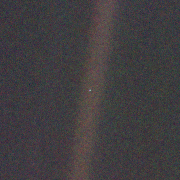 Or try this simple image. Some of you will recognize it. Some will know the phrase often associated with it: the Pale Blue Dot.
This is the last image of Earth taken by the Voyager probe, as it passed Saturn on its journey out of the Solar System.
Do I believe in anything greater than myself? Yes. In my boldest moments, I try to go beyond simply accepting the facts of astronomy as told in numbers. I try to take into the very centre of my self the understanding given by astronomers and scientists. To grasp the enormity of everything that exists, and to accept my humble place in this reality.
It is a difficult task for my limited, pragmatic ape brain. But I have the help of some great poet-scientists of yesterday and today. Here's one of them, Carl Sagan - the man we can thank for the Pale Blue Dot image - contemplating its meaning for us who live on that dot:
Photo credits:
Scale of the stars - source unknown. Link given by a member of the Friendly Atheist forum.
Pale Blue Dot - public domain, created by NASA. Via Wikimedia.
Thursday, 21 May 2009
Support at the speed of light
If you're ever feeling down and in need of an uplifting thought, try this science-inspired contemplation. It occurred to me yesterday as I was seeking consolation after a rather acute disappointment.

The Earth's gravity pulls on us to the tune of almost 10 m/s/s. In other words, if it were unopposed, every second it would accelerate us downwards 10 metres per second faster. But fortunately, we have a very supportive ground to keep us up. Remember Newton's third law of motion? Every action has an equal and opposite reaction. So that 10 m/s/s downward pull is counteracted by a 10 m/s/s supportive force holding us up.*
Now, imagine we had that 10 m/s/s support out in space, where there was no gravity to counteract it. How fast would you go?
 Well, the speed of light is just shy of 300 million metres per second, so after 30 million seconds, one gravity of acceleration would get you to the speed of light.
And how long is 30 million seconds, you ask?
Just shy of a year: 353 days.
Think about that. Every year, the ground under you supports you with enough force to get you to the speed of light.
* For the pedants in my audience, yes, I know that force and acceleration are two different things. But for the purpose of this contemplation, the differences are immaterial, and to pedantically point them out would distract from the point of the contemplation.
Photo credits:
Earth photo from the Great Expectations blog, probably public domain.
Millennium Falcon cockpit at light speed from the Common Defense blog, almost certainly copyright Lucasfilm, fair use.
The Earth's gravity pulls on us to the tune of almost 10 m/s/s. In other words, if it were unopposed, every second it would accelerate us downwards 10 metres per second faster. But fortunately, we have a very supportive ground to keep us up. Remember Newton's third law of motion? Every action has an equal and opposite reaction. So that 10 m/s/s downward pull is counteracted by a 10 m/s/s supportive force holding us up.*
Now, imagine we had that 10 m/s/s support out in space, where there was no gravity to counteract it. How fast would you go?
Well, the speed of light is just shy of 300 million metres per second, so after 30 million seconds, one gravity of acceleration would get you to the speed of light.And how long is 30 million seconds, you ask?
Just shy of a year: 353 days.
Think about that. Every year, the ground under you supports you with enough force to get you to the speed of light.
----------------
* For the pedants in my audience, yes, I know that force and acceleration are two different things. But for the purpose of this contemplation, the differences are immaterial, and to pedantically point them out would distract from the point of the contemplation.
Photo credits:
Earth photo from the Great Expectations blog, probably public domain.
Millennium Falcon cockpit at light speed from the Common Defense blog, almost certainly copyright Lucasfilm, fair use.
Tuesday, 12 May 2009
Novella on science
I am always looking for good, concise ways to define science and to explain why it is key to a realistic understanding of the world around us. This recent post by Steve Novella on his blog, Neurologica, opens with a pretty good summation of science and the skeptical outlook that underlies it:
For more skepticism and science from Steve and company, I enthusiastically recommend you check out the Skeptics Guide to the Universe. It is a fun and informative podcast that covers all sorts of cool and unusual topics - from current science to skeptical thinking to evaluating paranormal claims.There are numerous ways in which thought processes go astray, leading us to false conclusions, even persistent delusions. Skepticism, as an intellectual endeavor, is the study of these mental pitfalls, for a thorough understanding of them is the best way to avoid them.
Science itself is a set of methods for avoiding or minimizing errors in observation, memory, and analysis. Our instincts cannot be trusted, so we need to keep them in check with objective outcome measures, systematic observation, and rigid control of variables. In fact bias has a way of creeping into any observation and exerting powerful if subtle effects, leading to the need to completely blind scientific experiments. Good scientists have learned not to trust even themselves.
Friday, 6 March 2009
Periodic anniversary

It is once again the anniversary of the Periodic Table of the Elements. It was first introduced to the world on this day in 1869, in a presentation to the Russian Chemical Society by Chemist Dimitri Mendeleev.
I write this with a sleeping baby in one arm, so it'll be brief.
First, a quiz for you - a fun activity for Periodic Table Day. Feel free to give your answers and other thoughts in the comments on this post.
- What was periodic about Mendeleev's table?
- What was the reason (discovered much later) for that periodicity?
- How are the elements ordered in the table?
- Where does hydrogen belong - on the left or on the right? Why?
- What predictions did the original table suggest? Have they been confirmed?
- Does the Periodic Table depict a fact or a theory? Explain.
Tuesday, 20 January 2009
Mooning over creationists (sequel)
In a post last year, I noted an intriguing question asked on the website of the local Edinburgh Creation Group (ECG).
They asked how the moon got into orbit.

The standard answer emerging from science is that some large object about the size of Mars (sometimes called “Theia”) hit the Earth very early on in the formation of the Solar System. That impact threw up debris which coalesced into the Moon. This hypothesis explains many otherwise-odd facts about the Earth-Moon system, such as their relative composition and their angular momentum.
 However, the ECG folks claim to have found a problem. It’s very simply and persuasively illustrated by this simulation of orbital mechanics, which was linked from the ECG's website*. Play with it a bit yourself, to get a feel for the principle involved. Basically, once other forces (rocket thrust, planetary impact, atmospheric friction, etc) have stopped acting, only gravity is left. And when two objects (say, a fragment of debris and the Earth) are interacting only by gravity and are not substantially affected by external forces, there are three possible outcomes:

First, I learned that scientists occasionally call it the Giant Splash rather than the Giant Impact, because at that scale even bodies of solid rock behaves more like a liquid when thumped together.
Second, when a bunch of debris is flying through space above the Earth's surface after such an impact, there is a very obvious force present that is adjusting the orbit of the fragments: the other fragments! Collisions and gravitational interaction between the bits of debris (which, remember, must together have massed at least as much as the moon) caused some of the fragments to settle into a stable orbit, where over time they accumulated into the single satellite we know today.
All this is a very abstract description of the answer. The details take massive computing power for simulations of all the particles thrown up by a big splash. Researchers have simulated many different types of impact, with different impactor sizes, different angles of impact (from head-on to glancing blow), and so on. Not all of the questions are resolved, but the problem highlighted by the ECG is certainly a non-issue.
If all that is too cerebral for you, I'll repeat something I said in the earlier post: I love games that use orbital mechanics. KSpaceDuel is one that models only a single centre of gravity, so if you don't use thrust you'll just stay in your initial orbit (until your opponent blows you up, anyway). [Note that it's a Linux-only game - yet another reason to start shedding that Windows or Mac addiction.] And for those of you who haven't yet converted to Linux, Orbit is an online flash game that very neatly illustrates how complex the gravitation effects become when you’re dealing with more than a couple of objects.
References:
Notes for an undergraduate course at UCL (detailed)
New Scientist, 2006 (summary)
* I am currently unable to find the link - they seem to have redesigned their site and left it out. I therefore cannot be certain whether or not the claim is supported by the members of the ECG.
They asked how the moon got into orbit.
The standard answer emerging from science is that some large object about the size of Mars (sometimes called “Theia”) hit the Earth very early on in the formation of the Solar System. That impact threw up debris which coalesced into the Moon. This hypothesis explains many otherwise-odd facts about the Earth-Moon system, such as their relative composition and their angular momentum.
However, the ECG folks claim to have found a problem. It’s very simply and persuasively illustrated by this simulation of orbital mechanics, which was linked from the ECG's website*. Play with it a bit yourself, to get a feel for the principle involved. Basically, once other forces (rocket thrust, planetary impact, atmospheric friction, etc) have stopped acting, only gravity is left. And when two objects (say, a fragment of debris and the Earth) are interacting only by gravity and are not substantially affected by external forces, there are three possible outcomes:- The smaller object already orbits the larger (or they orbit each other), and will continue to do so indefinitely.
- They are on a collision course, and will impact (probably not parting again).
- The smaller object meets or exceeds escape velocity, and leaves.
First, I learned that scientists occasionally call it the Giant Splash rather than the Giant Impact, because at that scale even bodies of solid rock behaves more like a liquid when thumped together.
Second, when a bunch of debris is flying through space above the Earth's surface after such an impact, there is a very obvious force present that is adjusting the orbit of the fragments: the other fragments! Collisions and gravitational interaction between the bits of debris (which, remember, must together have massed at least as much as the moon) caused some of the fragments to settle into a stable orbit, where over time they accumulated into the single satellite we know today.
All this is a very abstract description of the answer. The details take massive computing power for simulations of all the particles thrown up by a big splash. Researchers have simulated many different types of impact, with different impactor sizes, different angles of impact (from head-on to glancing blow), and so on. Not all of the questions are resolved, but the problem highlighted by the ECG is certainly a non-issue.
If all that is too cerebral for you, I'll repeat something I said in the earlier post: I love games that use orbital mechanics. KSpaceDuel is one that models only a single centre of gravity, so if you don't use thrust you'll just stay in your initial orbit (until your opponent blows you up, anyway). [Note that it's a Linux-only game - yet another reason to start shedding that Windows or Mac addiction.] And for those of you who haven't yet converted to Linux, Orbit is an online flash game that very neatly illustrates how complex the gravitation effects become when you’re dealing with more than a couple of objects.
References:
Notes for an undergraduate course at UCL (detailed)
New Scientist, 2006 (summary)
* I am currently unable to find the link - they seem to have redesigned their site and left it out. I therefore cannot be certain whether or not the claim is supported by the members of the ECG.
Thursday, 15 January 2009
Truth about dyslexia
Gentle and thoughtful Cath is on the warpath - and justifiably so.
Some loon (Graham Stringer, MP for Blackley) is trying to deny the existence of dyslexia, a well-evidenced and widespread disorder, using false claims, fallacious reasoning, and other tactics familiar to rational people.
I cannot add anything to her very lucid demolition of his article. I'll just give a couple of potentially useful links for further reading.
Here's an international list of Dyslexia research and support organizations that a quick search brought up, in case anyone wants to read further: Dyslexia Parents Resource.
And if you're from the Blackley area, check out Stringer's contact info, voting record, etc. on this page.
Some loon (Graham Stringer, MP for Blackley) is trying to deny the existence of dyslexia, a well-evidenced and widespread disorder, using false claims, fallacious reasoning, and other tactics familiar to rational people.
I cannot add anything to her very lucid demolition of his article. I'll just give a couple of potentially useful links for further reading.
Here's an international list of Dyslexia research and support organizations that a quick search brought up, in case anyone wants to read further: Dyslexia Parents Resource.
And if you're from the Blackley area, check out Stringer's contact info, voting record, etc. on this page.
Monday, 25 August 2008
Myers on meaning
At the end of a post about convergent evolution (and its misinterpretations), P.Z. Myers, author of the Pharyngula blog, gives these thoughts about meaning and purpose:
We are each our own individual engines of purpose, operating in a hostile universe where randomness can shape our fates. There is no grand scheme behind our existence, other than the same function that all our ancestors had: to order our local environment to allow each to survive and to make the world a little better for our progeny. And that's enough — that's all that is needed to make a rich, diverse, living planet, and it's all I need to live a satisfying life.What a heartfelt summary of meaning in a naturalistic worldview. Thankyou, P.Z.!
Subscribe to:
Posts (Atom)