
I am moving this blog to "http://www.friendlyhumanist.net". This is partly to improve the blog (WordPress has better features), and partly to appease my own ego (I wanted my own domain name).
The new blog has already been populated with all the old posts and comments. I even think I can set things up so this old address will automatically redirect to the new one.
But, for those of you using feed readers, you'll need to subscribe to the new feed (and unsubscribe from the old one). This will be the last post I put up on Blogger.
Feel free to take this opportunity to let me know (on the new blog, preferably) what works, and what doesn't. On a technical level, what would you like me to change on the blog? On a content level, is there anything you'd like to hear more about? Less?
Showing posts with label me. Show all posts
Showing posts with label me. Show all posts
Sunday, 10 January 2010


Thursday, 24 December 2009
More on Free Will
Since my March article about free will, I've learned that my position - that having free will is consistent with a mechanistic model of the universe (with or without quantum uncertainty thrown in) - is known as compatibilism.
 I recently read Thomas Pink's book, Free Will: A Very Short Introduction (from the excellent Very Short Introduction series put out by OUP) - and so I now fancy myself knowledgeable enough to connect my own casual ponderings with the great web of philosophy.
The position Mike took in his article is known as scepticism (in the context of free will, a combination of incompatibilism and a belief in causal determinism - not to be confused with other, more general forms of scepticism).
Guess who Pink identifies as the first compatibilist? Here's a quote:
I wouldn't go so far as to call myself a Hobbesian - he wrote about more than just this, and I don't know if the whole of his philosophy would appeal to me. But I tend to agree with this quote.
Note that this passage makes no claims about what it means for someone to "have a will to do" something. One thing I like about compatibilism is that it does not rely on a particular model (deterministic, non-deterministic, etc) of the universe.
See also:
Wikipedia article on Free Will.
Image credit:
Image of Hobbes via this collection. (On the topic of this post, check out this fan comic, inspired by the Calvin and Hobbes scene shown here.)
I recently read Thomas Pink's book, Free Will: A Very Short Introduction (from the excellent Very Short Introduction series put out by OUP) - and so I now fancy myself knowledgeable enough to connect my own casual ponderings with the great web of philosophy.The position Mike took in his article is known as scepticism (in the context of free will, a combination of incompatibilism and a belief in causal determinism - not to be confused with other, more general forms of scepticism).
Guess who Pink identifies as the first compatibilist? Here's a quote:
A FREE-MAN, is he, that ... is not hindred to doe what he has a will to ... from the use of the word Free-will, no Liberty can be inferred of the will, desire or inclination, but the Liberty of the man; which consisteth in this, that he finds no stop, in doing what he has the will, desire, or inclination to doe.The quote is from p65 of Pink's book, and it's by 17th-century English philosopher Thomas Hobbes.
I wouldn't go so far as to call myself a Hobbesian - he wrote about more than just this, and I don't know if the whole of his philosophy would appeal to me. But I tend to agree with this quote.
Note that this passage makes no claims about what it means for someone to "have a will to do" something. One thing I like about compatibilism is that it does not rely on a particular model (deterministic, non-deterministic, etc) of the universe.
See also:
Wikipedia article on Free Will.
Image credit:
Image of Hobbes via this collection. (On the topic of this post, check out this fan comic, inspired by the Calvin and Hobbes scene shown here.)
Friday, 18 December 2009
Why should humanists be in chaplaincy?
Humanitie, the quarterly magazine of the Humanist Society of Scotland, has a new issue out. Once again, Mike and I present our rather different perspectives - this time, on the relationship between humanists and chaplaincy. Don't forget to read Mike's column over at his blog.
I was recently asked a question about the place of humanists in chaplaincy life. In a chaplaincy, even an inclusive multi-faith chaplaincy, most people are religious. To what extent is it worthwhile and appropriate for humanists and other non-religious people to seek a place in chaplaincy?
The answer is obvious to me. Clearly, though, some religious people and even many humanists don't see things as I do. So here is my take on it.
First, some background. Our university chaplaincy is very deliberately open to students and staff of "all faiths and none".
My earliest experience with the chaplaincy was when I was first learning and reading about humanism, and coming to realize that it reflected a deep part of my identity. I started looking for like-minded people, for a community to connect with. I had heard of the chaplaincy and its openness to people of no religion. I visited the chaplain and asked if she knew of any humanist groups at the university. She didn't, but she thought it would be wonderful if there were a group. She also pointed me to the Humanist Society of Scotland (HSS), which has an Edinburgh group.
There is a whole story following on from that - of attending an HSS philosophy book group, of meeting another humanist student, of forming a student group with him that has become far more active and successful than I expected - but for now let's look at that first move on my part. Why did I go to the chaplaincy in search of humanists?
First, there was my awareness that the chaplaincy branded itself as inclusive - they reach out not only to religious folks, but to folks like me. Second, for all that some humanists like to distance themselves from religious believers, there is a crucial feature that we share. Humanism is a framework for seeking meaning, for defining an ethical stance, and for sharing inspiration and expressing awe. For most religious people I've talked to, their religion does just the same: it provides meaning, defines ethics, and it is the lens through which inspiration and awe are experienced and shared. Also, perhaps even more importantly, both humanism and religions are identities around which human communities gather. So humanism is to me as religion is to religious folks. Even then, new as I was to humanism, I could see that.
So it seemed obvious that the chaplaincy - a place for religious folks to meet like-minded people, a place for people to go for spiritual counselling, and a place that explicitly included non-religious people in its remit - was the right place to look for humanist groups at the university.
And of course, that answers the question I opened with too. If chaplaincy is an obvious place for a lone humanist to go in search of kindred spirits, then chaplaincy is an obvious place for a humanist group to be connected with so that those lone humanists can find us.
Yes, there is the Internet. Yes, there are other avenues for us to find one another. But that's no reason to shut such an obvious means of connection. Besides, the sort of personal bond that people visiting the chaplaincy tend to seek is not something that can be transmitted through a computer screen.
Of course, there is more to the chaplaincy than just finding folks like yourself. There is also the inter-faith element*. The idea of people of different backgrounds coming together to discover common ground. And I think that's incredibly valuable. It's something that's lacking from a lot of the "culture war" discussions that get headlines. It's important that humanists are involved in that as well.
True, I may think that the other guy's god is imaginary. True, he may think that I'm destined for hell if I don't come to believe as he does. But equally true is the fact that we both value compassion. We both try to buy products whose production doesn't exploit the vulnerable. We both try to act in ways that will preserve the planet for the next generation. We both strongly believe in each other's right to believe as we will.
In my experience, there is no place like a multi-faith chaplaincy for bringing people of different backgrounds together and helping us to realize how much we share. Not just superficial stuff. Deep stuff. Important stuff.**
Stuff we can draw on to make the world a better place, together.
That's why humanists should be involved in chaplaincy, and in other inter-faith endeavours.
Footnotes (not included in the print version):
* Yes, I know, the term inter-faith is problematic for people like us, who consciously set ourselves apart from religious faith. It is also often used in a manner that really does exclude us. But until you can come up with a better term for a meeting of religious and non-religious worldviews, and show that other people will use and understand it, it's better than nothing.
** A Unitarian church may do the same, but I don't have enough experience at one yet to say for sure.
I was recently asked a question about the place of humanists in chaplaincy life. In a chaplaincy, even an inclusive multi-faith chaplaincy, most people are religious. To what extent is it worthwhile and appropriate for humanists and other non-religious people to seek a place in chaplaincy?
The answer is obvious to me. Clearly, though, some religious people and even many humanists don't see things as I do. So here is my take on it.
First, some background. Our university chaplaincy is very deliberately open to students and staff of "all faiths and none".
My earliest experience with the chaplaincy was when I was first learning and reading about humanism, and coming to realize that it reflected a deep part of my identity. I started looking for like-minded people, for a community to connect with. I had heard of the chaplaincy and its openness to people of no religion. I visited the chaplain and asked if she knew of any humanist groups at the university. She didn't, but she thought it would be wonderful if there were a group. She also pointed me to the Humanist Society of Scotland (HSS), which has an Edinburgh group.
There is a whole story following on from that - of attending an HSS philosophy book group, of meeting another humanist student, of forming a student group with him that has become far more active and successful than I expected - but for now let's look at that first move on my part. Why did I go to the chaplaincy in search of humanists?
First, there was my awareness that the chaplaincy branded itself as inclusive - they reach out not only to religious folks, but to folks like me. Second, for all that some humanists like to distance themselves from religious believers, there is a crucial feature that we share. Humanism is a framework for seeking meaning, for defining an ethical stance, and for sharing inspiration and expressing awe. For most religious people I've talked to, their religion does just the same: it provides meaning, defines ethics, and it is the lens through which inspiration and awe are experienced and shared. Also, perhaps even more importantly, both humanism and religions are identities around which human communities gather. So humanism is to me as religion is to religious folks. Even then, new as I was to humanism, I could see that.
So it seemed obvious that the chaplaincy - a place for religious folks to meet like-minded people, a place for people to go for spiritual counselling, and a place that explicitly included non-religious people in its remit - was the right place to look for humanist groups at the university.
And of course, that answers the question I opened with too. If chaplaincy is an obvious place for a lone humanist to go in search of kindred spirits, then chaplaincy is an obvious place for a humanist group to be connected with so that those lone humanists can find us.
Yes, there is the Internet. Yes, there are other avenues for us to find one another. But that's no reason to shut such an obvious means of connection. Besides, the sort of personal bond that people visiting the chaplaincy tend to seek is not something that can be transmitted through a computer screen.
Of course, there is more to the chaplaincy than just finding folks like yourself. There is also the inter-faith element*. The idea of people of different backgrounds coming together to discover common ground. And I think that's incredibly valuable. It's something that's lacking from a lot of the "culture war" discussions that get headlines. It's important that humanists are involved in that as well.
True, I may think that the other guy's god is imaginary. True, he may think that I'm destined for hell if I don't come to believe as he does. But equally true is the fact that we both value compassion. We both try to buy products whose production doesn't exploit the vulnerable. We both try to act in ways that will preserve the planet for the next generation. We both strongly believe in each other's right to believe as we will.
In my experience, there is no place like a multi-faith chaplaincy for bringing people of different backgrounds together and helping us to realize how much we share. Not just superficial stuff. Deep stuff. Important stuff.**
Stuff we can draw on to make the world a better place, together.
That's why humanists should be involved in chaplaincy, and in other inter-faith endeavours.
Footnotes (not included in the print version):
* Yes, I know, the term inter-faith is problematic for people like us, who consciously set ourselves apart from religious faith. It is also often used in a manner that really does exclude us. But until you can come up with a better term for a meeting of religious and non-religious worldviews, and show that other people will use and understand it, it's better than nothing.
** A Unitarian church may do the same, but I don't have enough experience at one yet to say for sure.
Thursday, 26 November 2009
Hero
 I would like to introduce you to a hero of mine. His name is Robert Lang.
Robert Lang folds paper. He folds paper into birds. He folds paper into insects. He folds paper into insanely complex and improbably forms.
And that is enough to earn him my admiration (as an amateur folder myself).
But what really rockets him into the ranks of hero is his polymath tendencies. What he has done with his origami outside the traditional world of paper folding.
He has developed mathematical models of origami. His scientific approach has advanced the art to the point that most of the new forms created today would have been impossible half a century ago. But more than that, he has consulted on scientific and engineering projects, bringing the art of folding into space telescopes, car safety, and other areas.
He has given a TED talk; he has been featured in National Geographic.
Robert Lang inspires me. Not only is he an excellent origami artist - something I aspire to in a vague and occasional way. He has also managed to combine various interests of his into a unified and revolutionary whole - something I yearn for in an definite, persistent way.
As someone with a variety of disparate interests (experimental phonetics, computer programming, writing, parenting, humanist spirituality), I would love to bring some of them together, so that I am not always forced to choose to spend time on one at the expense of others.
So much for why I admire Robert Lang. But what does it mean for someone to be a hero?
Robert Lang has at least two attributes that make him a hero for me: he does something I would like to be able to do myself, and he inspires me to actually try to achieve it.
 It's not necessarily origami - as I said, origami is an interest of mine, but not necessarily a passion. (Though I do have Lang's book, Origami Design Secrets, from which I hope to learn how to design my own origami figures.) I don't mean to emulate him completely. But he inspires me to try my own brand of originality, my own synthesis of disparate interests. For the moment, it's an attempt to bring my programming interest into my academic phonetic research. I also have a project on the go bringing programming and humanist spirituality together (stay tuned).
Related to this, being my hero does not mean Lang seems infallible, or even super-human, to me. Of course he is just another person. But that's part of the inspiration: there is no great divide between the kind of person I am and the kind of person he is. I can do amazing things, just like he does.
I suppose that I might more accurately call Lang a role-model. But that has a slightly antiseptic ring to me. A role model sounds like someone your parents expose you to in an attempt to influence you.
A hero - that's someone you choose for yourself.
Photo credits:
Portrait of Lang with life-sized origami people from Lang's website.
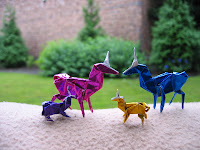
Image of origami unicorns by Timothy Mills. Models folded by me, from a design in Origami Step by Step, by Robert Hardin, who credits it to Patricia Crawford.
Tuesday, 24 November 2009
On Friendliness and Humanism
I am very self-conscious. When I read an atheist talking about "accommodationists" (for example, here), I get the feeling they would include me in that group, because I'm the Friendly Humanist - that is, I make some effort to get along with folks whose worldview diverges from my own. And when I read a theist talking about atheist dogmatism (for example, here), I feel that they're attacking my position, because I'm an atheist too.
Of course, most such passages are written by people who have never heard of me personally, so I know it's not personal. And it's possible that if the authors read my blog they would assert that I clearly don't fall into the category of weak-willed accommodationist on the one hand and dogmatic atheist on the other. Nevertheless, I often feel a bit like a mule - neither horses nor donkeys feel that I'm quite one of them. Ah well, I can live with that.
I brand myself as the Friendly Humanist for several reasons. It's an effort to counterbalance a tendency among some humanists to take cheap potshots at easy targets, often with no good purpose in mind and with very counterproductive effects. It's a reminder to myself not to use this blog simply as a platform for rants.
And it's an olive branch to those who are often placed in opposition to humanists: committed believers in a god or gods, or in some undefined "other" beyond the physical world, or in non-scientific, "alternative" medicine. I want to tell them, through the blog name and also through my writing, that I will listen to them and try to understand their position.
But the blog is called the Friendly Humanist, and so I also strive to uphold humanist values in my writing. I do not shy away from criticizing harmful actions - whether they are motivated by harmful intent or not, and whether they are based in religious belief or not. There is often a right answer and a wrong answer to questions about how the world is, and finding the right answer is a valuable endeavour.
I don't think these two goals - being friendly and being a humanist - are incompatible. But there are times when, in order to act with integrity, I must risk being perceived as unfriendly.
I suspect that my recent series on John Blanchard's book Does God Believe in Atheists? (beginning here) was such a case (on the basis of the only comment anyone posted to it). I stand by my review, but I invite anyone's thoughts if they think there's a way I could have put the case without being as dismissive of Blanchard.
There have been other times, and I'm sure there will be more in the future.
I am curious: do you, faithful readers, feel that I live up to my self-chosen title? Am I really all that friendly? Am I true to the principles of Humanism?
Of course, most such passages are written by people who have never heard of me personally, so I know it's not personal. And it's possible that if the authors read my blog they would assert that I clearly don't fall into the category of weak-willed accommodationist on the one hand and dogmatic atheist on the other. Nevertheless, I often feel a bit like a mule - neither horses nor donkeys feel that I'm quite one of them. Ah well, I can live with that.
I brand myself as the Friendly Humanist for several reasons. It's an effort to counterbalance a tendency among some humanists to take cheap potshots at easy targets, often with no good purpose in mind and with very counterproductive effects. It's a reminder to myself not to use this blog simply as a platform for rants.
And it's an olive branch to those who are often placed in opposition to humanists: committed believers in a god or gods, or in some undefined "other" beyond the physical world, or in non-scientific, "alternative" medicine. I want to tell them, through the blog name and also through my writing, that I will listen to them and try to understand their position.
But the blog is called the Friendly Humanist, and so I also strive to uphold humanist values in my writing. I do not shy away from criticizing harmful actions - whether they are motivated by harmful intent or not, and whether they are based in religious belief or not. There is often a right answer and a wrong answer to questions about how the world is, and finding the right answer is a valuable endeavour.
I don't think these two goals - being friendly and being a humanist - are incompatible. But there are times when, in order to act with integrity, I must risk being perceived as unfriendly.
I suspect that my recent series on John Blanchard's book Does God Believe in Atheists? (beginning here) was such a case (on the basis of the only comment anyone posted to it). I stand by my review, but I invite anyone's thoughts if they think there's a way I could have put the case without being as dismissive of Blanchard.
There have been other times, and I'm sure there will be more in the future.
I am curious: do you, faithful readers, feel that I live up to my self-chosen title? Am I really all that friendly? Am I true to the principles of Humanism?
Friday, 23 October 2009
A new descendent
Just a quick note to point you to this announcement of the birth of our son a week ago.
Thursday, 8 October 2009
I have an idea ...
 At work, I recently came across an amazing resource: CiteULike. It's a free website where you can build up a list of citations. I use it to manage the long list of papers and books I read and cite as a researcher. I can label citations, like I label blog entries on this site, according to common themes.
It also has social features: sharing citations between users, getting automated recommendations based on common research interests. And there are Groups.
Which gives me an idea.
There are loads of skeptical blogs out there. There are the science-based parenting folks (such as SBP themselves, Rational Moms), the science-based medicine gang (SBM, Ben Goldacre, etc), and of course the general skeptics (Bruce Hood, Massimo Pigliucci, Richard Wiseman, and loads more).
These blogs often bring up new or interesting research that bears on our lives - as parents, as users (and taxpaying supporters) of health care, and just as people trying to navigate the modern world. But finding a particular study that I remember reading about on some skeptical blog can be a real pain.
So it occurs to me - why not set up a group, or a set of groups, on CiteULike, where skeptics could post scientific articles of interest to the community? You can put notes on each article - for example, pointing to reviews on skeptical blogs. You can talk about the articles (and the body of evidence around given topics, like acupuncture or spanking) in forums. You can associate informative tags with articles. Or you can simply hang out and see what other people have dug up. The resource could be used by bloggers who like to check original research, and also by skeptical consumers of new and traditional media claims.
It's not something I can do on my own. I don't have the time or the expertise to dig up all the relevant papers.
So this is a call to all you skeptics out there who have a little bit of time or expertise. Are you willing to help get things started?
I've taken the first step: I've created a CiteULike group, Skeptical Parenting, to pilot this idea. I chose parenting partly because that's where I am closest to having some substantive expertise, and partly because my second child is due to arrive any day now.
The next step is up to you. Here is what I ask of anyone who is interested:
- Join me as a member of the group, or start another group. "Paranormal Research", "Science-Based Medicine Users" - whatever you're most into as a skeptic. If you start another group, let us know in the comments here. (Do a search on CiteULike before starting the group to make sure someone hasn't already started one.)
- Blog about this yourself - not many people read my blog, but some of you have very widely-read blogs. The more people read about this idea, the sooner we'll reach a sustainable number of participants.
- Tell your friends. We don't all have blogs, but we all have skeptical acquaintances on- and off-line that we can share cool new ideas with.
- Comment here, so I know that I'm not just talking to myself.
Monday, 5 October 2009
Ten random beliefs meme
I love a good meme, and once again Ken of C. Orthodoxy has passed on a zinger. Here are the rules, from the meme's originator, Clayboy:
Post a collection of 10 things you believe, ethical, philosophical or theological. You choose how much to connect them or make them coherent: do you want people to know where you belong, or do you want to mix and match to keep them guessing? I encourage you not to aim for a totally coherent credal statement of faith, and I also encourage you to put one or two in about controversial topics.Let's see...
- I believe that ultimate truths may be within our reach as a species, but absolute certainty is not.
- I believe there is a lot of potential value in symbols and stories, and that religions make better use of this value than humanist communities and individuals tend to. (I also believe that their power can make symbols and stories dangerous if used irresponsibly.)
- I believe that claims about what is physically true are of a different sort to claims about what is good or moral. The former are simple facts, independent of perspective, existing with or without observers. The latter are at least relative to (and so dependent on) our nature as a social species. They are not, however, relative to our personal whims and desires.
- I believe that scientific skepticism is a healthy and appropriate attitude to any belief that people want to persuade me of.
- I believe that a person's actions are more important than their beliefs. Beliefs are mainly important to the extent that they inform and motivate actions. (I also believe that a shocking number of people spend more time rationalizing actions that clash with their beliefs than they spend trying to tailor their actions to their beliefs.)
- I believe that powdered cheese is one of the most pernicious evils of modern society, followed closely by processed cheese slices and liquid cheese.
- I believe that questions of good and evil are properly independent of questions of the existence of any god. (I believe that the ethical framework I try to follow would be equally valid whether or not a god exists.)
- I believe that consciousness is a product of physical processes in my brain and body.
- I believe that consciousness is the most important thing in the universe.
- I believe we must always accept the possibility that we might be wrong, but that we should not live in fear of it happening. (This one is cribbed shamelessly from Ken, because it suits me so well.)
- I believe that every cell in my body is a direct descendent of some primordial replicator that appeared on Earth around 3.5 billion years ago.
- I believe that free software (and Linux in particular) is a woefully under-experienced joy in the world.
- I believe that my wife is beautiful and my daughter is smart (and vice versa).
- I believe that, like James McGrath, I need to learn about counting to ten.
Thursday, 1 October 2009
Atheist blogroll
 This blog has now been added to the Atheist Blogroll!
I have added an Atheist Blogroll thingame in the sidebar - just scroll down a little. There are apparently over 1000 blogs on the list right now, but my sidebar thing just the 25 most-recently-updated ones.
The Atheist blogroll is a free community-building service for Atheist bloggers from around the world. If you would like to join, visit Mojoey at Deep Thoughts for more information.
 Perhaps some of you would like to see what other flavours of atheism are out there. Perhaps you are an atheist blogger yourself and would like to sign up. For me, there are two main reasons for joining the blogroll.
First, I hope that it may increase my readership and bring in some more commenters.
Second, and more important, it's yet another way to stand up and be counted.
(Also, when I make claims about what atheists believe or say or support, I will be able to peruse a selection of those thousand blogs to see if I'm right. It's a slightly more focussed way of searching than Google.)
Wednesday, 26 August 2009
For Deena
I have no pretty words to mark this occasion. I have no fanfare to set this day apart from all the other days of our life together.
I have only the same words I share with you every day. I love you.
I have only the same choice I make anew each day. I choose you.
Happy ninth anniversary.
I have only the same words I share with you every day. I love you.
I have only the same choice I make anew each day. I choose you.
Happy ninth anniversary.
- your everyday Tim
Monday, 17 August 2009
AFK
This is just a quick note to say that I have just moved house, and will be without Internet at home for the better part of a month as we get everything set up. Until then, I'll keep an eye on comments during breaks at work.
I have already lined up several posts to carry the blog through my absence. After the final post on Blanchard's book, I'll return to a one-post-a-week schedule (plus tidbits).
On a more personal note, I've been feeling a little lonely here lately.
I'm happy to keep posting things into the ether. It's a good exercise in refining my thoughts and meditating on interesting issues. But it would be nice to get some feedback - I know there are several people who read but never say anything.
Consider this post a general invitation (plea?) for input. What do people like or dislike about this blog and its content? Is there anything you'd like to see more of? Less of?
What sort of people read this blog? Who is out there watching, examining (even enjoying?) the offerings here? Parents? Students? Professionals? Bored data crunchers? Cosmopolitan-drinking socialites?
I look forward to getting to know you all.
I have already lined up several posts to carry the blog through my absence. After the final post on Blanchard's book, I'll return to a one-post-a-week schedule (plus tidbits).
On a more personal note, I've been feeling a little lonely here lately.
I'm happy to keep posting things into the ether. It's a good exercise in refining my thoughts and meditating on interesting issues. But it would be nice to get some feedback - I know there are several people who read but never say anything.
Consider this post a general invitation (plea?) for input. What do people like or dislike about this blog and its content? Is there anything you'd like to see more of? Less of?
What sort of people read this blog? Who is out there watching, examining (even enjoying?) the offerings here? Parents? Students? Professionals? Bored data crunchers? Cosmopolitan-drinking socialites?
I look forward to getting to know you all.
Monday, 3 August 2009
Roleplay to a cleaner house
If everyone in your household already enjoys cleaning, this post isn't for you. If you never have problems getting the chores done, then feel free to stop reading now.
 Deena and I have just discovered a new way to keep track of chores and have fun doing them. It's called Chore Wars, and it's awesome. You register (for free) on the site, start up an adventuring party (your team), and decide what chores will merit rewards. When you complete a task, you claim it on the site. According to the FAQ,
We've only just started, and we're already having a blast. Deena's almost ready to level up already. I'm only halfway there, but I have some dirty dishes waiting to help me catch up as soon as I post this.
I don't expect we'll end up like this, though I know some who might use it this way:
 There are some promising testimonials on the site. We'll have to wait and see how well it works out for us. But it has all the right elements. It's fun (we love roleplaying); it's practical (it doesn't take much effort to do); it's free.
So, if you like games, and if you'd like to try motivating yourself to do more housework, give Chore Wars a try.
[Edit: Just figured out how to do this - here's an image of my character (updated regularly).]

Deena and I have just discovered a new way to keep track of chores and have fun doing them. It's called Chore Wars, and it's awesome. You register (for free) on the site, start up an adventuring party (your team), and decide what chores will merit rewards. When you complete a task, you claim it on the site. According to the FAQ,Experience points are tracked both as weekly high-score charts, and as ongoing character sheets - every time you rack up 200XP of chores, your character gains a "level", and their class changes to match the type of chores that they've been doing.Think of it as a kind of Mary Poppins "spoonful of sugar" for people who are mostly grown up and enjoy roleplaying.
We've only just started, and we're already having a blast. Deena's almost ready to level up already. I'm only halfway there, but I have some dirty dishes waiting to help me catch up as soon as I post this.
I don't expect we'll end up like this, though I know some who might use it this way:
There are some promising testimonials on the site. We'll have to wait and see how well it works out for us. But it has all the right elements. It's fun (we love roleplaying); it's practical (it doesn't take much effort to do); it's free.So, if you like games, and if you'd like to try motivating yourself to do more housework, give Chore Wars a try.
[Edit: Just figured out how to do this - here's an image of my character (updated regularly).]
Sunday, 2 August 2009
New blogger
Anyone remember the last count of blogs that have come out of our little Edinburgh student humanist group?
Well, there's (at least) one new one now, so here's my previous list, presented yet again for your reading pleasure:
If anyone knows of any others, please let me know in the comments and I'll augment this post accordingly.
Well, there's (at least) one new one now, so here's my previous list, presented yet again for your reading pleasure:
- Friendly Humanist (that's me, of course)
- The Not Quite So Friendly Humanist (my co-columnist for the quarterly magazine, Humanitie)
- This Humanist (who tipped me to the new blog - thanks Clare!)
- That Humanist (who hasn't posted anything in a year now, sadly)
- The hairy nipple of the angry walrus (a linguist friend of mine)
- Time Out Of Mind (by our previous president, Stuart)
If anyone knows of any others, please let me know in the comments and I'll augment this post accordingly.
Sunday, 21 June 2009
Me and U
Three interesting things happened to me today.
We have been attending for some months now. (Excessively-attentive readers may have noticed Unitarianism popping up occasionally - here, here, here, and here). What began (for me) as a little research into community-building - research I hope to apply to the humanist community - turned into an enriching experience of being part of a supportive community.
It is late, and I don't want to wax on at too great a length. Let me just say a couple of things to make sure my readers don't misunderstand.
I am not going to start blogging as the Friendly Unitarian now (and not just because of the unfortunate acronym). I still consider myself a humanist. (There's a sign on the outside of the Unitarian church that says something along the lines of "What do a Christian, an Agnostic, a Humanist, and a Buddhist have in common? They might all be Unitarians.")
I still consider myself a part of the humanist community in Scotland, and at my university. And online, of course.
I will blog another time about the natural connections between Unitarians and humanists. But for now, I recommend you read this address by Dale McGowan to a Unitarian congregation in the States.
I put it to all those humanists out there who identify with Harry (read Dale's full address to get the reference): we need to understand Sally better for humanism to grow into its full potential. Unitarians understand Sally very well indeed.
- The summer solstice happened early this morning. At this northern latitude, that's a big deal. I'm actually looking forward to a bit more night. (I think the early dawn and late sunset may be why Kaia seems to sleep so little. I ask the more experienced parents out there not to disillusion me.)
- It was my second Father's Day as a father. I got a delightful little card with a cute little red hand print on it from Kaia. I'll spare you my cheesy gushing. For now.
- Deena and I officially became members of the Edinburgh Unitarian Church.
We have been attending for some months now. (Excessively-attentive readers may have noticed Unitarianism popping up occasionally - here, here, here, and here). What began (for me) as a little research into community-building - research I hope to apply to the humanist community - turned into an enriching experience of being part of a supportive community.
It is late, and I don't want to wax on at too great a length. Let me just say a couple of things to make sure my readers don't misunderstand.
I am not going to start blogging as the Friendly Unitarian now (and not just because of the unfortunate acronym). I still consider myself a humanist. (There's a sign on the outside of the Unitarian church that says something along the lines of "What do a Christian, an Agnostic, a Humanist, and a Buddhist have in common? They might all be Unitarians.")
I still consider myself a part of the humanist community in Scotland, and at my university. And online, of course.
I will blog another time about the natural connections between Unitarians and humanists. But for now, I recommend you read this address by Dale McGowan to a Unitarian congregation in the States.
I put it to all those humanists out there who identify with Harry (read Dale's full address to get the reference): we need to understand Sally better for humanism to grow into its full potential. Unitarians understand Sally very well indeed.
Thursday, 11 June 2009
21st century farming
I've mentioned before that I grew up on a farm.
 It was a fairly standard western-Canadian farm, as far as I could tell. We grew stuff; we shipped it out to customers by rail or truck; we grew more stuff. (And by "we", I mean my dad, his dad, and his dad before him - a real family farm. I helped out, but was never farmer material.)
And, from fairly early, it was clear that my little* brother was the most likely successor. Mom and Dad never put any expectations on us to become farmers - it's not the kind of business that anybody should be pressured into. But John was such a natural.
Four or five years ago, after studying various farming techniques at college, he returned to the farm to practice his trade. I remember hearing from Mom and Dad that John had some interesting ideas. I remember hearing that things were a little different on the farm.
 But it wasn't until last year, when Deena, Kaia, and I were in Canada for several months over the summer, that I realized how much John had done.
He started growing flowers. And rather than bringing his product to the customers, like 99% of farmers do, he set up a U-pick business to bring customers to the product.
 He created mazes to attract people out to the site. He started holding festivals - Lily Festivals and Pumpkin Festivals - to promote the farm.
Last summer, over the weekend of the Lily Festival, there were more people visited the farm than the entire population of Bowden, the nearest town. Several times over.
People hear John on the radio and see him in the paper - he's always promoting the farm.
He's joined local and regional farm tourism groups to further promote his operation and that of other local producers.
He's cranked up the farm's web presence with a major website, Google ads, and now a blog.
He's even getting his family in on the operation. I helped out at the Lily Festival last year. And here I am, giving him a big plug on my blog. I do this in full appreciation of the fact that he gets more people visiting him in person than I get visiting this blog in a whole year. I'm not going to swamp him with extra visitors.
But that's okay. I'm basically just doing this to brag about my brother. Farming these days isn't what it used to be, and isn't that grand!
 Just in case it begins to sound like John is the only innovator on the farm, I'd like to point out that it was Dad who, not long ago, shifted the focus of the potato-growing operation from a more conventional bulk business to a mail-order, internet-driven operation catering to gardeners across Canada who want to grow specialty varieties of potatoes. John is an amazing entrepreneur, and he comes from a generations-long tradition of business-savvy and adaptable folks.

* Little as in younger. It has been several years since I, at 6'3" (191cm), was taller than either of my younger brothers.
Photo credits:
All photos from the Eagle Creek Farms website. I'm assuming I have permission to reproduce them for the purposes of bragging about the farm.
It was a fairly standard western-Canadian farm, as far as I could tell. We grew stuff; we shipped it out to customers by rail or truck; we grew more stuff. (And by "we", I mean my dad, his dad, and his dad before him - a real family farm. I helped out, but was never farmer material.)And, from fairly early, it was clear that my little* brother was the most likely successor. Mom and Dad never put any expectations on us to become farmers - it's not the kind of business that anybody should be pressured into. But John was such a natural.
Four or five years ago, after studying various farming techniques at college, he returned to the farm to practice his trade. I remember hearing from Mom and Dad that John had some interesting ideas. I remember hearing that things were a little different on the farm.
But it wasn't until last year, when Deena, Kaia, and I were in Canada for several months over the summer, that I realized how much John had done.He started growing flowers. And rather than bringing his product to the customers, like 99% of farmers do, he set up a U-pick business to bring customers to the product.
He created mazes to attract people out to the site. He started holding festivals - Lily Festivals and Pumpkin Festivals - to promote the farm.Last summer, over the weekend of the Lily Festival, there were more people visited the farm than the entire population of Bowden, the nearest town. Several times over.
People hear John on the radio and see him in the paper - he's always promoting the farm.
He's joined local and regional farm tourism groups to further promote his operation and that of other local producers.
He's cranked up the farm's web presence with a major website, Google ads, and now a blog.
He's even getting his family in on the operation. I helped out at the Lily Festival last year. And here I am, giving him a big plug on my blog. I do this in full appreciation of the fact that he gets more people visiting him in person than I get visiting this blog in a whole year. I'm not going to swamp him with extra visitors.
But that's okay. I'm basically just doing this to brag about my brother. Farming these days isn't what it used to be, and isn't that grand!
Just in case it begins to sound like John is the only innovator on the farm, I'd like to point out that it was Dad who, not long ago, shifted the focus of the potato-growing operation from a more conventional bulk business to a mail-order, internet-driven operation catering to gardeners across Canada who want to grow specialty varieties of potatoes. John is an amazing entrepreneur, and he comes from a generations-long tradition of business-savvy and adaptable folks.* Little as in younger. It has been several years since I, at 6'3" (191cm), was taller than either of my younger brothers.
Photo credits:
All photos from the Eagle Creek Farms website. I'm assuming I have permission to reproduce them for the purposes of bragging about the farm.
Tuesday, 14 April 2009
Ook ook!
 Sometimes, I decide to share something which contains no intellectual contribution, no illustration of the value or comfort or truth of the humanist life.
Sometimes, in short, I just want to hoot and holler and make sure my fellow apes notice me.
The latest addition to our home humanist library arrived yesterday. It's Dale's new book, Raising Freethinkers.
I haven't read any of it yet - I'll make sure to get some sort of review up when I do.
In the meantime, let me give you the two items that are sure to be highlights.
One is where he mentions the HSS Thought for the World campaign (which I've discussed a couple of times on this blog). And who do you think got into the list of "British humanist thinkers" that have been featured in "this brilliant podcast", alongside people like Stephen Law, Nigel Warburton, and (he says with a slight gasp of awe) A. C. Grayling? Me, myself, and I! (see page 244, last paragraph).
The other is in a list of "Twelve Blogs for Us" (start of chapter 9, pages 233-235). On it - on this printed list of blogs that are personally recommended by Dale McGowan, the indisputable leader of online secular parenting inspiration (just read some of his blog entries and you'll agree) - on this list is this very (occasionally) humble site. And, because I'm letting my inner ape shine through, I'm going to share Dale's description of this blog:
The blog of a smart and (yes) friendly Canadian humanist in Scotland. One of my favorites for quiet intelligence.Sigh. Thankyou Dale, for feeding my inner ape.
Now, back to some more quietly intelligent content...
Tuesday, 17 February 2009
Except on my blog
That's odd.
The world doesn't seem to be in an state of breathless anticipation. People are not biting their nails on the street corners, waiting to see what happens. Strangers are not coming up and offering me their sympathy and encouragement.
No matter how much evidence I get, part of me is still thrown off by each new proof that I'm not the centre of the universe.
Silly mammal.
(Stay tuned - in a few hours, I'll let you know how my dissertation defense went.)
[Update: After a pleasant conversation talking about all the interesting stuff I've been doing over the past 5 years, and why it's a valuable and important contribution to the body of science, I have passed with corrections. Wahoo!]
The world doesn't seem to be in an state of breathless anticipation. People are not biting their nails on the street corners, waiting to see what happens. Strangers are not coming up and offering me their sympathy and encouragement.
No matter how much evidence I get, part of me is still thrown off by each new proof that I'm not the centre of the universe.
Silly mammal.
(Stay tuned - in a few hours, I'll let you know how my dissertation defense went.)
[Update: After a pleasant conversation talking about all the interesting stuff I've been doing over the past 5 years, and why it's a valuable and important contribution to the body of science, I have passed with corrections. Wahoo!]
Tuesday, 6 January 2009
One step closer
I have submitted my PhD dissertation. It is right now in the hands of my examiners, who are reading it and deciding whether I'm worthy of three more letters after my name. I'm one step closer to being a fully-credentialed scientist. Pretty cool.
This also means I'll have time to get back to a somewhat more regular blog schedule, and to participating in the online humanist community a bit more. But I do still have a viva coming sometime soon, for which I need to prepare; I do still have a post-doc jam-packed with paper-writing for the next year; and I do still have a gregarious daughter and a patient wife who I want to spend the bulk of my free time with.
So please bear with me as I look for the right balance between family, work, and you. And, if you have any particular hopes or aspirations for this blog, let me know in the comments for this post.
This also means I'll have time to get back to a somewhat more regular blog schedule, and to participating in the online humanist community a bit more. But I do still have a viva coming sometime soon, for which I need to prepare; I do still have a post-doc jam-packed with paper-writing for the next year; and I do still have a gregarious daughter and a patient wife who I want to spend the bulk of my free time with.
So please bear with me as I look for the right balance between family, work, and you. And, if you have any particular hopes or aspirations for this blog, let me know in the comments for this post.
Monday, 30 June 2008
My home and native land
Tomorrow, July first, is Canada Day. It commemorates Confederation in 1867, the key step toward our independence from Britain. I'm here in Alberta, still writing up my PhD (almost done!), and I thought I'd take a few minutes to share with you what I love about this land I call home.

I grew up on an Alberta farm. The landscape of my youth contains gently rolling prairies dotted with native woods, and the wall of the Rocky Mountains standing guard on the western horizon.
Photos will never give you the full sense of a place that is at once complete and unfinished, a sense that I got early this spring, looking out over the soft browns of the grassland , dotted with pale, naked deciduous trees, dark spruce, and dirty-white patches of snow. For that, you would need to come stand beside me at the edge of the farmyard here, looking out over those fields. Breathe deep of the crisp, dusty air; squint against the brilliant sun and the vast, pale blue sky. Taste the calm anticipation of spring, the heady vibrancy of summer, the hot explosion of fall, or the sharp, dry tang of winter. Listen to the quiet, vibrant present, humming with the birds of the season and the distant activity of humans. Feel the steady is and the eager will be of the world commingling in this place.
See the sharp peaks of the Rockies on the western horizon. Go visit them. Stand surrounded by these majestic Titans, waiting eternally by the standards of a human life. They have grown an inch, a millimetre, a micrometre at a time, age after age, until the sea floor became the land's ambassador to the sky. Let yourself be thoroughly daunted by the realization of their vast, patient ascent, their venerable serenity. Some are almost as old as life itself; others are young, rising in the late Cretaceous (after the first mammals evolved).
I wish I could share with you just what I love about this land that is in turns both humble and arrogant, noble and common (much like its human tenants). But I cannot. At the root of my connection to Alberta, behind every phrase I use to try to evoke its essence in your mind, is that impossible-to-communicate longing called "home". If the central Alberta prairie is your home, you already know what I mean and my words are a pale substitute for our shared understanding. If it is not, I can only hope to show you fragments and moments of what this place is to me.
Perhaps that is enough.
Come and visit. Not necessarily me, or my family's farm (though you're welcome, of course). Come visit the land. Let me know what it says to you.
 Happy Canada Day.

I grew up on an Alberta farm. The landscape of my youth contains gently rolling prairies dotted with native woods, and the wall of the Rocky Mountains standing guard on the western horizon.
Photos will never give you the full sense of a place that is at once complete and unfinished, a sense that I got early this spring, looking out over the soft browns of the grassland
 , dotted with pale, naked deciduous trees, dark spruce, and dirty-white patches of snow. For that, you would need to come stand beside me at the edge of the farmyard here, looking out over those fields. Breathe deep of the crisp, dusty air; squint against the brilliant sun and the vast, pale blue sky. Taste the calm anticipation of spring, the heady vibrancy of summer, the hot explosion of fall, or the sharp, dry tang of winter. Listen to the quiet, vibrant present, humming with the birds of the season and the distant activity of humans. Feel the steady is and the eager will be of the world commingling in this place.
See the sharp peaks of the Rockies on the western horizon.
 Go visit them. Stand surrounded by these majestic Titans, waiting eternally by the standards of a human life. They have grown an inch, a millimetre, a micrometre at a time, age after age, until the sea floor became the land's ambassador to the sky. Let yourself be thoroughly daunted by the realization of their vast, patient ascent, their venerable serenity. Some are almost as old as life itself; others are young, rising in the late Cretaceous (after the first mammals evolved).
I wish I could share with you just what I love about this land that is in turns both humble and arrogant, noble and common (much like its human tenants). But I cannot.
 At the root of my connection to Alberta, behind every phrase I use to try to evoke its essence in your mind, is that impossible-to-communicate longing called "home". If the central Alberta prairie is your home, you already know what I mean and my words are a pale substitute for our shared understanding. If it is not, I can only hope to show you fragments and moments of what this place is to me.
Perhaps that is enough.
Come and visit. Not necessarily me, or my family's farm (though you're welcome, of course). Come visit the land. Let me know what it says to you.
Happy Canada Day.Sunday, 17 February 2008
Spirituality and reverence
Can you tell me more about spirituality and reverence among atheists?Cath asked this in the comments of my previous post, in response to my comment about religious people failing to see the deep spirituality of Dawkins. I'll get to Dawkins shortly. I want to start with a note on definitions.
 I am an atheist, but all that says is that I suspect there is no supernatural creator or moral lawgiver in the universe. It says nothing about my spirituality.
My worldview, the basis of my ethical and spiritual approach to the world, is Humanism. My favorite sound-bite definition is that offered on the Humanist Network News podcast - that Humanism is a non-religious worldview based on reason and compassion. For more depth, Wikipedia gives a good overview of Humanism.
First, you may have noticed from past posts
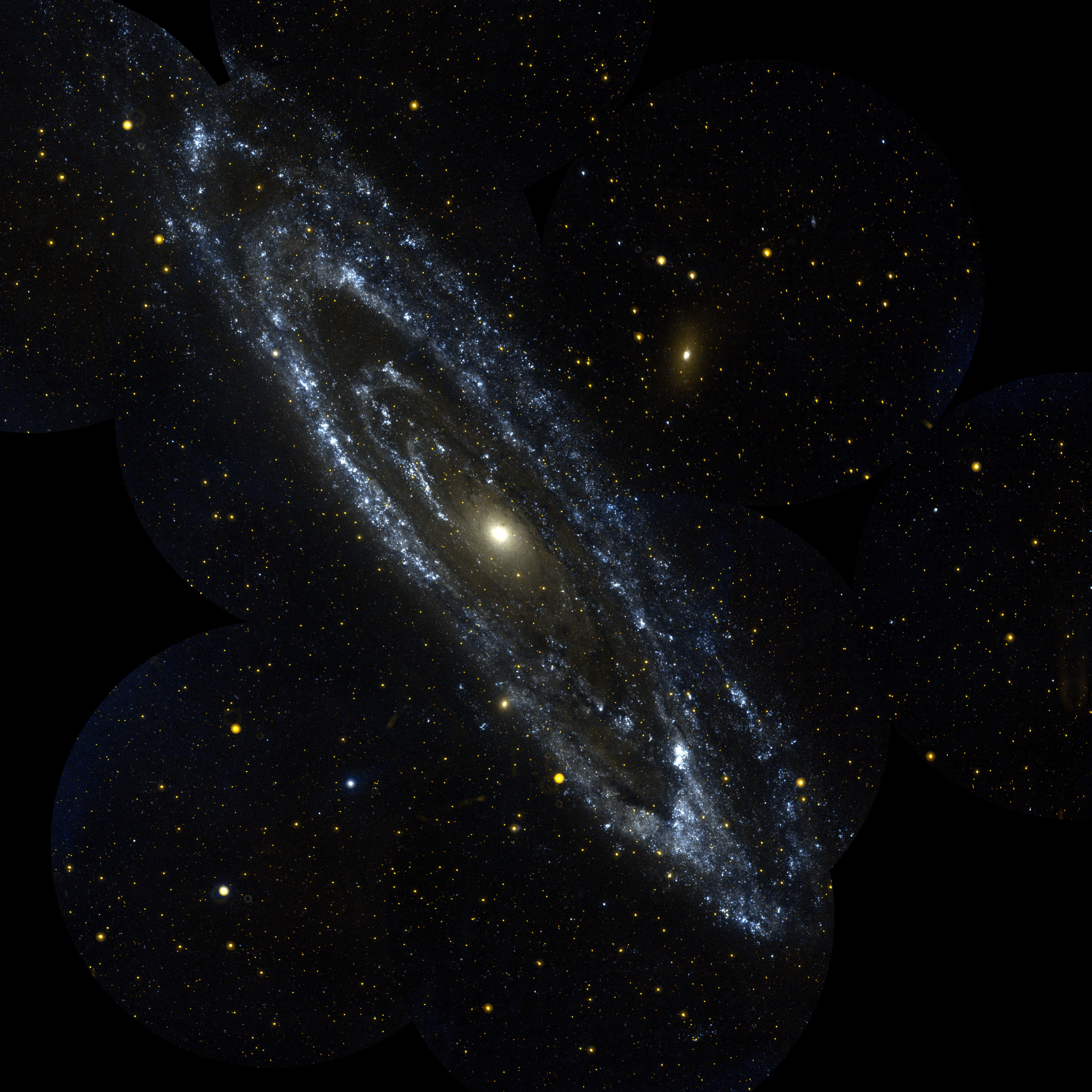 that I'm interested in Carl Sagan's analogy of the Cosmic Calendar to illustrate the depth of cosmic history. I find it enthralling that the universe is almost unimaginably old. The knowledge of how truly vast time and space are fills me with reverence for the universe. Though it has no mind, though it has no consciousness of me as an individual, nevertheless it is a thing of awesome beauty, and it is a recurring source of joy to remember that, through no merit of my own, I am lucky enough to be part of it.
That sense of staggering good fortune is touchingly expressed at the start of Richard Dawkins' book Unweaving the Rainbow:
We are going to die, and that makes us the lucky ones. Most people are never going to die because they are never going to be born. The potential people who could have been here in my place but who will in fact never see the light of day outnumber the sand grains of Sahara. Certainly those unborn ghosts include greater poets than Keats, scientists greater than Newton. We know this because the set of possible people allowed by our DNA so massively outnumbers the set of actual people. In the teeth of these stupefying odds it is you and I, in our ordinariness, that are here.Now I'd like to share with you a bit about my wedding with Deena seven years ago. It was before we had discovered Humanism as an organized community, but we already held broadly humanist beliefs, and the symbolism we chose then still resonates with us today.
The ceremony was held outdoors, in a cathedral of trees, with a small brook flowing by. Charles Darwin and his intellectual successors have shown us how truly connected we are to all of life - we are cousins to the ants and the poplar trees and the magpies.
We had friends and family with us. Marriage is a human act, and the moral community in which we made our commitment consists entirely of ourselves and other humans.
The poem "Habitation" by Canadian writer Margaret Atwood was read:
Marriage is notOur spirituality is provisional and fragile. It is provisional in that the things that matter to us, the people and life choices, could have been otherwise. I was not destined to meet Deena; I simply did meet her. Chance got us that far;
a house, or even a tent
It is before that, and colder:
the edge of the forest, the edge
of the desert
the unpainted stairs
at the back, where we squat
outdoors, eating popcorn
the edge of the receding glacier
where painfully and with wonder
at having survived even
this far
we are learning to make fire.

 our own choices (and further chances) have taken us to where we are today. The fortune we cherish is fragile because there are so many things that could shatter it, that could have made it other than what it is.
One guest at our wedding said that the above poem was rather cold. But it mirrors the sentiment from the Dawkins passage (which we wouldn't read for another six years). Our wealth lies not in having a pleasant ultimate destiny, but in random undeserved strokes of fortune, and our own capacity to react well to them.
Not every event has an actor behind it. There are no guarantees that justice will prevail. As conscious, moral beings, we are the only force in the universe that can push the balance toward good. Therein lies the starkness that can horrify the existentialist, but also the responsibility that motivates us as humanists.
We ate a symbolic meal during the ceremony, exchanging pinches of granola and toasting each other with our favorite drinks - fizzy apple juice for Deena, chocolate milk for me. We build our connections to other humans through a myriad of everyday acts - like the act of eating a meal together.
A gust of wind spilled most of the drinks over the little table we were using, and our wedding certificate still bears the brown stain of the chocolate milk. There was still enough left for the toast. We love telling friends where the brown stain on the wedding certificate came from.
The table was from the house of my granny, who had recently died. Though we do not believe people's souls survive after death, we cannot deny that memories of a person live on in others. We honour the memory of dead loved ones, and hope to live well so that the memories we leave in others after we die will be good ones.
The wedding was at noon, followed by a picnic lunch for all one hundred guests. Through the afternoon we walked about and played games. There was an inflatable bouncy castle on the lawn, frisbee golf all around, a treasure hunt, and general merriment.
 At the evening meal, we had dessert first. Sometimes, the point is to enjoy life, not to postpone enjoyment.
We (Deena and I) tend to look at life, spirituality, and ethics as the ancient Greeks did. Spirituality and ethics are not confined to when a person prays, or meditates, or is performing certain acts. They permeate our entire life - sometimes at a conscious level, sometimes not.
I hope that has at least started to answer your question, Cath.
Subscribe to:
Posts (Atom)


