Showing posts with label death. Show all posts

Friday, 21 August 2009

Right or obligation?

I was hanging out with my friend Marc the other day, when he said something that I only half-noticed at the time:
In all you do or say or think, recollect that at any time the power of withdrawal from life is in your own hands. (Meditations, book 2, paragraph 11)
It came back to me, however, when I read of the death of Edward and Joan Downes.

I feel that they have done nothing evil; nor have those at Dignitas who helped them. From what statements are available, it sounds like the couple's children agree with their decision.

I could spend post after post discussing and weighing the arguments presented by people who think that assisted suicide should be legal, and those who think it should not. But I honestly don't think I'd come up with anything that hasn't been said before.

I do have a question, though. Is life a right? Or is it an obligation? Should people be allowed to take their own lives? To help others do so? Should doctors expend their efforts on the possibility of extending someone's pain-ridden life by a few days? Or is that simply a cowardly form of torture, accepted because of the fear we healthy people have of unwanted death?

As with so many real-world problems, the answer is not easy. But the story of Edward and Joan Downes forces us to wonder if the current state of affairs is appropriate.

As I understand it, British law criminalizes those who participate in assisted suicide overseas; but nobody gets prosecuted for it, possibly because such people always seem to be loving family members, as far from criminal as one can get, morally speaking.

[I have to apologize to my readers - somehow, I managed to post this without actually writing the last paragraph. Here it is.]

It is inexcusable for a legal system to prohibit an act but to systematically refrain from executing the prescribed sanctions. The law is an ass - but when carried out appropriately, it is at least a consistent ass. Those involved in this law (legislators, police, etc) should either repeal the law or enforce it as it stands. I think they should repeal it, but either solution would be better than the current state of affairs.

Tuesday, 7 July 2009

What loss is death?

From Meditations by Marcus Aurelius (121-180 CE), book 2, paragraph 14:
Were you to live three thousand years, or even thirty thousand, remember that the sole life which a man can lose is that which he is living at the moment; and furthermore, that he can have no other life except the one he loses. This means that the longest life and the shortest amount to the same thing. For the passing minute is every man's equal possession, but what has once gone by is not ours. Our loss, therefore, is limited to that one fleeting instant, since no one can lose what is already past, nor yet what is still to come - for how can he be deprived of what he does not possess? So two things should be borne in mind. First, that all the cycles of creation since the beginning of time exhibit the same recurring pattern, so that it can make no difference whether you watch the identical spectacle for a hundred years, or for two hundred, or for ever. Secondly, that when the longest- and the shortest-lived of us come to die, their loss is precisely equal. For the sole thing of which any man can be deprived is the present; since this is all he owns, and nobody can lose what is not his.
Photo credit:

Photo of a bust of Marcus Aurelius, from the Wikimedia commons. Taken by user Bibi Saint-Pol and released into the public domain.

Tuesday, 16 June 2009

Natural consolations

Over at Daylight Atheism, Ebonmuse has shared yet another of his symphonically beautiful bits of writing. This one is in honour of his grandmother, who recently died. He calls it "Green Fields". Check it out. Here's a taster:

For those who are grieving, for those who mourn, and for all those who are burdened with the weary weight of sorrow, I have a prescription.

Find a quiet, peaceful place, a green field of grass where great trees grow and gift the world with their shade. Let it be just before sunset, at that golden hour when the heat of the afternoon is past, when the sky is blue as a pearl and the setting sun hues the world in its last, richest and most transitory light.

Sit against the trunk of an old and massive tree, one that's lived through summers and winters untold. Lean on its rough, moss-clad bark and feel the slow, patient pulse of the life in the green heart of the wood. Try to clear your mind of thought, and listen.

(Read the rest at Daylight Atheism.)

Photo credit:

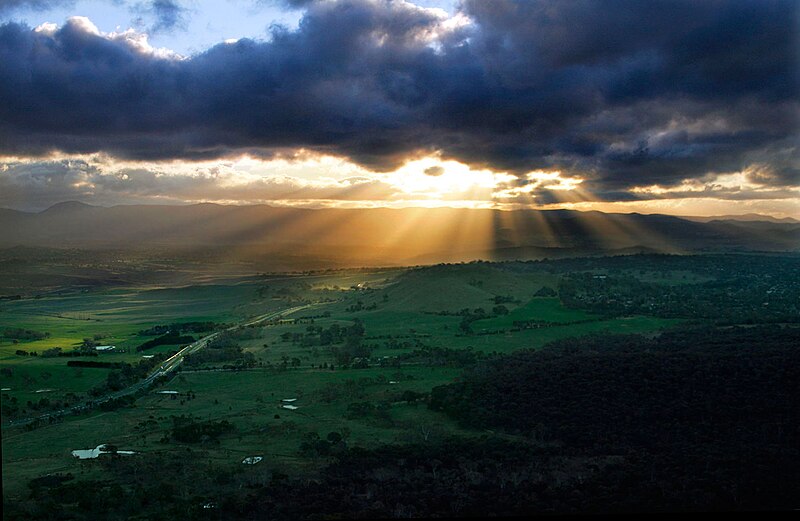
Crepuscular ray sunset from Telstra tower, by Fir0002/Flagstaffotos. Released under the GNU Free Documentation License (GFDL).

Friday, 12 September 2008

Life after death

We received the latest edition today of Humanitie, the quarterly magazine of the Humanist Society of Scotland. In it is this, my first (paid!) column in a series - accompanied by a twin column authored by Mike, the Not Quite So Friendly Humanist. The theme of this quarter's issue is death.

In April, I went with the local student linguistics club to the anatomy lab of a teaching hospital. I have studied the physical and psychological processes of speech for ten years, but I had never before seen the speech organs in place; never seen everything connected as it is in life. That visit greatly enriched my education.

If the anatomy lab is so helpful to a linguist, imagine the benefit to medical students and to those whose lives they will go on to save.

It's not all learning and delight, though. Stepping into the room, seeing the tables with the unmistakably human forms under sheets, I felt a stab in my heart - the visceral tragedy of death. Students of anatomy must acknowledge and respect the humanity - the sacredness - of the bodies being studied, while remaining detached enough to learn what there is to learn. Afterwards, one of my fellow students asked, "Did anyone else feel sad after the visit?" Yes, we did. This knowledge we had gained, this understanding, was only possible because people had died.

But the choice before us is not between their life and our knowledge. The choice is what to do when death comes. Though we were uneasy at times, I do not think anyone in our group regretted the experience, nor failed to appreciate the gravity of the choices and events that made it possible.

Because of that trip, I have decided to donate my body.

I've heard (and can imagine) many reasons for not donating one's body. They range from the superstitious - "What if my spirit can't move on because my body was not put to rest properly?" - to the self-conscious - "Do I want so many young medical students peering into my body?" These worries are real; but can they compete against the undeniable and tangible benefits the gift of one's body provides?

Simply put, yes. People's fear in contemplating such donations is immediate and profound. The fear of death cannot be set aside with a quick dose of reason; the prospect of having their body (or the body of a loved one) treated other than how they wish after death can cause true emotional distress. I would be a poor humanist indeed if I were to ignore such pain just because it isn't rational.

Nevertheless, medical students still need human bodies to learn from. The days of the Resurrection Men, and the grisly Burke and Hare murders, are well behind us. Today, the utmost respect is shown to donated bodies. But, as in the days of the Edinburgh grave robbers, there is always a shortage. Universities are forced to exploit alternative means of anatomical instruction - sometimes ingenious, but never quite as good as the real thing.

The gift of one's body suits every bit of humanist philosophy: care for others, value for education, and a dedication to reality over superstition and wishful thinking. I can think of few better epitaphs than on the marker of the plot used to inter the remains from the anatomy lab I visited: "To those far-sighted people who have contributed to the advancement of medical science & research."

The decision is deeply personal, and I do not condemn those who choose differently from me. But I do ask that you think about it. (Perhaps many people don't donate their bodies because it just doesn't occur to them.) Ask yourself which option accords best with your values and your beliefs.

Contact your nearest medical school to find out more about arranging the donation of your body.