Showing posts with label calendar. Show all posts

Monday, 28 September 2009

Meditation on the origin of life

In the Cosmic Calendar, the Origin of Life falls somewhere around now.* About three and a half billion years ago, the great abundance of life on Earth began, probably with a single replicating molecule - a precursor to DNA. Every living organism today, from the tiniest bacterium to the largest whale, descends in an unbroken line from that tiny bundle of atoms.

Today, I invite you to consider this:

We still reproduce as single-celled organisms.

Every act of human reproduction involves one cell from each parent. A single cell. For all our wondrous complexity, our bountiful organs and tissues, our towering intellects and tender thoughts ... for all that, we still have to humble ourselves to the level of our distant, millions-of-generations-past ancestors in order to participate in that most ancient, most definitive act of life: reproduction.**

Footnotes:

* In fact, the details of this event, including its exact date, are difficult to pin down. The Wikipedia article on abiogenesis gives possible dates ranging from 4.2 billion years ago (bya) to 2.4 bya - that is, 11 September to 29 October. However, today falls somewhere in the middle of the range, just over 3.5 bya. The fact that 28 September is also my daughter's birthday makes me even more prone to contemplating life's origins today.

** Not all multi-cellular organisms are so constrained. Many plants do a significant part of their reproduction by sending out shoots or otherwise cloning themselves, rather than going through the whole one-cell business. Who's superior now, eh?

Thursday, 17 September 2009

Talk Like a Pirate Day

Talk Like a Pirate Day is almost upon us. Marrrk your calendar: September 19, this Saturrrday. Arrr you ready for it? Thanks to that old salty dog, the Fiendly Arrrtheist, for makin' me awarrre of this. Arrr.

(What do ya say, me mateys? Be I ready for Talk Like a Pirate Day?)

Monday, 31 August 2009

Cosmic Calendar: Solar System forms

That season is upon us again.

I'm talking, of course, of the busiest months in the Cosmic Calendar. For those who don't know what the Cosmic Calendar is, please see my earlier posts on the topic (starting here).

I've added a list of upcoming Cosmic Calendar events to the (increasingly busy) sidebar on the right.

Today (4.6 billion years ago), the Solar System begins to form. In a day or two, the Earth will have formed (4.5 billion years ago). I apologize for not having more to say right now - this kind of snuck up on me, and I still have limited Internet access outside of work. Check out last year's post for a little more background on today's anniversary.

(Also see last year's post on Earth's birthday. If anyone has any insight into the bizarre claim made in the comments, please let me know. It still baffles me. I don't know if I could have responded more constructively.)

Tuesday, 24 March 2009

Invisible writer turns 200.

This year marks the 200th anniversary of the birth of someone whose writing system has helped millions of people ... but none of them have seen it.

Louis was born on the 4th of January, 1809. He was a gifted child, learning to play the cello and the organ at a young age.

Between the ages of 12 and 15, he invented a revolutionary new writing system. Loosely based on a clever "night-writing" code he learned from a soldier who visited his special school in Paris, the writing system won official recognition in 1854, two years after his death. Today it is widely recognized (though not widely studied) and bears Louis's surname, Braille.

In honour of Louis, I'm leaving images out of this entry. Just on the off chance that a blind person reads this post with a Braille reader. Check out the Wikipedia entries on Louis and his alphabet for plenty of images.

And why not send a card to someone you know using his alphabet?

Happy 200, Louis!

Friday, 6 March 2009

Periodic anniversary


It is once again the anniversary of the Periodic Table of the Elements. It was first introduced to the world on this day in 1869, in a presentation to the Russian Chemical Society by Chemist Dimitri Mendeleev.

I write this with a sleeping baby in one arm, so it'll be brief.

First, a quiz for you - a fun activity for Periodic Table Day. Feel free to give your answers and other thoughts in the comments on this post.
  1. What was periodic about Mendeleev's table?
  2. What was the reason (discovered much later) for that periodicity?
  3. How are the elements ordered in the table?
  4. Where does hydrogen belong - on the left or on the right? Why?
  5. What predictions did the original table suggest? Have they been confirmed?
  6. Does the Periodic Table depict a fact or a theory? Explain.
Okay, now a bit of periodic fun. And another: [Sorry, link to final image seems to have gone dead.]

Monday, 1 September 2008

Earth birthday

Another Cosmic Calendar event already!

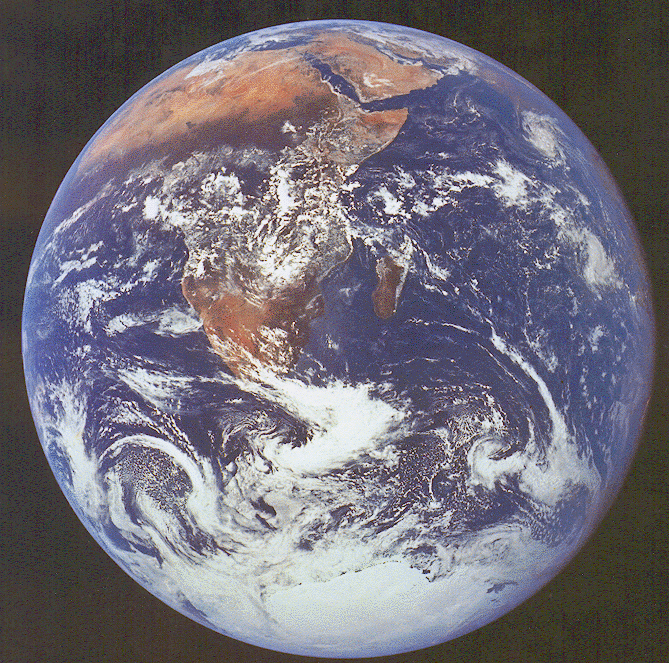
Only the day after the Solar System begins to form, our own humble planet comes into being.

(Remember, because we are compressing the entire history of the cosmos into one year, each day represents 37.4 million years.*)


I apologize for not having more to say just now - I am still in PhD write-up mode.

References used:
[1] Wikipedia, as usual.
[2] Talk Origins page on dating the age of the Earth

* For those who have followed this series from the beginning, you might remember that I claimed before the each day is 41 million years. I am now calling it 37.4 million. What gives? The earlier figure was based on a 15 billion-year-old universe. I have since learned that the consensus is for a slightly younger universe, at 13.7 billion years. Remember, this is a calendar based on what we know, and so when what we know changes, so does the calendar. If anyone else wants to fact-check my figures and calculations, please let me know.

Sunday, 31 August 2008

Solar System forms

[For those of you who enjoyed the Cosmic Calendar posts in December (here and here), I must apologize for the dearth of them so far this year. Not much happens before December, but I did miss announcing the formation of the Milky Way galaxy back on April 6th (10.1 billion years ago).]


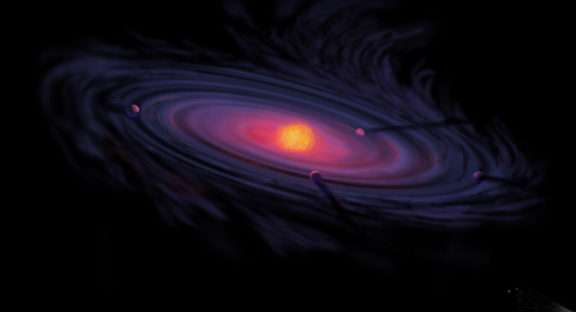
Some time about 4.6 billion years ago, our solar system began forming from a large cloud of dust and gas. In the Cosmic Calendar, that corresponds to today. So ... happy Solar System Day, everybody!

Next up ... birth of the Earth.

References used:
[1] The Wikipedia article on the Formation and evolution of the Solar System reports the cloud from which it formed starting to collapse about 4.6 billion years ago. That's also where I got the pretty picture, which is a public-domain depiction courtesy of NASA.
[2] The Natural History Museum reports an age of 4.5 billion years - slightly different (two days later in the Cosmic calendar). As the formation of the solar system probably took some time, any specific moment chosen as its "formation date" (birthday?) will be somewhat arbitrary.

Thursday, 6 March 2008

Periodic Table's 139th birthday

Just wanted to point you to a milestone in science that you can mark today - the 139th anniversary of Mendeleev's Periodic Table of the Elements. Thanks to the Skepchicks for the heads-up (and cool links - look in the comments too). Try Wikipedia (as always) for even more info and links.

Friday, 11 January 2008

Oldest Milky Way star


Only 500 million years after the Big Bang, a star was born that would later be part of globular cluster NGC 6397, 7200 light years from Earth, which contains of around 400 000 stars. This star, perhaps not the oldest in the galaxy, is the oldest one so far observed in the Milky Way galaxy: about 13.2 billion years old. That's January 14th for those following the Cosmic Calendar. Celebrate the birth of this early-starting star, HE 1523-0901, by getting up just after dawn on Monday.

Note that the galaxy itself didn't start to form from these early stars (and various other bits and bobs) until between 6.5 and 10.1 billion years ago - no earlier than April 6th in our Cosmic Calendar.

I would like to appeal to any experts or students in astrophysics or cosmic evolution to help me populate this sparse end of the Cosmic Calendar with interesting events in the early universe. For now, I'm digging up the occasional tidbit from Wikipedia with my own meagre understanding of the cosmos - a more systematic set of dates would be very welcome.

Saturday, 29 December 2007

Flowers and the end of the year

Around 125 million years ago - December 29 on the Cosmic Calendar - the oldest flowering plant fossils currently dated were alive and blooming. Perhaps you can celebrate by giving a flowering plant to a loved one. This is not difficult, as only a few of the commonly-known plants are non-flowering.

Flowering plants include not only flowers themselves; they also include most trees, and even virtually microscopic plants.

Heck, you could even whip up a nice winter broth from nothing but flowering plants and water (seasoned with other flowering plants). Remember, we all depend on flowering plants for our survival (they constitute most of the photosynthetic base of the planetary food cycle).

====

I will be occupied for a few days now, and am unlikely to blog until several days into 2008. So here's a summary of the major events in the Cosmic Calendar over the next few days.

I apologize for the lack of links to my source material. I'm a little ill, and not up to hunting them all down. New Year's Resolution #1: Be more organized with the Cosmic Calendar announcements next year.
  • 30 December (tomorrow): A moment of silence at 10:00 might be an appropriate way to mark the extinction of the dinosaurs 65 million years ago.
  • 31 December, 10:30 pm (2.5 million years ago): Ancestors of humans appeared. This is the genus Homo, not Homo sapiens yet. Start working on your posture.
  • 31 December, 11:46 pm (420 thousand years ago): Domestication of fire. Light a thin candle (420 thousand years passes quickly in the Cosmic Calendar).
  • 31 December, 11:52 pm (250 thousand years ago): Birth of Homo sapiens. Find some other humans and welcome them to the planet.
  • 31 December, 11:59:40 pm (10 thousand years ago): Earliest farming. Phone a farmer and give thanks for the food you eat.
  • 31 December, 11:59:50 pm (4500 years ago): Pyramids built. That's right, you have less than ten seconds to embarrass your friends with your "Walk like and Egyptian" tribute to these great symbols of superstition and slavery.
  • 31 December, 11:59:59 pm (500 years ago): Astronomer Nick Copernicus and others mark the dawn of science, a new stage on our path to understanding our real place in the universe, which will eventually culminate in the global adoption of the Cosmic Calendar as an annual cycle of reality-based festivities.
  • 31 December, 11:59:59.9998 pm: Last year's New Year's Eve, at which you were woefully unaware of the Cosmic Calendar. Spend the last 2 milliseconds of the year thanking your good fortune for finding it in time for this year's festivities.
  • 1 January: The Big Bang! We get to start all over again, some 15 billion years ago.
See you all next year.

Wednesday, 19 December 2007

Cambrian Explosion

For those of you following the Cosmic Calendar, yesterday was the Cambrian Explosion!

Sometime around half a billion years ago, a great deal of diversity in animal body plans appeared in a relatively short period of time. This was a major event in the development of the rich and complex biosphere we now enjoy.

Yesterday is also an ideal start for a Cosmic Advent Calendar. After the Cambrian Explosion, there is some sort of significant evolutionary event at least every day (every 41 million years) until the present moment (midnight on December 31st). In my Google Calendar version, I have found examples for every day except December 25th and 27th. Perhaps you can help fill them in?

I would love to announce an event every day on this blog through the advent period, but I will be away for a week visiting family. So I'll cover my lapse by inviting you to do this the freethinking way.

First, check out the Google Calendar. Feel free to check my accuracy - I'm no evolutionary biologist.

Second, think of two or three of your favorite animals. Think of (or research) a significant evolutionary event for each. Put that event on your own personal Cosmic Calendar.

Third, meditate on how life might have been like in the deep past. Today, the first vertebrates appear: fish. Can you imagine a world without fish? With only one species of fish? What did it look like? The land is still effectively barren - no plants, no animals (not even insects).

Finally, do something that is relevant to the day's Cosmic event. My impulse is to make it food-related - eat fish and chips, or fish-shaped crackers.

Enjoy, and have an exciting Cosmic Countdown!

Saturday, 15 December 2007

Humanist calendars

I've already written about the idea of humanist holidays. Well, I've been a a little active on that, in between being a dad and working on my PhD.

The latest products of my inspiration are two public Google Calendars.

The first is a Cosmic Calendar:


The second is a list of Humanist Holidays:


Many humanists are interested in holidays that they can celebrate without compromising their beliefs - Thanksgiving seems safe; some form of a winter festival can be more iffy, but I don't see the problem (even the 25th of December has suitable humanist significance if you look). And there are other dates too with the potential to become new, secular days of celebration.

So tell me: What have I missed? What have I misplaced? What changes would you make? (Astrophysicists, can we fill in the early months of the Cosmic Calendar any more?)

I've made the calendars public not to persuade everyone to adopt my version of Humanist celebrations, but to invite everyone to comment, participate, modify.

So sign up for Google Calendars. Add one or both of these to your set of calendars (events for each one show up in a different colour). You can even import individual events into your personal calendar and modify them as you like.

Let me know what you think.

[Postscript: I notice others have taken parallel tracks in this pursuit. Pastafarians also have a Google Calendar resource to keep track of their seasonal observances (just search the public calendars for Flying Spaghetti Monster.)]

Monday, 10 December 2007

Celebrate today!

Thank goodness I check my favorite blogs with obsessive regularity - or else I might have missed the fact that today is Human Rights Day. It's the 59th anniversary of the ratification of the Universal Declaration of Human Rights by the United Nations General Assembly.

Thanks to This Humanist for letting me know in time. As many of you have noticed, I am eager to discover and celebrate days of significance to the Humanist community. Now I have something to put on December 10th.

Monday, 24 September 2007

A humanist calendar ...?

At our recent student fair, I saw an interfaith calendar that highlighted all the various religious festivals and holy days of several world religions. Of course, humanism wasn't on it – not only because humanism is not a religion, but also because, although we are a community of people with shared values, we have not really established a yearly calendar of dates special to our community.

Throughout history, one thing that has united human communities is a common calendar of observances. From the solar equinoxes and solstices indicated by Stonehenge, to the holy days (and weeks and months) of any contemporary religion you could name, to the secular holidays celebrating days of national importance (Canada Day, the Queen's Birthday, Family Day), every human community has shared important days of the year. These days commemorate events of historical importance to the community (national independence, birth or death of important religious figures), mark the seasons (harvest festival, solar equinoxes/solstices), or simply set aside time for things the community values (Family Day, National Day of Prayer, National Day of Reason).

Humanists have some such days, though they may be local rather than general to the community at large. For example, our Edinburgh branch of the Humanist Society of Scotland holds a Darwin Day event on February 12 (generally a discussion with an evolutionary theme). Many American non-believers hold the National Day of Reason, on May 3 (giving blood) – in part to celebrate reason and in part to protest the National Day of Prayer on the same day, an unconstitutional incursion of religion into their officially secular state.

For those of us with families who celebrate the standard holidays of the dominant culture, there are clever alternatives. The fun and creative Church of Reality website suggests celebrating Newton's birthday on December 25 (“because Newton actually was born on December 25th”).
“We call the holiday Crispness because it's about keeping your mind crisp. And it's not a coincidence that it's the same day as Christmas and the Yule holiday where Christmas came from. It is the day that we celebrate the Tree of Knowledge, which represents the sum total of all human understanding. We use the traditional pine tree, which is already a very fractal looking tree to represent the Tree of Knowledge. The tree is decorated with lights and ornaments symbolizing The Sacred Network or the Internet.”
It's fun, it's festive, and it means that Deena and I can celebrate December 25 with our (nominally Christian) families without a nagging sense of dishonesty to our values and beliefs. (Remember that using the dates of existing celebrations for a new community with very different beliefs is an ancient and honorable tradition.)

I just learned (a day too late for this year) through Dale McGowan's blog that the fall equinox (September 21) is the International Day of Peace. This is something most humanists can get behind. Earth Day covers the opposite equinox, on March 21.

A source of many potentially awesome holidays, at least in the final few months of the year, is the Cosmic Calendar, brainchild of the great Carl Sagan. In it, the entire 15-billion-year history of the cosmos as we know it is scaled into a single year, with the big bang at the start of January 1st and the present moment at the end of December 31st. Along the way you get events like the formation of the Milky Way galaxy (May 1), the Solar System (September 9), and the Earth (September 14), the origin of life (September 25), on up through our ancestors: eukaryotes (November 15), worms (December 16), fish (December 19), insects (December 21), dinosaurs (December 24), mammals (December 26), primates (December 29), hominids (December 30), and then down through the evening of December 31. Go see the whole year here or here.

There are clearly many potential humanist holidays to choose from – some already established in certain communities, others new and untested. Deena and I already celebrate some of them (such as Darwin Day and Crispness), and plan to celebrate others in coming years.

What do you think? Do you, as a humanist, celebrate humanist-themed days through the year? Do you simply take the holidays of the culture around you, and spend the time in your own humanist pursuits? Do you think we'll ever have a common calendar of humanist days, or are we simply too individualistic for such conformity?

Are shared holidays too much a part of religion, and not appropriate for humanists to buy into? How should we balance individual thought and independence with community and interdependence?