Wednesday, 1 July 2009

What do you know about Canada?

It's Canada Day again. Last year I was actually in Canada for this national day. Today, I am hard at work at my desk in Edinburgh, Scotland. (Well, except for this brief break to blog of course.)

In the interest of brevity, I will simply list a couple of neat facts about Canada.

Did you know that the name "Canada" comes from an aboriginal word meaning "village"? Wikipedia did.

Incidentally, I learned in that article that the American 'Articles of Confederation (1777) included a clause pre-authorizing the admission of "Canada" as a new state if it wished to join the U.S.'

Of course, we did not join the US. In fact, in the War of 1812*, we (as part of Britain) fought the States. One of the consequences was that the White House was burned down.

However, any ill-feelings from that incident have not survived. Canadians generally have a strong sense of national identity, often making a particular point of our differences from the Americans. But we also have a great big long (8891 km) border that has not needed military guarding (by either side) for yonks**.

On the other hand, we are perhaps more affected than any other country by the cultural exports of the US - particularly movies and television. Some of the effect is negative (Canadians sometimes knowing American geography and history better than Canadian geography and history). Some is positive (a lot of American television and movie production has been done at Canadian sites, largely because it's often cheaper).

Anyway, I hope this has been informative for my readers (Canadian and non-Canadian). If you have any other interesting Canadian facts, please share it in the comments.

* Note, this is the Anglo-American War of 1812, not Napoleon's invasion of Russia. Apparently, the Russian composer Tchaikovsky had the latter in mind, not the former, when he composed the 1812 Overture. It's a good bit of music nevertheless.

** many years (highly technical Canadian term)

Image credit:

Canada flag from Wikimedia Commons. Public domain.

Tuesday, 30 June 2009

Ingersoll on doubt

I offer for contemplation a quote by the great 19th-century orator, Robert Green Ingersoll:
Fear believes, courage doubts.
(from his Lecture on Ghosts - see this collection in Project Gutenberg for the full text.)

I know that this can be taken in different ways by different people, so I offer more commentary than I usually do with quotations.

For those of you whose first impulse is to be insulted, I encourage you to try to step back and see the sense in which it is a valuable sentiment. Note that it does not mean that all belief is born of fear, nor all doubt of courage; it just means that fear is a great motivator of ill-founded belief, and courage an important foundation for honest doubt.

For those of you whose first impulse is to feel smug - that this is a condemnation of someone else - I encourage you to think again. Do you apply doubt to all of your beliefs, or are some "special" in one way or another?

Ingersoll's quote - from a discussion of witch-hunts and superstitious hysteria - is a warning to us all. It is a statement about human nature, not just about one type of worldview.

Tuesday, 23 June 2009

What time is yours?

Marcus Aurelius (121-180 CE) has some blunt words to share about procrastination, which I cannot disagree with*:
Think of your many years of procrastination; how the gods have repeatedly granted you further periods of grace, of which you have taken no advantage. It is time now to realize the nature of the universe to which you belong, and of that controlling Power whose offspring you are; and to understand that your time has a limit set to it. Use it, then, to advance your enlightenment; or it will be gone, and never in your power again. (Meditations, book 2, paragraph 4)
* Okay, so unlike the good emperor, I do not literally believe in any gods, nor a "controlling Power whose offspring [I am]". But it's no problem to set aside those bits, or read them metaphorically, while agreeing with the rest.

More from this ancient Stoic to come.

Photo credit:

Photo of a bust of the young Marcus Aurelius, from the Wikimedia commons. Taken by Marie-Lan Nguyen and released into the public domain.

Monday, 22 June 2009

A perilous experiment?

Here is my latest article in Humanitie. Mike (the Not Quite So Friendly Humanist) and I have both recently had experiences with religious evangelism. His is here.

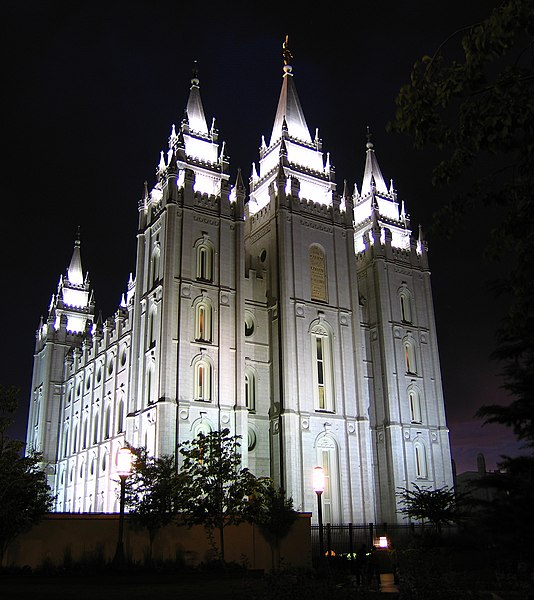
Several months ago, some Mormon missionaries approached me on the street. I knew very little about their beliefs, most of it from comedians and atheist critics. So Deena and I invited them over.

I will blog later about what I learned of their particular beliefs. What I want to discuss right now is an experiment they asked us to try after our first meeting.

They asked us to pray.

I found myself facing a dilemma. On the one hand, praying feels like a betrayal of my values as a humanist. How could I sincerely ask for an answer from a god whose existence I believe to be improbable, undiscoverable, and irrelevant to living a good life? On the other hand, free thinking is at the heart of humanism. Prayer is an experience I had never tried before.

So I decided that, conducted carefully, praying would not betray my principles. I would try it - and perhaps learn something new about myself and my Mormon friends.

I had many questions heading into the experiment. Would I feel anything peculiar? How might I interpret it? Would I, in the limited but well-publicised tradition of sceptical converts, "see the light"? Would I have an unusual experience but shrug it off? Would I feel nothing at all?

I sat in a comfortable posture in a quiet room, closed my eyes, and asked aloud, "God, do you exist?"

I quieted my thoughts to make room for even the softest suggestion from an external deity. I sent my internal sceptic, who was clamouring to declare the whole exercise a farce, out to get tea.

Then I waited. I tried to be ready for any type of result - from a sudden Damascus-road conversion to quiet "promptings of the spirit".

I was so still that all I heard for several minutes was the beating of my heart and the ticking of the electric clock. There was nothing else. Nothing that could be interpreted as a message from a god - not even a little thrill of what-if.

Later, I related this experience to the Mormons. They were undeterred. They encouraged me to keep trying: "God is not always heard the first time."

Fair enough. No responsible scientist would draw a firm conclusion from just one data point.

So I continued the experiment, varying the format to get a sample of different styles of prayer: different postures, different forms of address, different questions. I prayed alone; I prayed with Deena; I even led the prayer at the end of our meetings with the Mormons once or twice. The result was the same each time: I was answered only by my own thoughts and feelings.

At a recent meeting, one of the Mormons promised, "If you keep trying, eventually you will get an answer." Well, I have tried the experiment. I have set aside my reservations and sought the truth, true to my humanist values. And I have an answer. There probably is no personal god.

Now it's time for me to move on to the next question, the next empirical adventure.

Photo credit:

Mormon temple image by user Ricardo630, accessed at Wikimedia Commons, released under Creative Commons Attribution ShareAlike 2.5 license.

Sunday, 21 June 2009

Me and U

Three interesting things happened to me today.
  1. The summer solstice happened early this morning. At this northern latitude, that's a big deal. I'm actually looking forward to a bit more night. (I think the early dawn and late sunset may be why Kaia seems to sleep so little. I ask the more experienced parents out there not to disillusion me.)
  2. It was my second Father's Day as a father. I got a delightful little card with a cute little red hand print on it from Kaia. I'll spare you my cheesy gushing. For now.
  3. Deena and I officially became members of the Edinburgh Unitarian Church.

We have been attending for some months now. (Excessively-attentive readers may have noticed Unitarianism popping up occasionally - here, here, here, and here). What began (for me) as a little research into community-building - research I hope to apply to the humanist community - turned into an enriching experience of being part of a supportive community.

It is late, and I don't want to wax on at too great a length. Let me just say a couple of things to make sure my readers don't misunderstand.

I am not going to start blogging as the Friendly Unitarian now (and not just because of the unfortunate acronym). I still consider myself a humanist. (There's a sign on the outside of the Unitarian church that says something along the lines of "What do a Christian, an Agnostic, a Humanist, and a Buddhist have in common? They might all be Unitarians.")

I still consider myself a part of the humanist community in Scotland, and at my university. And online, of course.

I will blog another time about the natural connections between Unitarians and humanists. But for now, I recommend you read this address by Dale McGowan to a Unitarian congregation in the States.

I put it to all those humanists out there who identify with Harry (read Dale's full address to get the reference): we need to understand Sally better for humanism to grow into its full potential. Unitarians understand Sally very well indeed.

Wednesday, 17 June 2009

Homeopathy awareness

Steve Novella at the Neurologica blog just pointed out that this is the British Homeopathic Association's "Homeopathy Awareness Week".

He is right - I think we all need to be more aware of just how homeopathy can affect our lives. I encourage you to read Steve's post, which gives a quick history and an overview of what homeopathy entails. (See also the Science-Based Medicine blog.)

I also encourage you to look at what the carefully-assembled evidence from multiple scientific studies has to say about homeopathy. I recommend Ben Goldacre at Bad Science for this - here's a list of his Bad Science blog posts about homeopathy, and here's a particularly good overview. Also, anyone who can't imagine that their experiences with homeopathy could be "just placebo effects" should really listen to his two-part programme on the BBC about the placebo effect. You don't need to look to homeopathy for some mind-blowing, magical-seeming effects. There's plenty in the real world of scientific medical research. And read his book, Bad Science.

Bottom line: Real medicine is about proving something is safe and effective, and abandoning it as soon as it is shown to be either unsafe or ineffective.

Alternative medicine is about believing something is safe and effective, and rejecting, ignoring, or suppressing any evidence to the contrary.

It hurts people. It hurts people because alternative practitioners encourage distrust of real medicine in general. It hurts people because they take homeopathic treatments instead of real medicine. See for example this tragic story about Gloria Thomas Sam, a nine-month-old girl who died horribly because she was given homeopathic treatment rather than real medicine for eczema. Eczema!

Real medicine isn't infallible. But its researchers abide by strict rules of evidence: something must be proven both safe and effective before it is used in medical practice. Real medicine is self-correcting.

Homeopathy, and most alternative "medicine" modalities, are not self-correcting.

I encourage everyone - adherent, opponent, and uninterested layperson - to become a little more aware of homeopathy this week.

Photo credits:

Bad Science cover art from Bad Science blog (assumed fair use).

Water memory poster from Hell's News Stand (adapted from a less politely-worded version; also available with a G rating). Published with invitation to redistribute.

Tuesday, 16 June 2009

Natural consolations

Over at Daylight Atheism, Ebonmuse has shared yet another of his symphonically beautiful bits of writing. This one is in honour of his grandmother, who recently died. He calls it "Green Fields". Check it out. Here's a taster:

For those who are grieving, for those who mourn, and for all those who are burdened with the weary weight of sorrow, I have a prescription.

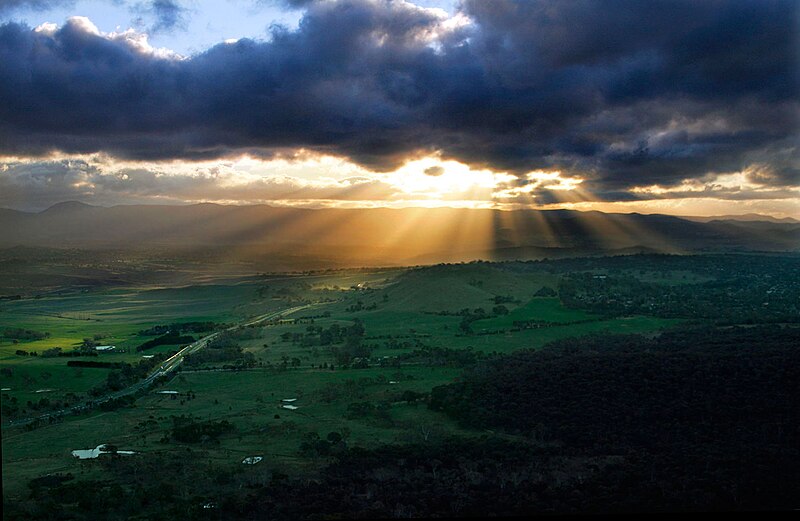
Find a quiet, peaceful place, a green field of grass where great trees grow and gift the world with their shade. Let it be just before sunset, at that golden hour when the heat of the afternoon is past, when the sky is blue as a pearl and the setting sun hues the world in its last, richest and most transitory light.

Sit against the trunk of an old and massive tree, one that's lived through summers and winters untold. Lean on its rough, moss-clad bark and feel the slow, patient pulse of the life in the green heart of the wood. Try to clear your mind of thought, and listen.

(Read the rest at Daylight Atheism.)

Photo credit:

Crepuscular ray sunset from Telstra tower, by Fir0002/Flagstaffotos. Released under the GNU Free Documentation License (GFDL).