Showing posts with label Richard Dawkins. Show all posts

Friday, 4 December 2009

Defending Dawkins (2)

This is a further entry in a back-and-forth between me and bettynoirbettyblanc (henceforth "Betty"), on evolution and Richard Dawkins. It began in this post of hers, to which I responded here. She followed up with a response here. The following will make more sense if you have read those posts first.

Betty, I can certainly understand your dislike of Richard Dawkins. He often neglects to soften his critique of religious ideas (individually and collectively), and it is natural that many religious people feel that he misrepresents them. Some of their complaints - your complaints - are justified.

However, I feel that your response ignores or misses many of the key points I was trying to convey, and exaggerates Dawkins' faults beyond reason.

First, I did not accuse you of denying evolution. You will notice, if you look again at my post, that I direct my criticisms on that point at creationists.The language of your original post leaves plenty of room for people to assume that you are more sympathetic to the creationist perspective than the scientific perspective, but I was (and continue to be) careful not to pigeonhole you unjustly.

You say "I would guard against listening to anyone who claims they are an expert on something just because they have a few ladybird guides on their shelf." You certainly shouldn't believe me, just because I've read some popular science books on evolution. Nor should you even take an expert's opinion as incontrovertible fact. As I said:
These outreach biologists (Dawkins, Gould, Wilson, etc) don't make arguments of the form "I believe this, and I'm and expert so just take my word for it." They make arguments of the form "Here's some evidence. Here's why it supports evolution." With plenty of references to original research so that you can independently verify their claims if you don't trust them.
As for Dawkins' "obsession" with religion - you make a valid point. Much of his online presence seems to be centred around religion. I offered a possible explanation, which is supported by an excerpt from Dawkins' new book - an explanation which you seem to have ignored. I'll reiterate it here, as I think it is important. Dawkins is a biologist, and studies evolution. One of the greatest forces opposing science education is the creationist movement, which undermines the teaching of evolution in schools. By far the most common motivation for this opposition is a particular literal take on the Abramic creation story. Thus, Dawkins is well-motivated to oppose this particular version of religion. He recognizes that it is not the whole of religion. Here are his own words (talking about his new book):
The Archbishop of Canterbury has no problem with evolution, nor does the Pope (give or take the odd wobble over the precise palaeontological juncture when the human soul was injected), nor do educated priests and professors of theology. The Greatest Show on Earth is a book about the positive evidence that evolution is a fact. It is not intended as an anti-religious book. I’ve done that, it’s another T-shirt, this is not the place to wear it again. Bishops and theologians who have attended to the evidence for evolution have given up the struggle against it. Some may do so reluctantly, some, like Richard Harries, enthusiastically, but all except the woefully uninformed are forced to accept the fact of evolution.
Note that he's explicitly stepping out of his role as a critic of religion in this book.

In that same article (I encourage you to read it, so that you can see the context for yourself), Dawkins explains his use of the Holocaust-denier comparison - a comparison that you, Betty, seem particularly offended by. You ask, in your response post, "The Friendly Humanist says this [is] accurate, but says he would not use this analogy himself. Why not? Could it be that comparing creationists to Holocaust deniers is grossly offensive?"

First, you are right: the reason I would not use the analogy is because it is offensive. Holocaust-denial is associated with more than just a denial of historical facts; it is associated (rightly) with an evil political and social ideology. Here is what I said in defense of his analogy:
First, it is accurate inasmuch as both holocaust-deniers and evolution-deniers reject the overwhelming preponderance of evidence in favour of a position that is based entirely on ideology.
A better analogy, which shares this important characteristic while not being so offensive, might be to moon-hoaxers - people who believe that humans have never stepped on the Moon, and that the Apollo landings were an elaborate deceit.

You also suggest that supporters of evolution harbour "smug assumptions which lurk not too far from the surface: ‘we are smart, they are not’ followed by ‘we are European and sophisticated, they are American and primitive’ or ‘we are Western and progressive, they are Middle Eastern or Oriental, and barbaric’."

I can only respond that I have never come across this attitude, either explicitly or implicitly. As I said in my post, the biologists I've read point to the evidence, explain how it was interpreted, and draw their conclusions. The claim, then, is "we have followed the evidence, they have not". Is this smug? Perhaps, but only to the extent that anyone is smug who defends one position based on the evidence, in the knowledge that some people sincerely hold another.

I realize that you are not interested in getting into a debate over evolution, and I don't intend to engage you in one. I am not a biologist, after all, just a fan of science.

For all that I sometimes disagree with the tone (and occasionally the content) of his writings, I feel that you have misrepresented Dawkins in your posts, Betty. He is not a diplomat, but he is not the mean, attention-mongering anti-theist that you make him out to be. He works together with religious people on causes of common interest (as noted in the aforementioned excerpt from his new book). He acknowledges the literary value of the Bible (in The God Delusion). He objected to the title of his BBC documentary, The Root of all Evil, because he recognizes that religion is not the root of all evil.

Of course, he remains an atheist. He has reasons for his position, and he shares them in books and articles. He makes money from his writing. You are free to continue to dislike him for this or any reason. You are even free to be skeptical of evolution if you are so inclined. But I implore you, if you do read anything he writes, to do so with a more sympathetic eye. Give him the benefit of the doubt. He may disappoint you in places, but I think it will be far less frequently than you expect.

Saturday, 26 September 2009

Defending Dawkins

I recently came across Bettynoirbettyblanc's blog, and this post in particular, where she discusses her problem with Richard Dawkins. I was composing a response to post in the discussion, but it grew into something a little long for a comment. Here it is, with relevant excerpts from her post.

In the post, Betty discusses her take on Richard Dawkins - a man who, for good or ill, is the first person people think of when atheism is mentioned in Britain, especially in connection with evolution. I encourage you to read what she writes before continuing here, as I will not cover all of what she says, nor present her thoughts in the order she does.
Why do I find him interesting? I just wonder about his dogged obsession with religion and with those that practice it. He is a scientist and yet he seems to spend [much] of his time trying to argue that following a religion is at best ridiculous and at worst positively harmful. I just don’t understand why.
I've read several of Dawkins' books, and I think that this misrepresents him. While I think his tone regarding religion is not particularly helpful, it's worth noting that of the ten popular books he has written, only one is about religion (yes, it's The God Delusion).* Not exactly a dogged obsession. More of an unavoidable side-note for someone in his field who wishes to engage the public.
A whopping 40% of Americans are creationists and Dawkins compares them to holocaust deniers. This is highly offensive. A holocaust denier is someone who twists the facts of the historical record in order to bolster a racist agenda. These people are motivated by their hatred of Jews. The facts do not matter. For a creationist, evolution has not been proven beyond reasonable doubt. There are questions about the theory that they believe have not been adequately answered. They believe the story of creation not in order to further a hate campaign, but as part of a belief system.
While I wouldn't personally choose to compare evolution-deniers to Holocaust-deniers, I understand Dawkins' choice of such an analogy. First, it is accurate inasmuch as both holocaust-deniers and evolution-deniers reject the overwhelming preponderance of evidence in favour of a position that is based entirely on ideology. As Betty says, they "twist the facts of the historical record in order to bolster an agenda. ... The facts do not matter." At least that part applies equally well to both sorts of deniers.

For someone in Dawkins' position - someone who has spent his life working to learn more about our biological origins - it is certainly understandable that he will view creationists as the enemy. He feels passionately about his work. Every one of his books that I have read (even, at times, The God Delusion) bursts with enthusiasm about what we, as a species, have learned about our origins through dogged scientific effort. He has committed his life to this pursuit. He has submitted himself to the scientific community, which tends to be ruthless in its attempts to disprove new ideas, and which only accepts them after repeated failures to disprove them. (One prominent example is the idea introduced in the mid-19th-century that the diversity of species is due to the accumulation of small changes accumulated over time and channelled by natural selection.)

Not only that, but for much of Dawkins' career he has also engaged in the admirable task of sharing this wonder and these discoveries with the public, in his very readable and accessible books of science.

Creationists belittle not only Dawkins' work, but the careful work of hundreds (thousands?) of scientists leading back to Darwin. They belittle it without any good arguments, without any good evidence, and usually with a complete failure to grasp the evidence they're trying to refute.

They are not interested in submitting themselves to the rigours of science. They are not interested in letting the evidence rule on which answer is right. Their actions suggest that they are only interested in convincing everyone that the scientists are wrong (and/or evil) and that we should set science aside in favour of their ideological commitment to a disproven belief. (I'm referring there to young-earth creationism and ID, not religion in general.)
Either he wants people to know about evolution and to ‘convert’ the creationists or he just wants a nice argument to bolster his book sales. I think if it was the former then he would be wise to act in a more conciliatory manner, and watch his language (ie the use of the word ‘ignorant’, I would also like to point out at this point that some of the people I know who are most knowledgeable about evolution are in fact creationists).
While it may not be nice of him to call evolution-deniers "ignorant", it is difficult to see how the term is wrong. The only way to confidently proclaim evolution false is to set aside (deliberately or in ignorance) the entire geological, molecular, geographical, and experimental bodies of evidence that support evolution. Though I'm sure most creationists' motivation for this is simply to carry on believing what they wish to believe, not to promote hate (has Dawkins or anyone else ever claimed that?), that doesn't change the facts. One has to remain ignorant (ie, not knowing of or understanding the evidence) to honestly deny evolution. (I can't say much about the claim that "some of the people [Betty knows] who are most knowledgeable about evolution are in fact creationists". Would they seem knowledgeable to a biologist, or only to someone like Betty who confesses little understanding of or interest in the science behind this "debate"?)
I can’t verify much of what he says because I don’t have access to the research or fully understand the terms and the processes involved. It’s been a long time since I did higher biology and chemistry! I suspect that for most of his vociferous cheerleaders on websites and forums across the globe, this is also the case. Perhaps they don’t wish to seem stupid for questioning?

In this respect, I find his followers similar to those of religious faiths. They are taking what he says at face value because they believe in him. They may well be correct – I don’t know. The argument seems reasonable, but who knows?
Is that a rhetorical question, "who knows?" Because there's an obvious answer. The actual biologists (ie, people who dedicate their lives to understanding this stuff) know. And a good number of them have produced books that Betty and I and any of our readers can understand. These outreach biologists (Dawkins, Gould, Wilson, etc) don't make arguments of the form "I believe this, and I'm and expert so just take my word for it." They make arguments of the form "Here's some evidence. Here's why it supports evolution." With plenty of references to original research so that you can independently verify their claims if you don't trust them.

On the other side of the issue, I have read creationist apologists like Lee Strobel and John Blanchard argue for an evolution-denying ideology. They consistently fail to accurately represent the case for evolution, and then inexpertly demolish the straw men they have invented. (I've discussed Blanchard's attempt here. Strobel is being taken apart in exquisite detail by Ebonmuse here.)

So, the supporters of evolution rely on the evidence, occasionally spending some time pointing out the flaws in the deniers' arguments. The deniers of evolution paint caricatures of the evidence, attack the caricatures, and pretend that they're doing science too. They don't do real science: they don't make falsifiable predictions, and they certainly don't do experiments to test them.

When I read Dawkins, I can trust that most of what he says about science is based on the scientific method. He's reporting conclusions that have been carefully tested, which qualified people have tried and failed to disprove. I take what he says at face value because I trust the procedure that has been followed to arrive at those conclusions. When I look further, the people who are qualified to understand the evidence all tend to agree with him.

On the other hand, he clearly isn't speaking as a scientist in many of his comments about religion, and so I don't take them at face value. In fact, I often disagree with him, vocally, in settings where that sets me apart (ie, among other humanists). I'm not treated as stupid for questioning because my humanist acquaintances - like Dawkins, like most atheists and humanists - value questioning. We believe that any claim should be open to question, no matter how popular it is. If the question has nothing to back it up - no evidence to motivate a shift in our beliefs, then we set it aside. But if the questioner has a sound reason for dissenting from popular opinion and solid evidence to back up their dissent, then that dissent spreads.

It was that sort of questioning that led to Darwin's great breakthroughs. It is that sort of questioning that has led to every refinement and revision in the theory of evolution since then. It is that sort of questioning that has driven science for the past few centuries, with countless concrete benefits as proof of the process.

And, although religion is not uniformly anti-knowledge or anti-progress, the opponents of science have almost uniformly been religious.
Worse, I believe his words convert more people to fundamentalist ideas than anything else as they engender a sense of victimhood and persecution amongst those who don’t agree with what he says.
I would object to the use of the term "fundamentalist" here, as it seems completely divorced from any useful definition I've come across. But yes, to the extent that he overstates the religious antipathy to science, and exaggerates the incompatibility of science and religion, he does encourage an unhelpful us-versus-them mentality among atheists, and it's one that I try to combat where I can. There are many, many religious believers who have nothing wrong with atheists or with evolution. Many of them are acquaintances and friends of mine.

Recent centuries and decades have seen a dramatic reduction in institutional discrimination against the non-religious. Keep in mind, however, that "victimhood" is not always an inappropriate feeling. Sometimes you are a victim, and you need to be aware of it. Some laws favouring religious over non-religious belief still remain, even in the enlightened West (even in uber-secular Finland). Dawkins is a scientist, and as Betty says, 40% of Americans deny the evidence that is at the foundation of his field. To the extent that they try to challenge the teaching of that science in schools, and seek to warp people's perceptions of it in universities (for example, see this development), there is a concerted attack on precisely the field of knowledge Dawkins has devoted his life to. It's worth noticing and acknowledging that scientists (and everyone who benefits from their work) are victims of the creationists' campaign of science-denial. That way we can do something constructive to counter it.

I really don't like my first mention of such an apparently pleasant person as Betty to come off so negative and critical. (I enjoyed this post of hers, and this one.) I hope that I have made it clear that Dawkins has by no means a free pass to my credulity, particularly when he talks about religion. Whether that helps encourage her to look deeper into the whole evolution/creation thing is up to her.

I hope Betty will respond to what I've said, either in the comments here or on her own blog post (where I'll point her to this post). And of course, anyone else who agrees or disagrees with either of us is invited to comment too.

-----

* From the same list of publications, using just the titles as a guide, I count no more than 8 of 16 popular articles dealing with religion (at least 11 of the 16 have a scientific slant), and only 3 of 30 academic articles can plausibly be said to be about religion, the remainder being biological. So, out of 56 items listed, no more than 12, or about 21%, are about religion - most of these being popular articles. At least 48, or about 86%, deal primarily or exclusively with science. (Totals exceed 100% because some articles seem to deal with both science and religion. Also note that I think one or two articles appear both in the scientific and the popular list.) Readers can decide whether this amounts to a "dogged obsession with religion". Perhaps the dogged obsession belongs to those apologists who wish to diminish his influence, Dawkins being a well-known and widely-respected public figure.

Tuesday, 11 August 2009

Does Blanchard understand humanism? (3 of 5)

This is the third part in a series discussing John Blanchard's book, Does God Believe in Atheists? In this post, I discuss his presentation of humanist thought. The previous posts are here and here.

I hoped that Blanchard's knowledge of philosophy would be better than his understanding of biology. And why not? Many people who are experts in one are completely uninterested in the other.

But then, many people can't be bothered with either good science or good philosophy - both of which require them to be open to the possibility that their preconceptions are wrong.

As early as the introduction, we get strong indications that Blanchard might not be speaking to atheists after all. In a bid to pin down terminology right from the start, he decides to define atheism in a way that would be unrecognizable to most people who call themselves atheists. First, he defines theism with a list of fourteen characteristics that add up to Christianity (p21). Fair enough.

Then he defines atheism as everything else.

What???

I challenge Blanchard to produce a Muslim, a Hindu, or a Mormon who is willing to self-identify as an atheist. I challenge him to produce a self-identified atheist who group their beliefs in common with Muslims, Hindus, and Mormons, but not with Christians.
If we define God in the way I have suggested, our second proposition, which says that most people in the world are atheists, comes into play. (p23)
So Blanchard is consciously setting up a Christians-against-the-world picture of religion and atheism.

Let's set aside this staggering redefinition of terms, and look at what he says about humanism in particular.

Blanchard relates the tale of Galileo being forced by the Roman Catholic church to recant on the Copernican heliocentric model of the solar system. He correctly notes that it's commonly repeated in atheist circles. Why do we rehearse this story so often?
This story is worth telling because it is sometimes used by humanists to argue that science gets rid of God. (p157)
No. Its most common (and entirely appropriate) use in humanist contexts is to demonstrate how belief in God has been used as an excuse to impede science and to deny or ignore the physical evidence. Another point of the Galilean drama is that science offers natural explanations for things that had previously been attributed to God. That is, it makes unbelief more plausible. It does not make unbelief necessary.

On to modern secular humanism ...
In John Gerstner's words, 'secularism in simpler language is merely worldliness; or "this-worldliness" in contrast to "other-worldliness". This one-world-at-a-time philosophy sees the future as an irrelevance, if not an impertinence. (p161)
Yes, secularism focuses on the world we experience rather than the world some imagine might come later. How does that bit about the future come in? I can only imagine that he's referring to the afterlife. Well, the afterlife may be the most important part of the future to a theist, but to atheists there is still plenty of future that we are concerned about in this world, in this life.

It gets worse.

He goes through some of the articles from the 1973 Humanist Manifesto II. Now, as a humanist, I don't necessarily agree with all of its statements (though I support the main themes). Blanchard seems to neglect the fact that, as a non-dogmatic worldview, humanism fosters a great variety among its adherents. The Manifesto is not a statement of faith - it is entirely unlike the 1910 statement of Five Fundamentals of Christian doctrine after which fundamentalists were originally named.

But setting that aside, what does Blanchard have to say about the content of the Manifesto?

He quotes the first article of the Manifesto:
We find insufficient evidence for the existence of a supernatural; it is either meaningless or irrelevant to the question of the survival and fulfilment of the human race.
Okay, I agree with that, though a negative statement is not what I would put first. I am not, as a humanist, primarily concerned with any of the myriad things I don't believe; I'm more interested in testing and applying those things that I do believe and value. But god-belief is relevant in that many people do believe in the supernatural, so communicating our position invariably includes pointing out how and why we differ.

Note, also, that the first article of the Manifesto is four paragraphs long. His quote is picked from the middle of the second paragraph. How does this article begin, you might wonder?
In the best sense, religion may inspire dedication to the highest ethical ideals. The cultivation of moral devotion and creative imagination is an expression of genuine "spiritual" experience and aspiration.
Such an olive branch contradicts Blanchard's general theme of selfish and anti-religious humanists. Why might he ignore this important bit of text in one of his chosen sources on humanist attitudes?

Instead, he mentions Ludovic Kennedy, a humanist who, in 1997, was working on a book to "definitively disprove the existence of God", and then declares, "The non-existence of God is not being floated as a possibility, or as a theory which is open to discussion or examination; it is being asserted as an article of faith."

There are probably some humanists who, like Kennedy, are sure that there is no God. Not so many as Blanchard seems to assume, I think. Certainly, the Manifesto implies nothing of the sort. Even arch-atheist Richard Dawkins, in his most polemic book, The God Delusion, declares himself only about a 6 on a scale from 1 (strong theist) to 7 (strong atheist): "I'd be surprised to meet many people in category 7, but I include it for symmetry with category 1, which is well populated." (p51) Note also that, in that book, Dawkins does discuss and examine the hypothesis of a god's existence, as have many writers before him. Contra Blanchard, it is a theory being subjected, by humanists, to empirical enquiry, and not an article of faith.

(Blanchard's book came out several years before The God Delusion, so it would be unfair of me to criticize him for not noticing this particular comment of Dawkins. However, Dawkins' declaration makes one wonder to what extent even the most vocal atheists fit Blanchard's caricature of dogmatic unbelief. I mention Dawkins because he is a high-profile atheist, and thus the sort of person that even a haphazard researcher like Blanchard might come across when forming his opinions. Blanchard is clearly not talking about him. He is clearly not talking about me - I'm a 5 or 6 on Dawkins' scale, for what it's worth. I wonder what atheists he thinks he is talking about?)

What does Blanchard make of the second article in the Manifesto? Here is the bit he quotes:
As far as we know, the total personality is a function of the biological organism transacting in a social and cultural context.
Blanchard manages to reduce this statement to "humans are just machines", which is a good metaphor when used responsibly, but is a gross distortion of what the Manifesto is saying here. Then he raises the observation that we have not created a machine that is very much like a human, as if that refutes the idea presented in the Manifesto (or his distortion of it). If the irrelevance of his observation is not crashingly obvious to you, please let me know in the comments and we can address it.

I could go on, but I think the whole line of irksome misunderstandings Blanchard commits can be summed up in one line. In this passage, he has just asserted that the idea of "truth" becomes meaningless if the mind contemplating it is "just a machine".
No humanist has yet been able to produce a credible response to that." (p168)
He seems to feel roughly the same about every major tenet of humanism that he comes across.

Here's the problem: Blanchard hasn't been trying to find humanists' credible responses. Or at least, he's not reporting them. Throughout this section (and the one on evolution), what we see is Blanchard reading a text with an eye always on finding the flaw in the humanist's or the biologist's perspective, but always failing to see what people - the evolutionary biologists or the humanists - actually believe (or even say).

Tuesday, 7 April 2009

Spirituality of the Rainbow

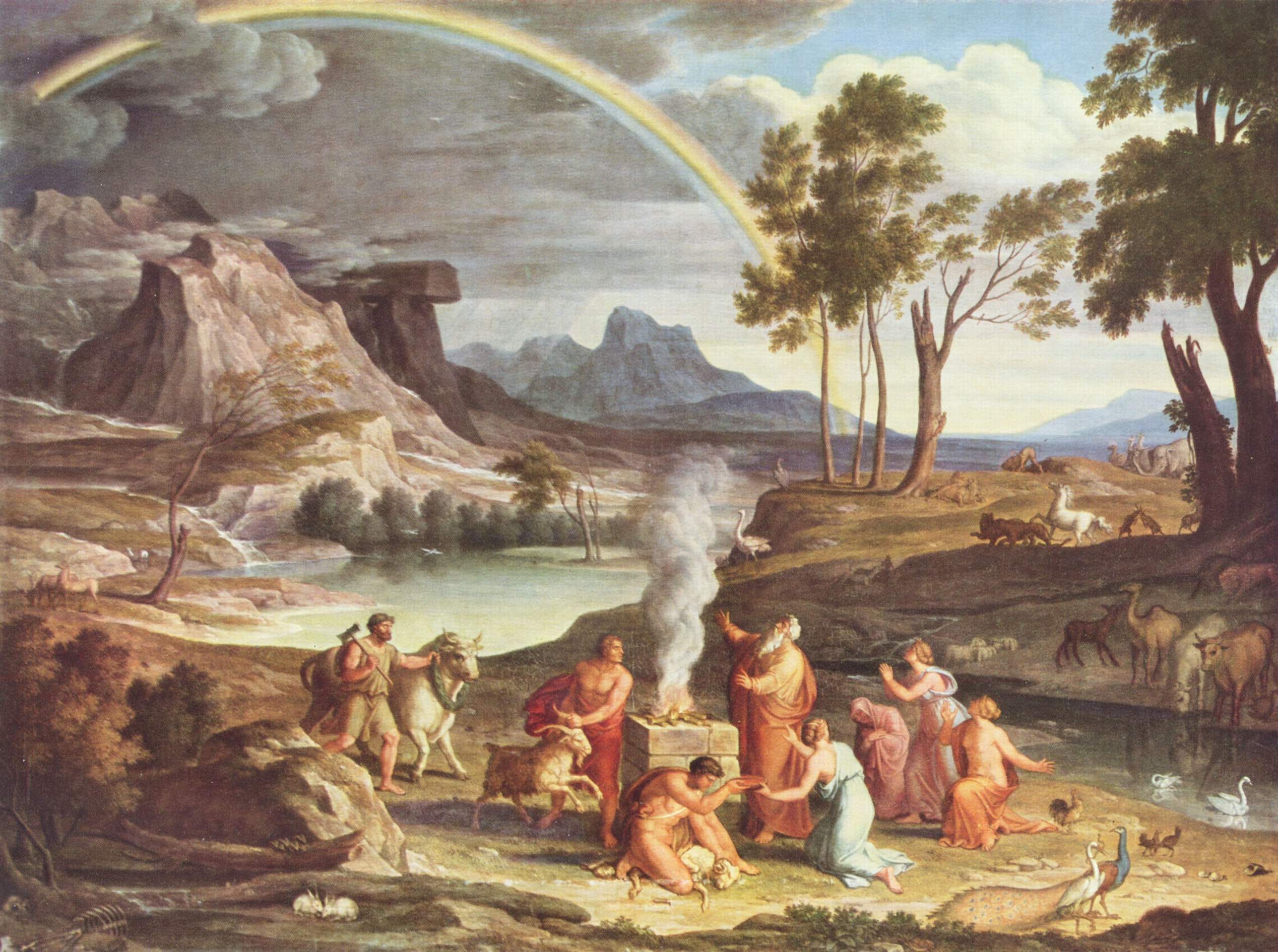
A rainbow is a beautiful sight.

Rainbows have inspired people for ages, spawning many myths and poems.

There are those who think that knowledge of how a rainbow works somehow destroys that beauty. Here are some lines from Keats' poem, "Lamia", lamenting Newton's insights into optics that let us see inside the workings of the rainbow:
Do not all charms fly
At the mere touch of cold philosophy?
There was an awful rainbow once in heaven:
We know her woof, her texture; she is given
In the dull catalogue of common things.
Philosophy will clip an Angel’s wings,
Conquer all mysteries by rule and line,
Empty the haunted air, and gnomed mine—-
Unweave a rainbow, as it erewhile made
The tender-person’d Lamia melt into a shade.
I can almost understand his sorrow - mystery is beautiful, and when knowledge expands, mystery seems to retreat.

But what a narrow view of the world, to think that more knowledge, more understanding, somehow robs the world of its mystery and its beauty. Let me relate a personal account.

It begins with a book, whose name is taken from the passage above. In Unweaving the Rainbow, Richard Dawkins shows not only the glory and delight of discovery that lies at the root of scientific pursuits. He gives us a glimpse of the deeper beauty revealed by those pursuits.

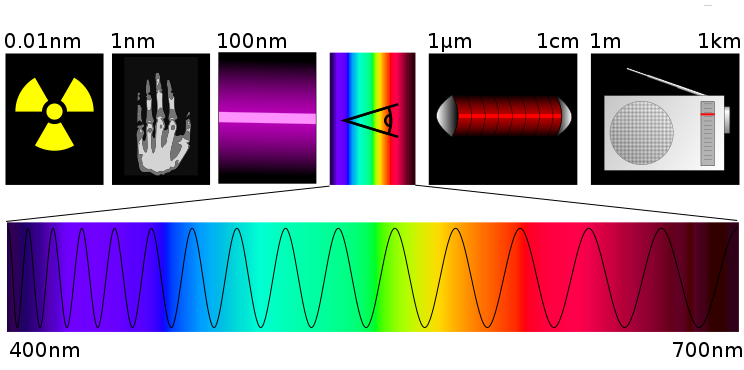
He reminds us (for example) that Newton's work on optics has been carried on. We now know that visible light - spanning the colours of the rainbow - is but a tiny slice of a great continuum. The electromagnetic spectrum extends off the red end of the rainbow into infrared and radio waves. Off the other end, we get ultraviolet, x-ray, and gamma waves.

The rainbow we see is only a fragment - the tiny slice of that greater spectrum, visible to our pragmatically-evolved eyes.

I was on a train, some weeks after reading Dawkins' thoughts. Looking out the window, I saw a rainbow, gliding along the nearby hills, keeping pace with us. It was soft and faint, as beautiful as the first rainbow I ever saw as a child.

But this time there was something more. As I stared at it, I thought of it not simply as a strip of colours, but as something greater and deeper - the full spectrum of light. Of course, I still didn't see those other colours. Knowledge had not altered my eyes at all. But it was as if I could almost feel them.

Like when you hear a loved one walk up behind you. All that you physically sense is the sound. But you know what they look like, how they walk, how they stand. How tall they are. How likely they are to tickle you if they get close enough. With the sound of their steps and their breathing, your mind calls up all of this knowledge, filling in the experience for you so that you can almost see the person behind you, almost feel their movements and expressions.

In just that way, I felt the invisible rainbow filling the sky outside my train - down to the centre of the arc and out as far as the sky went. It was magnificent. Such glory; such encompassing beauty.

Beauty that I would never have known if the rainbow had not been "unwoven".

Thankyou, Richard Dawkins, for helping me to see this. Thankyou to every scientist who gives us the chance to see the unseen, hear the unheard, touch the untouchable.

We are, and forever will be, surrounded by a sea of mystery. What delight to be able to reach into it, to see the wondrous glory that is only accessible by the tools of science - Keats' "cold philosophy". Cold? The thought of all the knowledge, all the enrichment of subjective experience that science can give us, warms my very being.

I wish I could show Keats the rainbow I now see, thanks to scientists like Newton. But I'll have to content myself by sharing it with you. May you feel the same exhilaration I feel at the sight of every rainbow!


Photo credits:

The rainbow images are from the Wikipedia article on rainbows. The first is public domain; the second is licenced under an Attribution ShareAlike Creative Commons licence by its creator, Eric Rolph.

The spectrum illustration is from the Wikipedia article on the electromagnetic spectrum. It is licenced under an Attribution ShareAlike Creative Commons licence by its creator, Tatoute.