Humanitie, the quarterly magazine of the Humanist Society of Scotland, has a new issue out. Once again, Mike and I present our rather different perspectives - this time, on the relationship between humanists and chaplaincy. Don't forget to read Mike's column over at his blog.
I was recently asked a question about the place of humanists in chaplaincy life. In a chaplaincy, even an inclusive multi-faith chaplaincy, most people are religious. To what extent is it worthwhile and appropriate for humanists and other non-religious people to seek a place in chaplaincy?
The answer is obvious to me. Clearly, though, some religious people and even many humanists don't see things as I do. So here is my take on it.
First, some background. Our university chaplaincy is very deliberately open to students and staff of "all faiths and none".
My earliest experience with the chaplaincy was when I was first learning and reading about humanism, and coming to realize that it reflected a deep part of my identity. I started looking for like-minded people, for a community to connect with. I had heard of the chaplaincy and its openness to people of no religion. I visited the chaplain and asked if she knew of any humanist groups at the university. She didn't, but she thought it would be wonderful if there were a group. She also pointed me to the Humanist Society of Scotland (HSS), which has an Edinburgh group.
There is a whole story following on from that - of attending an HSS philosophy book group, of meeting another humanist student, of forming a student group with him that has become far more active and successful than I expected - but for now let's look at that first move on my part. Why did I go to the chaplaincy in search of humanists?
First, there was my awareness that the chaplaincy branded itself as inclusive - they reach out not only to religious folks, but to folks like me. Second, for all that some humanists like to distance themselves from religious believers, there is a crucial feature that we share. Humanism is a framework for seeking meaning, for defining an ethical stance, and for sharing inspiration and expressing awe. For most religious people I've talked to, their religion does just the same: it provides meaning, defines ethics, and it is the lens through which inspiration and awe are experienced and shared. Also, perhaps even more importantly, both humanism and religions are identities around which human communities gather. So humanism is to me as religion is to religious folks. Even then, new as I was to humanism, I could see that.
So it seemed obvious that the chaplaincy - a place for religious folks to meet like-minded people, a place for people to go for spiritual counselling, and a place that explicitly included non-religious people in its remit - was the right place to look for humanist groups at the university.
And of course, that answers the question I opened with too. If chaplaincy is an obvious place for a lone humanist to go in search of kindred spirits, then chaplaincy is an obvious place for a humanist group to be connected with so that those lone humanists can find us.
Yes, there is the Internet. Yes, there are other avenues for us to find one another. But that's no reason to shut such an obvious means of connection. Besides, the sort of personal bond that people visiting the chaplaincy tend to seek is not something that can be transmitted through a computer screen.
Of course, there is more to the chaplaincy than just finding folks like yourself. There is also the inter-faith element*. The idea of people of different backgrounds coming together to discover common ground. And I think that's incredibly valuable. It's something that's lacking from a lot of the "culture war" discussions that get headlines. It's important that humanists are involved in that as well.
True, I may think that the other guy's god is imaginary. True, he may think that I'm destined for hell if I don't come to believe as he does. But equally true is the fact that we both value compassion. We both try to buy products whose production doesn't exploit the vulnerable. We both try to act in ways that will preserve the planet for the next generation. We both strongly believe in each other's right to believe as we will.
In my experience, there is no place like a multi-faith chaplaincy for bringing people of different backgrounds together and helping us to realize how much we share. Not just superficial stuff. Deep stuff. Important stuff.**
Stuff we can draw on to make the world a better place, together.
That's why humanists should be involved in chaplaincy, and in other inter-faith endeavours.
Footnotes (not included in the print version):
* Yes, I know, the term inter-faith is problematic for people like us, who consciously set ourselves apart from religious faith. It is also often used in a manner that really does exclude us. But until you can come up with a better term for a meeting of religious and non-religious worldviews, and show that other people will use and understand it, it's better than nothing.
** A Unitarian church may do the same, but I don't have enough experience at one yet to say for sure.
Showing posts with label religion. Show all posts
Showing posts with label religion. Show all posts
Friday, 18 December 2009


Friday, 20 November 2009
Christians against sectarianism
I wrote just the other day about the new humanist ad campaign - this time directed at combating sectarianism.
I'm delighted to report that the campaign is drawing support not only from other humanists, but also from religious people. The Evangelical Alliance has put out a press release in support of the ads' message:
Why don't we all help spread the word? Let's make it clear that this is an issue that can and does resonate with many segments of society, not just with the nonreligious.
I'm delighted to report that the campaign is drawing support not only from other humanists, but also from religious people. The Evangelical Alliance has put out a press release in support of the ads' message:
Justin Thacker, Head of Theology at the Evangelical Alliance said: "It is great to see that the Humanists are now agreeing that children have to make their own decisions about faith.Thanks to Dale for pointing out this welcome source of agreement with the humanist campaign. Like him, I was unable to find any mainstream media noting this support - only religious publications like Christianity Today and Ekklesia. Not to demean those publications - I simply mean to point out that, in the interest of controversy, the mainstream media has once again missed an important part of the story: they seem to have latched onto the frothing and uninformed reaction of a fundamentalist Irish minister, who doesn't seem to have read the ads, and certainly hasn't read the background information.
"Evangelicals do not believe that God has any grandchildren, only children. You are not a Christian simply because your parents are. Every child or adult has to make up their own minds about the reality of God.
Why don't we all help spread the word? Let's make it clear that this is an issue that can and does resonate with many segments of society, not just with the nonreligious.
Wednesday, 18 November 2009
Campaign against sectarianism
I recently shared some brief thoughts about sectarian education ("faith schools") in the UK. I've now learned of a follow-up to the hugely popular atheist bus campaign.
The British Humanist Association is launching the "Atheist Billboard Campaign". An interesting twist is that (contrary to what many kneejerk commentators are likely to declare), the billboards do not promote atheism at all.
 Accompanying a picture of two unbearably cute kids jumping joyfully (left) is the text:
"Please don't label me. Let me grow up and choose for myself."
Another version (right) says:
"No faith schools. Yes you can donate today."
Yes, I suppose "No faith schools" may sound, to some ears, like a promotion of atheism, or at least an attack on religion. It's not - and the campaign is clear in that it's against sectarianism, not against religion in general. However you feel about it, the idea appears to enjoy popular support. A poll by Accord reports that 57% of people in the UK feel that faith schools undermine community cohesion. A four-year-old poll reported in the Guardian reports '64% agreeing that "the government should not be funding faith schools of any kind".'
Now look at the text in the background of the ad (it's clearest in the big version, which I've included at the bottom of this post). Clearly among the labels that we should avoid (according to the ad) are "agnostic child", "atheist child", and "humanist child".
If you agree with this message - that children should not be labelled according to the beliefs of their parents, and that faith schools should not be publicly funded, go donate to the campaign here or here. If you disagree, or aren't sure, go learn more.
And, as always, please let me know what you think.

The British Humanist Association is launching the "Atheist Billboard Campaign". An interesting twist is that (contrary to what many kneejerk commentators are likely to declare), the billboards do not promote atheism at all.
 Accompanying a picture of two unbearably cute kids jumping joyfully (left) is the text:
"Please don't label me. Let me grow up and choose for myself."

Another version (right) says:
"No faith schools. Yes you can donate today."
Yes, I suppose "No faith schools" may sound, to some ears, like a promotion of atheism, or at least an attack on religion. It's not - and the campaign is clear in that it's against sectarianism, not against religion in general. However you feel about it, the idea appears to enjoy popular support. A poll by Accord reports that 57% of people in the UK feel that faith schools undermine community cohesion. A four-year-old poll reported in the Guardian reports '64% agreeing that "the government should not be funding faith schools of any kind".'
Now look at the text in the background of the ad (it's clearest in the big version, which I've included at the bottom of this post). Clearly among the labels that we should avoid (according to the ad) are "agnostic child", "atheist child", and "humanist child".
If you agree with this message - that children should not be labelled according to the beliefs of their parents, and that faith schools should not be publicly funded, go donate to the campaign here or here. If you disagree, or aren't sure, go learn more.
And, as always, please let me know what you think.

Tuesday, 6 October 2009
Entitled to our own opinions
From his book Looking in the Distance (pages 101-102), here is Richard Holloway on the intersection of religion and science (emphasis mine):
It is embarrassing when theologians try to conflate the Christian story with the current scientific narrative; and it is a mistake, however understandable, when scientists try to disprove the Christian story as though it were just another set of outdated scientific claims. The scientific attack on Christianity is excusable, however, because fundamentalist groups insist on marketing Christianity as a science rather than as myth. While we are all entitled to our own opinions, we are not entitled to our own facts, which is why scientists cannot avoid getting drawn into the quagmire of the science versus religion debate.That last sentence contains the real money quote for me here:
While we are all entitled to our own opinions, we are not entitled to our own facts.This is why scientists and fans of science get so het up when people deny things like the well-established and exhaustively-tested effectiveness and safety of vaccines, or the copious and consistent evidence for evolution.
Friday, 2 October 2009
Atheists and Unitarians

 I am an atheist.
I am also a member of a Unitarian congregation.*
So when this news item showed up in my blog reader (courtesy of Friendly Atheist), I immediately felt torn in two directions.
Briefly, the denominational magazine of the international Unitarian Universalist Association (UUA), Unitarian Universalist World, ran an ad for the Freedom From Religion Foundation (FFRF). The ad was meant to encourage UUA members - many of whom are atheists and most of whom would likely support the FFRF's main purpose of separation of church and state - to join FFRF and support its work.
 However, the content of the ad (reproduced at left courtesy of Daylight Atheism or here in PDF) contained several quotes hostile to religion from famous atheists.
Some UUA members complained that this was an inappropriate ad to run in a publication for people who overwhelmingly consider themselves to be religious. The editor issued an apology, saying that he probably should have run an ad more tailored to this particular audience. (Note, however, as Hemant pointed out in a follow-up post here, that there were in fact only 8 complaints from UUA members, and several comments of support. Also, the FFRF has gained some supporters through the ad.)
So, on the one side, we have some affronted UUA members. I sympathise. After all, despite what some thin-skinned atheists (including, to my surprise, Hemant himself) are claiming, the ads do attack religious belief. Here are a couple of the quotes:
As my ancestors are free from slavery, I am free from the slavery of religion. (Butterfly McQueen)So, religion is equated to slavery, and faith to willing self-deception. Whether you think it's true or not, that's insulting to religious people. It is not simply an assertion of the positive value of atheism.
Faith is believing what you know ain't so. (Mark Twain)
On the other side, though, organized atheists often have a hard time getting their voice into the public sphere. Public ad campaigns on billboards and buses have often been rejected for being too controversial, even when carrying a very simple statement of non-belief. ("Don't believe in God? You're not alone.") Despite the success of recent books promoting atheism, it can still be an uphill battle to get people to even listen to us.
In the end, though, I have to side with Greta Christina. In this thoughtful and calm article dissenting from the kneejerk atheist position, she points out that no private organization is under a legal or moral obligation to give voice to opinions that they object to.
Don't forget: in his apology, the editor did not say "We should never have considered an ad from an organisation like the FFRF." He said (emphasis mine):
I have come to the conclusion that it was a mistake to run this particular ad. While the stated mission of the Freedom From Religion Foundation is entirely consistent with UU values, this ad seems hostile to all religion. To be more specific, I believe that I failed to help the advertiser match their message to our readers. An ad spotlighting FFRF’s purpose of “working for the separation of state and church” would have been more appropriate than one that for many appears to be condemning religion in general.There seems to be a tendency among some atheists to equate "You should express your dissent from religion in a less antagonistic manner" with "You should shut up and leave religion alone." Sure, there are some people who think we should shut up. But the Unitarians are certainly not among them, and this incident does nothing to suggest they are. (Remember: they did run the ad!)
On a different tack, Ebonmuse at Daylight Atheism (who also has a Unitarian connection) discusses the problems that arise from the use of the term "religion" to describe Unitarians. They do not share either dogma or supernatural beliefs - two features that are pretty much universal among religions as we're used to thinking of them. So when FFRF and others make a comment about "religion", it's fairly likely that it isn't meant to apply to folks like the Unitarians.
I disagree with Ebonmuse's speculation that this was a "marketing decision". Unitarianism has developed from a clearly, specifically Christian denomination into what it is today without a clear break in the continuity of the community. There is no obvious time in their history where it makes sense to say, "before this, Unitarians were religious; ever since, they have been non-religious". In other words, it is a historical accident that an essentially non-religious community describes itself as "religious". Nevertheless, as Ebonmuse says, Unitarians stand out as exceptional among religious communities (alongside liberal Quakers, some western Buddhists, and secular Jews) in that they share few of the qualities that tend to identify a group as religious.
Having said that, it would be sensible for anyone advertising in a church publication to know something about how church members see themselves, and to adjust their ad accordingly, regardless of how unusual their definitions are. The purpose of an ad should be to attract interest, and offense rarely manifests as a willingness to support the offender.
I'll close by sharing Greta Christina's words. "We have to not be reflexive cheerleaders for people who are on our side. We have to judge these questions, not by choosing sides between atheists and non-atheists, but on the basis of the ethical principles involved. ... [T]he atheists aren't always going to be right."
Amen.
Footnotes:
* I will use "Unitarian" because that is how our congregation identifies itself. I know that many people who fall under the UUA umbrella prefer "Unitarian Universalist", but unless I'm talking specifically about such an individual I'll default to the shorter term.
Saturday, 26 September 2009
Defending Dawkins
I recently came across Bettynoirbettyblanc's blog, and this post in particular, where she discusses her problem with Richard Dawkins. I was composing a response to post in the discussion, but it grew into something a little long for a comment. Here it is, with relevant excerpts from her post.
In the post, Betty discusses her take on Richard Dawkins - a man who, for good or ill, is the first person people think of when atheism is mentioned in Britain, especially in connection with evolution. I encourage you to read what she writes before continuing here, as I will not cover all of what she says, nor present her thoughts in the order she does.
For someone in Dawkins' position - someone who has spent his life working to learn more about our biological origins - it is certainly understandable that he will view creationists as the enemy. He feels passionately about his work. Every one of his books that I have read (even, at times, The God Delusion) bursts with enthusiasm about what we, as a species, have learned about our origins through dogged scientific effort. He has committed his life to this pursuit. He has submitted himself to the scientific community, which tends to be ruthless in its attempts to disprove new ideas, and which only accepts them after repeated failures to disprove them. (One prominent example is the idea introduced in the mid-19th-century that the diversity of species is due to the accumulation of small changes accumulated over time and channelled by natural selection.)
Not only that, but for much of Dawkins' career he has also engaged in the admirable task of sharing this wonder and these discoveries with the public, in his very readable and accessible books of science.
Creationists belittle not only Dawkins' work, but the careful work of hundreds (thousands?) of scientists leading back to Darwin. They belittle it without any good arguments, without any good evidence, and usually with a complete failure to grasp the evidence they're trying to refute.
They are not interested in submitting themselves to the rigours of science. They are not interested in letting the evidence rule on which answer is right. Their actions suggest that they are only interested in convincing everyone that the scientists are wrong (and/or evil) and that we should set science aside in favour of their ideological commitment to a disproven belief. (I'm referring there to young-earth creationism and ID, not religion in general.)
On the other side of the issue, I have read creationist apologists like Lee Strobel and John Blanchard argue for an evolution-denying ideology. They consistently fail to accurately represent the case for evolution, and then inexpertly demolish the straw men they have invented. (I've discussed Blanchard's attempt here. Strobel is being taken apart in exquisite detail by Ebonmuse here.)
So, the supporters of evolution rely on the evidence, occasionally spending some time pointing out the flaws in the deniers' arguments. The deniers of evolution paint caricatures of the evidence, attack the caricatures, and pretend that they're doing science too. They don't do real science: they don't make falsifiable predictions, and they certainly don't do experiments to test them.
When I read Dawkins, I can trust that most of what he says about science is based on the scientific method. He's reporting conclusions that have been carefully tested, which qualified people have tried and failed to disprove. I take what he says at face value because I trust the procedure that has been followed to arrive at those conclusions. When I look further, the people who are qualified to understand the evidence all tend to agree with him.
On the other hand, he clearly isn't speaking as a scientist in many of his comments about religion, and so I don't take them at face value. In fact, I often disagree with him, vocally, in settings where that sets me apart (ie, among other humanists). I'm not treated as stupid for questioning because my humanist acquaintances - like Dawkins, like most atheists and humanists - value questioning. We believe that any claim should be open to question, no matter how popular it is. If the question has nothing to back it up - no evidence to motivate a shift in our beliefs, then we set it aside. But if the questioner has a sound reason for dissenting from popular opinion and solid evidence to back up their dissent, then that dissent spreads.
It was that sort of questioning that led to Darwin's great breakthroughs. It is that sort of questioning that has led to every refinement and revision in the theory of evolution since then. It is that sort of questioning that has driven science for the past few centuries, with countless concrete benefits as proof of the process.
And, although religion is not uniformly anti-knowledge or anti-progress, the opponents of science have almost uniformly been religious.
Recent centuries and decades have seen a dramatic reduction in institutional discrimination against the non-religious. Keep in mind, however, that "victimhood" is not always an inappropriate feeling. Sometimes you are a victim, and you need to be aware of it. Some laws favouring religious over non-religious belief still remain, even in the enlightened West (even in uber-secular Finland). Dawkins is a scientist, and as Betty says, 40% of Americans deny the evidence that is at the foundation of his field. To the extent that they try to challenge the teaching of that science in schools, and seek to warp people's perceptions of it in universities (for example, see this development), there is a concerted attack on precisely the field of knowledge Dawkins has devoted his life to. It's worth noticing and acknowledging that scientists (and everyone who benefits from their work) are victims of the creationists' campaign of science-denial. That way we can do something constructive to counter it.
I really don't like my first mention of such an apparently pleasant person as Betty to come off so negative and critical. (I enjoyed this post of hers, and this one.) I hope that I have made it clear that Dawkins has by no means a free pass to my credulity, particularly when he talks about religion. Whether that helps encourage her to look deeper into the whole evolution/creation thing is up to her.
I hope Betty will respond to what I've said, either in the comments here or on her own blog post (where I'll point her to this post). And of course, anyone else who agrees or disagrees with either of us is invited to comment too.
* From the same list of publications, using just the titles as a guide, I count no more than 8 of 16 popular articles dealing with religion (at least 11 of the 16 have a scientific slant), and only 3 of 30 academic articles can plausibly be said to be about religion, the remainder being biological. So, out of 56 items listed, no more than 12, or about 21%, are about religion - most of these being popular articles. At least 48, or about 86%, deal primarily or exclusively with science. (Totals exceed 100% because some articles seem to deal with both science and religion. Also note that I think one or two articles appear both in the scientific and the popular list.) Readers can decide whether this amounts to a "dogged obsession with religion". Perhaps the dogged obsession belongs to those apologists who wish to diminish his influence, Dawkins being a well-known and widely-respected public figure.
In the post, Betty discusses her take on Richard Dawkins - a man who, for good or ill, is the first person people think of when atheism is mentioned in Britain, especially in connection with evolution. I encourage you to read what she writes before continuing here, as I will not cover all of what she says, nor present her thoughts in the order she does.
Why do I find him interesting? I just wonder about his dogged obsession with religion and with those that practice it. He is a scientist and yet he seems to spend [much] of his time trying to argue that following a religion is at best ridiculous and at worst positively harmful. I just don’t understand why.I've read several of Dawkins' books, and I think that this misrepresents him. While I think his tone regarding religion is not particularly helpful, it's worth noting that of the ten popular books he has written, only one is about religion (yes, it's The God Delusion).* Not exactly a dogged obsession. More of an unavoidable side-note for someone in his field who wishes to engage the public.
A whopping 40% of Americans are creationists and Dawkins compares them to holocaust deniers. This is highly offensive. A holocaust denier is someone who twists the facts of the historical record in order to bolster a racist agenda. These people are motivated by their hatred of Jews. The facts do not matter. For a creationist, evolution has not been proven beyond reasonable doubt. There are questions about the theory that they believe have not been adequately answered. They believe the story of creation not in order to further a hate campaign, but as part of a belief system.While I wouldn't personally choose to compare evolution-deniers to Holocaust-deniers, I understand Dawkins' choice of such an analogy. First, it is accurate inasmuch as both holocaust-deniers and evolution-deniers reject the overwhelming preponderance of evidence in favour of a position that is based entirely on ideology. As Betty says, they "twist the facts of the historical record in order to bolster an agenda. ... The facts do not matter." At least that part applies equally well to both sorts of deniers.
For someone in Dawkins' position - someone who has spent his life working to learn more about our biological origins - it is certainly understandable that he will view creationists as the enemy. He feels passionately about his work. Every one of his books that I have read (even, at times, The God Delusion) bursts with enthusiasm about what we, as a species, have learned about our origins through dogged scientific effort. He has committed his life to this pursuit. He has submitted himself to the scientific community, which tends to be ruthless in its attempts to disprove new ideas, and which only accepts them after repeated failures to disprove them. (One prominent example is the idea introduced in the mid-19th-century that the diversity of species is due to the accumulation of small changes accumulated over time and channelled by natural selection.)
Not only that, but for much of Dawkins' career he has also engaged in the admirable task of sharing this wonder and these discoveries with the public, in his very readable and accessible books of science.
Creationists belittle not only Dawkins' work, but the careful work of hundreds (thousands?) of scientists leading back to Darwin. They belittle it without any good arguments, without any good evidence, and usually with a complete failure to grasp the evidence they're trying to refute.
They are not interested in submitting themselves to the rigours of science. They are not interested in letting the evidence rule on which answer is right. Their actions suggest that they are only interested in convincing everyone that the scientists are wrong (and/or evil) and that we should set science aside in favour of their ideological commitment to a disproven belief. (I'm referring there to young-earth creationism and ID, not religion in general.)
Either he wants people to know about evolution and to ‘convert’ the creationists or he just wants a nice argument to bolster his book sales. I think if it was the former then he would be wise to act in a more conciliatory manner, and watch his language (ie the use of the word ‘ignorant’, I would also like to point out at this point that some of the people I know who are most knowledgeable about evolution are in fact creationists).While it may not be nice of him to call evolution-deniers "ignorant", it is difficult to see how the term is wrong. The only way to confidently proclaim evolution false is to set aside (deliberately or in ignorance) the entire geological, molecular, geographical, and experimental bodies of evidence that support evolution. Though I'm sure most creationists' motivation for this is simply to carry on believing what they wish to believe, not to promote hate (has Dawkins or anyone else ever claimed that?), that doesn't change the facts. One has to remain ignorant (ie, not knowing of or understanding the evidence) to honestly deny evolution. (I can't say much about the claim that "some of the people [Betty knows] who are most knowledgeable about evolution are in fact creationists". Would they seem knowledgeable to a biologist, or only to someone like Betty who confesses little understanding of or interest in the science behind this "debate"?)
I can’t verify much of what he says because I don’t have access to the research or fully understand the terms and the processes involved. It’s been a long time since I did higher biology and chemistry! I suspect that for most of his vociferous cheerleaders on websites and forums across the globe, this is also the case. Perhaps they don’t wish to seem stupid for questioning?Is that a rhetorical question, "who knows?" Because there's an obvious answer. The actual biologists (ie, people who dedicate their lives to understanding this stuff) know. And a good number of them have produced books that Betty and I and any of our readers can understand. These outreach biologists (Dawkins, Gould, Wilson, etc) don't make arguments of the form "I believe this, and I'm and expert so just take my word for it." They make arguments of the form "Here's some evidence. Here's why it supports evolution." With plenty of references to original research so that you can independently verify their claims if you don't trust them.
In this respect, I find his followers similar to those of religious faiths. They are taking what he says at face value because they believe in him. They may well be correct – I don’t know. The argument seems reasonable, but who knows?
On the other side of the issue, I have read creationist apologists like Lee Strobel and John Blanchard argue for an evolution-denying ideology. They consistently fail to accurately represent the case for evolution, and then inexpertly demolish the straw men they have invented. (I've discussed Blanchard's attempt here. Strobel is being taken apart in exquisite detail by Ebonmuse here.)
So, the supporters of evolution rely on the evidence, occasionally spending some time pointing out the flaws in the deniers' arguments. The deniers of evolution paint caricatures of the evidence, attack the caricatures, and pretend that they're doing science too. They don't do real science: they don't make falsifiable predictions, and they certainly don't do experiments to test them.
When I read Dawkins, I can trust that most of what he says about science is based on the scientific method. He's reporting conclusions that have been carefully tested, which qualified people have tried and failed to disprove. I take what he says at face value because I trust the procedure that has been followed to arrive at those conclusions. When I look further, the people who are qualified to understand the evidence all tend to agree with him.
On the other hand, he clearly isn't speaking as a scientist in many of his comments about religion, and so I don't take them at face value. In fact, I often disagree with him, vocally, in settings where that sets me apart (ie, among other humanists). I'm not treated as stupid for questioning because my humanist acquaintances - like Dawkins, like most atheists and humanists - value questioning. We believe that any claim should be open to question, no matter how popular it is. If the question has nothing to back it up - no evidence to motivate a shift in our beliefs, then we set it aside. But if the questioner has a sound reason for dissenting from popular opinion and solid evidence to back up their dissent, then that dissent spreads.
It was that sort of questioning that led to Darwin's great breakthroughs. It is that sort of questioning that has led to every refinement and revision in the theory of evolution since then. It is that sort of questioning that has driven science for the past few centuries, with countless concrete benefits as proof of the process.
And, although religion is not uniformly anti-knowledge or anti-progress, the opponents of science have almost uniformly been religious.
Worse, I believe his words convert more people to fundamentalist ideas than anything else as they engender a sense of victimhood and persecution amongst those who don’t agree with what he says.I would object to the use of the term "fundamentalist" here, as it seems completely divorced from any useful definition I've come across. But yes, to the extent that he overstates the religious antipathy to science, and exaggerates the incompatibility of science and religion, he does encourage an unhelpful us-versus-them mentality among atheists, and it's one that I try to combat where I can. There are many, many religious believers who have nothing wrong with atheists or with evolution. Many of them are acquaintances and friends of mine.
Recent centuries and decades have seen a dramatic reduction in institutional discrimination against the non-religious. Keep in mind, however, that "victimhood" is not always an inappropriate feeling. Sometimes you are a victim, and you need to be aware of it. Some laws favouring religious over non-religious belief still remain, even in the enlightened West (even in uber-secular Finland). Dawkins is a scientist, and as Betty says, 40% of Americans deny the evidence that is at the foundation of his field. To the extent that they try to challenge the teaching of that science in schools, and seek to warp people's perceptions of it in universities (for example, see this development), there is a concerted attack on precisely the field of knowledge Dawkins has devoted his life to. It's worth noticing and acknowledging that scientists (and everyone who benefits from their work) are victims of the creationists' campaign of science-denial. That way we can do something constructive to counter it.
I really don't like my first mention of such an apparently pleasant person as Betty to come off so negative and critical. (I enjoyed this post of hers, and this one.) I hope that I have made it clear that Dawkins has by no means a free pass to my credulity, particularly when he talks about religion. Whether that helps encourage her to look deeper into the whole evolution/creation thing is up to her.
I hope Betty will respond to what I've said, either in the comments here or on her own blog post (where I'll point her to this post). And of course, anyone else who agrees or disagrees with either of us is invited to comment too.
-----
* From the same list of publications, using just the titles as a guide, I count no more than 8 of 16 popular articles dealing with religion (at least 11 of the 16 have a scientific slant), and only 3 of 30 academic articles can plausibly be said to be about religion, the remainder being biological. So, out of 56 items listed, no more than 12, or about 21%, are about religion - most of these being popular articles. At least 48, or about 86%, deal primarily or exclusively with science. (Totals exceed 100% because some articles seem to deal with both science and religion. Also note that I think one or two articles appear both in the scientific and the popular list.) Readers can decide whether this amounts to a "dogged obsession with religion". Perhaps the dogged obsession belongs to those apologists who wish to diminish his influence, Dawkins being a well-known and widely-respected public figure.
Thursday, 24 September 2009
Defending Christians
From the Friendly Atheist, I have learned that there is a couple in Liverpool facing criminal charges for saying things that hurt the feelings of a Muslim woman who was staying at their hotel.
According to the Telegraph,
The couple now face fines up up to £2500 each and a criminal record under Section 5 of the Public Order Act (causing harassment, alarm or distress).
Now, I generally don't trust the press's ability (or inclination) to accurately portray events such as these. However, if we assume for the moment that the Telegraph isn't distorting the facts, then this is an abominable application of a (probably) bad law. Sure, statements like those reported above aren't particularly pleasant. But illegal?
According to the paper, the statements were made during a conversation the woman was participating in. She wasn't being harassed; she wasn't being bullied or proselytized. She was engaging in a conversation about her religious beliefs with people who didn't share them. Certainly she should have been prepared for challenging statements?
Anyway, we'll keep an eye on how this pans out. I'd really like to think that this country can learn to set aside or amend bad laws whose only function is to censor honest opinions which harm nobody.
According to the Telegraph,
Among the things Mr Vogelenzang, 53, is alleged to have said is that Mohammad was a warlord. His wife, 54, is said to have stated that Muslim dress is a form of bondage for women.
The couple now face fines up up to £2500 each and a criminal record under Section 5 of the Public Order Act (causing harassment, alarm or distress).
Now, I generally don't trust the press's ability (or inclination) to accurately portray events such as these. However, if we assume for the moment that the Telegraph isn't distorting the facts, then this is an abominable application of a (probably) bad law. Sure, statements like those reported above aren't particularly pleasant. But illegal?
According to the paper, the statements were made during a conversation the woman was participating in. She wasn't being harassed; she wasn't being bullied or proselytized. She was engaging in a conversation about her religious beliefs with people who didn't share them. Certainly she should have been prepared for challenging statements?
Anyway, we'll keep an eye on how this pans out. I'd really like to think that this country can learn to set aside or amend bad laws whose only function is to censor honest opinions which harm nobody.
Monday, 21 September 2009
Blasphemy law in Finland!
Helsinki city councillor Jussi Halla-aho has been fined 330 Euros for a blog post [in Finnish, English translation here] in which he criticised the Muslim prophet Mohammed for being a paedophile. While I don't particularly like his tone, it worries me that his prosecution was under an anti-blasphemy law. As far as I can tell, blasphemy tends to mean "someone claims offense due to their religious beliefs". And hurt feelings - even really hurt feelings - are never a good excuse to limit free speech. To anyone who supports blasphemy laws, let me suggest that you look for alternative ways to deal with the matter. Ways that don't involve trampling other people's rights.
Thanks to Friendly Atheist for bringing this item to my attention.
Thanks to Friendly Atheist for bringing this item to my attention.
Friday, 28 August 2009
Religious rights: free speech and hate speech
 A couple of news items flagged up by Hemant, the Friendly Atheist, the other day have me thinking about "religious freedom". What should the relationship be between laws protecting freedom of religion and the rest of the laws in a society?
One is this report of a bus driver in Iowa refusing to drive a bus with an ad on it promoting a local atheist group. The message on the ad is: "Don't believe in God? You are not alone.", and includes the group's name (Iowa Atheists and Freethinkers) and their URL (iowaatheists.org). The bus driver was suspended for refusing to do her job. She's now back at work, but the issue is probably not over. Her employers said she can keep her job so long as she doesn't do it again; she says that if she's given another bus with the ad, she will again refuse to drive it.
The other is this story (which I could only find reported at the Telegraph) of street preachers John and Miguel Hayworth being told off by police for allegedly reading homophobic and racist passages from the Bible to passersby. They feel that their right to religious practice is being infringed. Others feel that their actions amount to hate speech.
In the case of the bus driver, I really don't think there's much room for reasonable dissent. The ad is in no way inflammatory. It doesn't say anything that could reasonably be considered offensive. It is even milder than the surprisingly controversial UK bus ads, which go so far as to say that "There's probably no god". I can't see how the driver could argue that driving the bus would violate any sensible ethic. Her reaction reflects a general tendency among humans to exaggerate the offensiveness of statements they disagree with.
The case of the street preachers raises a more interesting and difficult issue to resolve. On the one hand, free speech is a fundamentally important right. It supersedes people's desire not to be offended (for example, by inflammatory passages of scripture). On the other hand, incitement to violence is dangerous and should be prevented - if someone is actively promoting hatred and violence against a group, then society (through the police and the courts) is right to stop them.
So the question is, where is the line between protected free speech and prohibited hate speech? As Hemant points out, there are several passages in the Bible that simply and straightforwardly promote death for certain acts. Here are a couple of examples:
Exodus 22:18 "Thou shalt not suffer a witch to live."(For more examples, see this essay at Religious Tolerance.)
Leviticus 20:13 "If a man lies with a man as one lies with a woman, both of them have done what is detestable. They must be put to death; their blood will be on their own heads."
I'm not saying these verses in particular were used by the Hayworths - they are not among those mentioned in the Telegraph article. But they are from the Bible, and thus might be claimed as protected by religious evangelists.
If someone were to stand on the Royal Mile in the centre of Edinburgh and start saying we should kill all the Wiccans, or all the practicing homosexual men, that person would (I hope) be arrested. Nobody has a right to encourage violence like that.
And yet, the passages I mention above say exactly that: kill witches; kill men who have sex with men.
So here are the crucial questions:
Would it ameliorate the crime at all if the exhortation to violence is based on (or directly read from) a religious text? Should religious expression trump hate speech laws?
On both counts, my answer is a firm no. No idea deserves any special protection just because someone claims it as a religious idea, no matter how old or widespread the idea is.
Despite occasional cries to the contrary, applying the same rules to everyone regardless of their religious beliefs is not discrimination. It is the opposite. Discrimination would be applying different rules (extending either privilege or persecution) based solely on religious belief (or lack of it).
So, if the Hayworths were reciting passages that promote hatred and violence against others, then police interference was justified. If they were just reciting passages that are offensive to others' feelings (and there are plenty to choose from), then they should have been allowed to continue.
(A point of curiosity: I wonder if the Hayworths would defend the atheist bus ads? After all, they are at least as innocuous a form of expression as reciting scripture to passersby. Conservative religious people seem often to be not only the ones crying foul when they don't have all the religious privileges they would like; they also seem to be the most vocal critics of atheists who try to share their worldview with others.)
Tuesday, 18 August 2009
Does Blanchard understand other religions? (4 of 5)
This is the fourth part in a series discussing John Blanchard's book, Does God Believe in Atheists? In this post, I discuss his presentation of religious beliefs which differ from his own. The previous posts are here, here, and here.
This entry in the series is very short. There are two reasons for this. One is that Blanchard himself doesn't spend much time on the topic. The other is that not much needs to be said in response (from the humanist perspective at least - I imagine the Mormons or the Muslims might have more to say).
Blanchard spends very little time outlining the beliefs and practices of a number of non-Christian religions, as well as some Christian sects that he considers "atheistic" (remember his "everyone else" definition of atheism).
On the one hand, I tend to agree with him that there is very little reason to accept any of these religious beliefs as true. On the other hand, from what little I know of Mormonism and Islam (two of the groups on his list that I've had some contact with), he's not terribly careful about presenting the beliefs as the believers understand them. (Sound familiar?)
It is illuminating to see other religions through Blanchard's eyes. To him, their faults can be summed up as "not like what I believe".
Which may illuminate why he defined atheists as "everyone else" to begin with. He's not interested in how I, or my Mormon neighbours, or my Muslim neighbours, see the world. He's interested in reinforcing his us-versus-them idea of Christianity.
This entry in the series is very short. There are two reasons for this. One is that Blanchard himself doesn't spend much time on the topic. The other is that not much needs to be said in response (from the humanist perspective at least - I imagine the Mormons or the Muslims might have more to say).
Blanchard spends very little time outlining the beliefs and practices of a number of non-Christian religions, as well as some Christian sects that he considers "atheistic" (remember his "everyone else" definition of atheism).
On the one hand, I tend to agree with him that there is very little reason to accept any of these religious beliefs as true. On the other hand, from what little I know of Mormonism and Islam (two of the groups on his list that I've had some contact with), he's not terribly careful about presenting the beliefs as the believers understand them. (Sound familiar?)
It is illuminating to see other religions through Blanchard's eyes. To him, their faults can be summed up as "not like what I believe".
Which may illuminate why he defined atheists as "everyone else" to begin with. He's not interested in how I, or my Mormon neighbours, or my Muslim neighbours, see the world. He's interested in reinforcing his us-versus-them idea of Christianity.
Thursday, 6 August 2009
Competing religious liberties
This is further to a post from a few weeks back about a petition to expand religious freedom regarding civil partnerships.
Civil partnerships are the closest thing same-sex couples in the UK have to marriage. Religious organizations are not allowed to perform civil partnerships in the UK. Several religious communities, including the Unitarians that I heard it through, would like to perform these ceremonies, and feel that it is an arbitrary restriction on their freedom of conscience not to allow them to do so. I completely agree, and support them in their effort to reform the law.
Some weeks later, I was chatting with a conservative Christian friend of mine, and this topic came up. I thought this was a straightforward issue - nobody could reasonably oppose the petition, even if they didn't want to support it.
My friend put an interesting argument for the other side, though. She said that, if religious groups are allowed to perform these ceremonies, equality legislation regarding the provision of services to people regardless of sexual orientation might lead to churches being forced to perform civil partnership ceremonies. Otherwise, they'd be up for human-rights violations for unfairly discriminating on the basis of sexual orientation. This, she said, would unfairly impose on their freedom of conscience.
I actually agree - such an eventuality would be unjust in much the same way that the current situation is unjust: it would prevent people from exercising their freedom of conscience.
Now, the obvious (not just to me) solution to the whole mess is to separate state marriage from church marriage entirely. If you want government recognition of your marriage, you would register it at a government office. No church ceremony would have any legal weight, and therefore churches could be put under no obligation to perform services that their consciences object to. Her church would be safe from discrimination. The Unitarians and other liberal churches would be free to treat same-sex unions the same as opposite-sex unions. Everybody would be happy.
But of course, the complete disentangling of church and state, especially in Britain, especially for marriage, would be a difficult task. (A worthy task, I think, but a difficult one.)
So we seem to be left with the choice about whose freedom of conscience to protect - the liberals' or the conservatives'? (Put more personally, is it my freedom of conscience, or my friend's, that gets violated?)
But that's not really the choice before us. It's a choice between a real and present restriction on the liberal churches' freedom on the one hand, and a hypothetical and avoidable restriction on the conservative churches' freedom on the other. The liberal churches are currently currently unable to treat same-sex couples as equal to opposite-sex couples, and this deeply offends their moral sensibilities. The conservative churches are not forced to do anything. The only way they would be is if legislators made the law more equal without including protection for freedom of conscience. I seriously doubt that they would overlook such a detail, given the undeniably strong political force wielded by the religious lobby. Not only that, but many others (such as me) would object to conservative churches being forced to marry couples they don't want to - be they of the same-sex, of different religions, of different races - whatever.
So again, I'm back to my original position. The ideal solution would be to keep church ceremonies completely separate from state-recognized marriage. This isn't a radical idea - even Mexico, with a largely religious population, does it. In Britain, the solution more likely to be worked out in the short term is to remove the prohibition on churches performing same-sex marriages, while maintaining the important freedom of conscience that would allow conservative churches to continue discriminating in this area.
Civil partnerships are the closest thing same-sex couples in the UK have to marriage. Religious organizations are not allowed to perform civil partnerships in the UK. Several religious communities, including the Unitarians that I heard it through, would like to perform these ceremonies, and feel that it is an arbitrary restriction on their freedom of conscience not to allow them to do so. I completely agree, and support them in their effort to reform the law.
Some weeks later, I was chatting with a conservative Christian friend of mine, and this topic came up. I thought this was a straightforward issue - nobody could reasonably oppose the petition, even if they didn't want to support it.
My friend put an interesting argument for the other side, though. She said that, if religious groups are allowed to perform these ceremonies, equality legislation regarding the provision of services to people regardless of sexual orientation might lead to churches being forced to perform civil partnership ceremonies. Otherwise, they'd be up for human-rights violations for unfairly discriminating on the basis of sexual orientation. This, she said, would unfairly impose on their freedom of conscience.
I actually agree - such an eventuality would be unjust in much the same way that the current situation is unjust: it would prevent people from exercising their freedom of conscience.
Now, the obvious (not just to me) solution to the whole mess is to separate state marriage from church marriage entirely. If you want government recognition of your marriage, you would register it at a government office. No church ceremony would have any legal weight, and therefore churches could be put under no obligation to perform services that their consciences object to. Her church would be safe from discrimination. The Unitarians and other liberal churches would be free to treat same-sex unions the same as opposite-sex unions. Everybody would be happy.
But of course, the complete disentangling of church and state, especially in Britain, especially for marriage, would be a difficult task. (A worthy task, I think, but a difficult one.)
So we seem to be left with the choice about whose freedom of conscience to protect - the liberals' or the conservatives'? (Put more personally, is it my freedom of conscience, or my friend's, that gets violated?)
But that's not really the choice before us. It's a choice between a real and present restriction on the liberal churches' freedom on the one hand, and a hypothetical and avoidable restriction on the conservative churches' freedom on the other. The liberal churches are currently currently unable to treat same-sex couples as equal to opposite-sex couples, and this deeply offends their moral sensibilities. The conservative churches are not forced to do anything. The only way they would be is if legislators made the law more equal without including protection for freedom of conscience. I seriously doubt that they would overlook such a detail, given the undeniably strong political force wielded by the religious lobby. Not only that, but many others (such as me) would object to conservative churches being forced to marry couples they don't want to - be they of the same-sex, of different religions, of different races - whatever.
So again, I'm back to my original position. The ideal solution would be to keep church ceremonies completely separate from state-recognized marriage. This isn't a radical idea - even Mexico, with a largely religious population, does it. In Britain, the solution more likely to be worked out in the short term is to remove the prohibition on churches performing same-sex marriages, while maintaining the important freedom of conscience that would allow conservative churches to continue discriminating in this area.
Tuesday, 21 July 2009
Pagan police
 According to the BBC, "Pagan police officers in some areas are being allowed to take as many as eight days leave a year for events such as the summer solstice and Halloween."
At first blush, this seems obvious and uncontroversial. Pagan officers are being given similar rights to officers who profess other religious beliefs. Whatever one might think of the beliefs themselves, those who hold them deserve the same rights as anyone else.
But two very different sources have an alternative take on it.
On the one hand, National Secular Society president Terry Sanderson says, "The police should call a stop to this and dismantle all religious groups," according to the Metro. (I was unable to confirm this on the NSS's own website. All they seem to have is this rather neutral description of the news item.) [Edit: An anonymous commenter has given a link to the NSS page with this quote.]
Expressing his support for the NSS position is Christian blogger Cranmer:
Cranmer is all for freedom of religion: it is foundational to liberal democracy. But Her Majesty’s Police Service is not charged with the provision of religious services: it is not a theological college, a sexual health clinic or an identity counselling service.Let me just respond to a couple of the key ideas here.
First, it does not seem to be the case that public money supports these sectarian groups within the police services. The BBC reports that "A Home Office spokesman said: the Pagan Police Association did not receive any funding from the Home Office." It sounds more like police officers spontaneously self-organizing groups that speak to their particular, independently-held identities. People may like or dislike the idea of police officers identifying with different parts of the community they come from, but I can't see any solid grounds for "dismantling" groups that celebrate the force's diverse background.
Second, Cranmer points out that everyone is a minority of one, if you add enough qualifiers. His example of this extreme his tongue-in-cheek proposal of a "Gay Black Jedi Police Association". So we need to be careful that any provisions we make for sub-groups within the community are compatible with such extremes.
After all, I could make the case for my family's birthdays being sacred to me. (I won't, but it is no more ridiculous than any more common religious observance.) Does this entitle me to take those days as holidays in lieu of Easter and Christmas?
The obvious answer (please tell me if I'm missing something) is yes. In a society that doesn't privilege one religion over others, any individual's declaration of faith, however idiosyncratic or apparently ridiculous it seems to others, deserves the same legal privileges as any other individual's. This should hold whether the belief is shared by nobody else or by everybody.
As a result, one is forced to be much more canny about what privileges the more popular beliefs get. Do religious dress codes trump professional uniform codes? Do people get to exempt themselves from tasks they find distasteful on account of their beliefs? How about cubicle decorations? (The line between okay and not-okay is always a vague and controversial one.)
So what is the lesson from the pagan holidays for police officers? Well, it seems to me that the employers in question have struck the right balance. They are not privileging pagans over others; they are not privileging others over pagans. They are not (so far as I can tell) diverting public resources to support sectarian beliefs of any kind.
Well done them.
Image credit:
The Pentacle, a common symbol of Pagan beliefs, is from Wikimedia Commons, posted by user Nyo. Public domain.
Monday, 22 June 2009
A perilous experiment?
Here is my latest article in Humanitie. Mike (the Not Quite So Friendly Humanist) and I have both recently had experiences with religious evangelism. His is here.
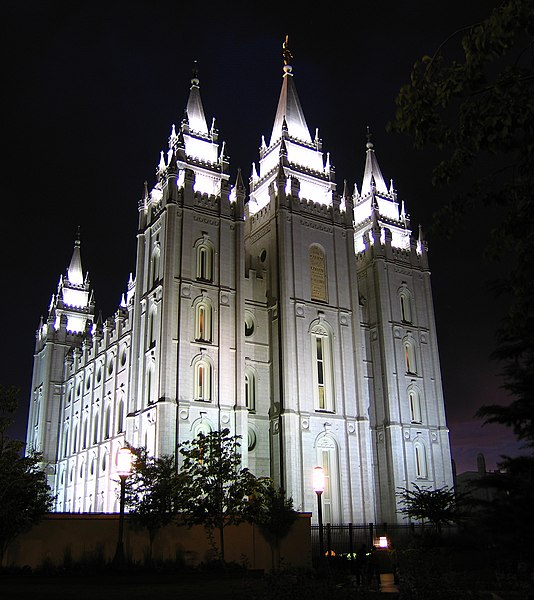
 Several months ago, some Mormon missionaries approached me on the street. I knew very little about their beliefs, most of it from comedians and atheist critics. So Deena and I invited them over.
I will blog later about what I learned of their particular beliefs. What I want to discuss right now is an experiment they asked us to try after our first meeting.
They asked us to pray.
I found myself facing a dilemma. On the one hand, praying feels like a betrayal of my values as a humanist. How could I sincerely ask for an answer from a god whose existence I believe to be improbable, undiscoverable, and irrelevant to living a good life? On the other hand, free thinking is at the heart of humanism. Prayer is an experience I had never tried before.
So I decided that, conducted carefully, praying would not betray my principles. I would try it - and perhaps learn something new about myself and my Mormon friends.
I had many questions heading into the experiment. Would I feel anything peculiar? How might I interpret it? Would I, in the limited but well-publicised tradition of sceptical converts, "see the light"? Would I have an unusual experience but shrug it off? Would I feel nothing at all?
I sat in a comfortable posture in a quiet room, closed my eyes, and asked aloud, "God, do you exist?"
I quieted my thoughts to make room for even the softest suggestion from an external deity. I sent my internal sceptic, who was clamouring to declare the whole exercise a farce, out to get tea.
Then I waited. I tried to be ready for any type of result - from a sudden Damascus-road conversion to quiet "promptings of the spirit".
I was so still that all I heard for several minutes was the beating of my heart and the ticking of the electric clock. There was nothing else. Nothing that could be interpreted as a message from a god - not even a little thrill of what-if.
Later, I related this experience to the Mormons. They were undeterred. They encouraged me to keep trying: "God is not always heard the first time."
Fair enough. No responsible scientist would draw a firm conclusion from just one data point.
So I continued the experiment, varying the format to get a sample of different styles of prayer: different postures, different forms of address, different questions. I prayed alone; I prayed with Deena; I even led the prayer at the end of our meetings with the Mormons once or twice. The result was the same each time: I was answered only by my own thoughts and feelings.
At a recent meeting, one of the Mormons promised, "If you keep trying, eventually you will get an answer." Well, I have tried the experiment. I have set aside my reservations and sought the truth, true to my humanist values. And I have an answer. There probably is no personal god.
Now it's time for me to move on to the next question, the next empirical adventure.
Photo credit:
Mormon temple image by user Ricardo630, accessed at Wikimedia Commons, released under Creative Commons Attribution ShareAlike 2.5 license.
 Several months ago, some Mormon missionaries approached me on the street. I knew very little about their beliefs, most of it from comedians and atheist critics. So Deena and I invited them over.
I will blog later about what I learned of their particular beliefs. What I want to discuss right now is an experiment they asked us to try after our first meeting.
They asked us to pray.
I found myself facing a dilemma. On the one hand, praying feels like a betrayal of my values as a humanist. How could I sincerely ask for an answer from a god whose existence I believe to be improbable, undiscoverable, and irrelevant to living a good life? On the other hand, free thinking is at the heart of humanism. Prayer is an experience I had never tried before.
So I decided that, conducted carefully, praying would not betray my principles. I would try it - and perhaps learn something new about myself and my Mormon friends.
I had many questions heading into the experiment. Would I feel anything peculiar? How might I interpret it? Would I, in the limited but well-publicised tradition of sceptical converts, "see the light"? Would I have an unusual experience but shrug it off? Would I feel nothing at all?
I sat in a comfortable posture in a quiet room, closed my eyes, and asked aloud, "God, do you exist?"
I quieted my thoughts to make room for even the softest suggestion from an external deity. I sent my internal sceptic, who was clamouring to declare the whole exercise a farce, out to get tea.
Then I waited. I tried to be ready for any type of result - from a sudden Damascus-road conversion to quiet "promptings of the spirit".
I was so still that all I heard for several minutes was the beating of my heart and the ticking of the electric clock. There was nothing else. Nothing that could be interpreted as a message from a god - not even a little thrill of what-if.
Later, I related this experience to the Mormons. They were undeterred. They encouraged me to keep trying: "God is not always heard the first time."
Fair enough. No responsible scientist would draw a firm conclusion from just one data point.
So I continued the experiment, varying the format to get a sample of different styles of prayer: different postures, different forms of address, different questions. I prayed alone; I prayed with Deena; I even led the prayer at the end of our meetings with the Mormons once or twice. The result was the same each time: I was answered only by my own thoughts and feelings.
At a recent meeting, one of the Mormons promised, "If you keep trying, eventually you will get an answer." Well, I have tried the experiment. I have set aside my reservations and sought the truth, true to my humanist values. And I have an answer. There probably is no personal god.
Now it's time for me to move on to the next question, the next empirical adventure.
Photo credit:
Mormon temple image by user Ricardo630, accessed at Wikimedia Commons, released under Creative Commons Attribution ShareAlike 2.5 license.
Friday, 12 June 2009
My European representatives
 Last week, I voted for the first time in the European election. (For those not familiar with the EU electoral system, voting is granted on residency rather than nationality, so although I have only a Canadian passport, I am still able to vote.)
 The results are out. I have yet to make heads or tails of the overall results. Since each of the 27 member countries fields its own parties, the resulting body is inevitably a jambalaya of different interests.
But at the national level, one can get a fair idea of what any given country has fielded. The UK results are troubling in two ways.
First - a topic I've complained about before - only about a third of the eligible electorate turned out. In a country with almost 50 million eligible voters, only 15 million of us bothered to participate. There are sometimes good reasons not to vote - medical emergencies, natural disasters, and the like - but a good many of those who don't vote had bad reasons. Couldn't be bothered to vote. Didn't think it would make a difference. Hadn't read up on the issues. Not interested in politics.
Though it may lose me the title of "friendly" humanist, I have to say that all of those are pathetic excuses. Democracy is not something that other people give us, as some kind of birthright. It's something we must continually exercise. It is all too easy to lose. Look at the Belgians and the Luxembourghers - they had a 91% turnout!
Second, I am frankly embarrassed at the representation that my fellow British voters chose.
A quarter of a million Britons supported the joint ticket Christian Party and Christian People's Alliance. I have nothing against people believing what they like, and living their own lives in accordance with their beliefs, but these parties' platforms are fully oriented toward establishing a theocracy. I guess the lessons of Britain's history of state-sponsored religion are lost on some people. (Catholic-Protestant violence both ways, the persecution of the Covenanters, and probably others I haven't yet learned of.)
Fortunately, the Christian parties fell short of enough votes to send a single candidate to the European Parliament.
More appalling is the fact that the British National Party 2 seats. This is an openly racist, xenophobic party. (Membership is open only to whites, for example.) And almost a million British voters thought they would make the best representatives in Europe. Scary.
I'm also disturbed that UK Independence Party got 13 seats. While they are not as scary as the BNP (they even make a point of saying they're not racist), their policies tend toward the unrealistically insular "Britain for British", "cut all immigration" sentiment, which sets off warning bells for me. And they got the 2nd most votes of all UK parties in this election, with 2.5 million.
I don't fully understand the EU, and I have strong reservations about some of its influence, but xenophobia is not a helpful reaction. (I need to acknowledge, though, that my opinions are those of a Canadian working in Britain. In addition, academia seems to have more international representation than almost any other employment sector.)
Having said all that, I do want to point out that, if my neighbours really want to vote for these people, then these people should be their representatives.
That's democracy for you.
Even when I hate how someone exercises their power, denying them that power is not an appropriate response. (You know the Belgians and Luxembourghians I praised earlier? Each country sent 3 representatives from its dominant Christian political party. I'm far more encouraged at the turnout than discouraged at the religious sentiment.)
Until they cross the line and start undermining the freedoms that democracy relies on - like freedom of expression and of conscience, and basic human rights. Which I suspect fringe groups like the BNP and the pro-theocracy crowd might do, given the chance.
Honestly: for the most part, this is a great country. But sometimes its people make my head spin.
Image credits:
EU flag image from Wikimedia Commons, multiple authors (see linked page). Public domain.
Jambalaya image from Wikimedia Commons, copyright Cliff Hutson. Licenced under the GNU Free Documentation License and the Creative Commons Attribution-ShareAlike license.
Thursday, 19 March 2009
Learning from religion
Over at This Humanist, Clare has just shared some thoughts on what religious communities do better (at the moment) than humanist communities.
Clare's general approach to humanism and to religion is pretty close to my own, and I agree with her here too. Among the other things in the post, she says, "Religious life creates community."
It's true that community can come from non-religious life too. There's a little community hall near the farm I grew up on - it used to be a schoolhouse - and I remember gathering there every year with several dozen neighbours to celebrate Halloween and Christmas. (I know, Christmas is nominally a religious holiday - but at least for me in that community, it was not about religion but about the celebration.)
But it's also true in my experience that, as an organized worldview, humanism does not do community as well as religions do. My guess is that it's down to experience: we haven't been organized as long as they have, and haven't worked out all the details needed to build a vibrant and nurturing community for all our members.
And so, like Clare, I think it would be sensible of us to see how our human neighbours have solved the problems we still grapple with.
Clare's general approach to humanism and to religion is pretty close to my own, and I agree with her here too. Among the other things in the post, she says, "Religious life creates community."
It's true that community can come from non-religious life too. There's a little community hall near the farm I grew up on - it used to be a schoolhouse - and I remember gathering there every year with several dozen neighbours to celebrate Halloween and Christmas. (I know, Christmas is nominally a religious holiday - but at least for me in that community, it was not about religion but about the celebration.)
But it's also true in my experience that, as an organized worldview, humanism does not do community as well as religions do. My guess is that it's down to experience: we haven't been organized as long as they have, and haven't worked out all the details needed to build a vibrant and nurturing community for all our members.
And so, like Clare, I think it would be sensible of us to see how our human neighbours have solved the problems we still grapple with.
Friday, 27 February 2009
Discrimination or hysteria?
There have been more developments since my recent post about nurse Caroline Petrie. Cath and I have exchanged some discussion on our respective blogs, but I feel that there is enough new material to merit a separate post - largely to clear things up a little.
So here's where we stand:
There is the case of the nurse, Caroline Petrie, who offered to pray for a patient and, as a result, faced disciplinary action. And more recently, there is the case of a school receptionist, Jennie Cain, whose daughter was told off for discussing her religion with a classmate. (There are other incidents mentioned alongside these, but it is these two news items that seem central to the current discussion, so I'll limit myself to them.)
On the fact of it - with just those claims - Cath is right that these seem to be outrageous cases of religious discrimination.
But then you dig deeper.
According to the Telegraph, Caroline Petrie has a history of promoting her religion at work. Before a previous reprimand, she used to leave prayer cards with patients. Now, a clear case of overstepping the line would be pushing religious tracts on patients. Do prayer cards count as religious tracts? I'd say yes, but that may be a matter of taste. Also, as I mentioned in my previous post, she is not being asked to check her religion at the door. She is just being given guidelines - which seem reasonable to me - about when it's appropriate to bring religion into her role as a medical carer. For example, wait for the patient to ask for prayer, rather than pro-actively offering it.
I understand that prayer is important to Mrs. Petrie (and Cath and other Christians who identify with her). And I'm willing to concede that perhaps the employer's rule is more restrictive than it really needs to be to protect the patients. But calling it religious discrimination - particularly, saying that Christianity is being singled out - is unsupported by the available facts. The course of the case is nicely summed up in a sequence of clips from BBC here, where it is made clear that the trust has also acknowledged the need to respect the spiritual needs of patients. Mrs. Petrie has been fully reinstated with no further disciplinary action.
The Jennie Cain case also takes on a different tone when we look deeper. The Telegraph, the Daily Mail, and the Christian Institute all claim that the catalyst in the case was a young girl "talking about Jesus". Innocuous enough, but the Express and Echo paper points out that the girl was threatening her classmate with hell if she didn't believe in God. Now, there are a lot of ways that even that topic might have come across, but you have to acknowledge that eternal suffering is a pretty horrible idea to be sharing with a young child - particularly one who hasn't been exposed to all the Christian background that is said to soften and justify it. Furthermore, those crying discrimination are deciding to ignore head teacher Gary Read's take on things - both that he felt the girl's claim was hurtful to the other child, and that his response was gentle and proportionate. The Express and Echo also reports that parents are supporting Mr. Read on this issue. Check out this BBC video, presenting both sides:
Mr. Read says, "Whether it's considered to be private or not, the fact ... that a member of our staff was making quite serious allegations about the way the school was dealing with things which weren't true." Weren't true. Could it be that Mrs. Cain is actually in trouble because she was slandering the school? That certainly changes the tone of things. And here's what he says he told the girl: "What you said has upset another child and frightened her, so I don't want you to say that." Which seems reasonable, and in no way anti-Christian (or even generally anti-religious). Cath points out that belief in hell is pretty basic to most Christians' belief. Fair enough - but one's beliefs do not give one licence to threaten or upset other children. It's okay for a teacher to ask a child not to frighten other children. To say that religious statements should have a special exemption from this - that would be religious discrimination.
Of course, there is more to this case. Mrs. Cain sent a personal e-mail to friends at her church, not from a school computer, which was apparently obtained by the head teacher and is being used as justification for disciplinary action. The head teacher says that Mrs. Cain was making inappropriate allegations against the school in the e-mail, but the Christian commenters claim (or, in some cases, simply insinuate) that it was obtained inappropriately; if so, they are right in saying that its content is irrelevant.
So, in sum, we have what may be an innocent comment from a child that was mercilessly suppressed, or may be an insensitive comment from a child that was dealt with gently. We have a private e-mail that may have been obtained through shady means (though we aren't given enough details to know this), which may have been a simple plea for help and prayers, and may have been a slanderous diatribe. Out of this mess (which I have spent a reasonable amount of time sorting through), I do not think we can confidently assert persecution.
I am trying very hard to avoid the dismissive and completely unsympathetic tone set by another non-religious commentator. I take very seriously my "Friendly Humanist" name. But the balance of evidence in these two cases - Caroline Petrie and Jennie Cain - does not seem to justify the claims of systematic anti-Christian prejudice that are being made.
It may be that, as more facts emerge, the current uncertainties in these cases will be resolved in the direction of discrimination. It may be, but I doubt it.
Why?
Because the UK is a Christian country.
Demographically, more people identify as Christian than anything else. Politically, we have a parliament that privileges Christian beliefs and practices above others. Socially, we have a landscape dominated by Christian holidays, Christian landmarks, and Christian language.
I'm not trying to claim here that I'm being discriminated against. (Except for the political bit - but that's a topic for another time.) I'm just trying to let my Christian colleagues out there in the ether see why these cases are less than compelling as evidence that the world, or particular instances of British bureaucracy, are against them.
So here's where we stand:
There is the case of the nurse, Caroline Petrie, who offered to pray for a patient and, as a result, faced disciplinary action. And more recently, there is the case of a school receptionist, Jennie Cain, whose daughter was told off for discussing her religion with a classmate. (There are other incidents mentioned alongside these, but it is these two news items that seem central to the current discussion, so I'll limit myself to them.)
On the fact of it - with just those claims - Cath is right that these seem to be outrageous cases of religious discrimination.
But then you dig deeper.
According to the Telegraph, Caroline Petrie has a history of promoting her religion at work. Before a previous reprimand, she used to leave prayer cards with patients. Now, a clear case of overstepping the line would be pushing religious tracts on patients. Do prayer cards count as religious tracts? I'd say yes, but that may be a matter of taste. Also, as I mentioned in my previous post, she is not being asked to check her religion at the door. She is just being given guidelines - which seem reasonable to me - about when it's appropriate to bring religion into her role as a medical carer. For example, wait for the patient to ask for prayer, rather than pro-actively offering it.
I understand that prayer is important to Mrs. Petrie (and Cath and other Christians who identify with her). And I'm willing to concede that perhaps the employer's rule is more restrictive than it really needs to be to protect the patients. But calling it religious discrimination - particularly, saying that Christianity is being singled out - is unsupported by the available facts. The course of the case is nicely summed up in a sequence of clips from BBC here, where it is made clear that the trust has also acknowledged the need to respect the spiritual needs of patients. Mrs. Petrie has been fully reinstated with no further disciplinary action.
The Jennie Cain case also takes on a different tone when we look deeper. The Telegraph, the Daily Mail, and the Christian Institute all claim that the catalyst in the case was a young girl "talking about Jesus". Innocuous enough, but the Express and Echo paper points out that the girl was threatening her classmate with hell if she didn't believe in God. Now, there are a lot of ways that even that topic might have come across, but you have to acknowledge that eternal suffering is a pretty horrible idea to be sharing with a young child - particularly one who hasn't been exposed to all the Christian background that is said to soften and justify it. Furthermore, those crying discrimination are deciding to ignore head teacher Gary Read's take on things - both that he felt the girl's claim was hurtful to the other child, and that his response was gentle and proportionate. The Express and Echo also reports that parents are supporting Mr. Read on this issue. Check out this BBC video, presenting both sides:
Mr. Read says, "Whether it's considered to be private or not, the fact ... that a member of our staff was making quite serious allegations about the way the school was dealing with things which weren't true." Weren't true. Could it be that Mrs. Cain is actually in trouble because she was slandering the school? That certainly changes the tone of things. And here's what he says he told the girl: "What you said has upset another child and frightened her, so I don't want you to say that." Which seems reasonable, and in no way anti-Christian (or even generally anti-religious). Cath points out that belief in hell is pretty basic to most Christians' belief. Fair enough - but one's beliefs do not give one licence to threaten or upset other children. It's okay for a teacher to ask a child not to frighten other children. To say that religious statements should have a special exemption from this - that would be religious discrimination.
Of course, there is more to this case. Mrs. Cain sent a personal e-mail to friends at her church, not from a school computer, which was apparently obtained by the head teacher and is being used as justification for disciplinary action. The head teacher says that Mrs. Cain was making inappropriate allegations against the school in the e-mail, but the Christian commenters claim (or, in some cases, simply insinuate) that it was obtained inappropriately; if so, they are right in saying that its content is irrelevant.
So, in sum, we have what may be an innocent comment from a child that was mercilessly suppressed, or may be an insensitive comment from a child that was dealt with gently. We have a private e-mail that may have been obtained through shady means (though we aren't given enough details to know this), which may have been a simple plea for help and prayers, and may have been a slanderous diatribe. Out of this mess (which I have spent a reasonable amount of time sorting through), I do not think we can confidently assert persecution.
I am trying very hard to avoid the dismissive and completely unsympathetic tone set by another non-religious commentator. I take very seriously my "Friendly Humanist" name. But the balance of evidence in these two cases - Caroline Petrie and Jennie Cain - does not seem to justify the claims of systematic anti-Christian prejudice that are being made.
It may be that, as more facts emerge, the current uncertainties in these cases will be resolved in the direction of discrimination. It may be, but I doubt it.
Why?
Because the UK is a Christian country.
Demographically, more people identify as Christian than anything else. Politically, we have a parliament that privileges Christian beliefs and practices above others. Socially, we have a landscape dominated by Christian holidays, Christian landmarks, and Christian language.
I'm not trying to claim here that I'm being discriminated against. (Except for the political bit - but that's a topic for another time.) I'm just trying to let my Christian colleagues out there in the ether see why these cases are less than compelling as evidence that the world, or particular instances of British bureaucracy, are against them.
Friday, 11 April 2008
Alberta Votes (3 of 3): Religious interference
 Okay, this isn't strictly an Alberta news item. But, at about the time I began this series on the Alberta election (see here and here for previous installments), I heard that a Catholic bishop in Ottawa is refusing communion to politicians who support abortion rights.
It's not the first time or place this has happened: it has come up recently in Scotland, Wales, the US, and probably many other places as well. Sanctions don't stop at refusing communion - excommunication is also on the table according to some bishops. (Note that not all Catholics think this is an appropriate action for the church to take.)
I am not here to discuss arguments for or against abortion rights (not today anyway). What I would like to explore is the implications of such pressure for democratic government.
On a personal level, first of all, let me say that if I have reason to believe that a candidate will let any particular interest group dictate their actions when in power (rather than, say, the will of us voters), then they have already lost my vote. I hate the idea of voting against someone because of their religion, but if a candidate declares a firm devotion to the Catholic church, and the church orders all its members to toe the doctrinal line or else, then I have no hesitation in deciding against voting for that candidate.
So much for the personal side of things. What about the public interest?
 There are regular scandals over money changing hands for political motives. Why are such actions a bad thing? Because they represent an individual, company, or group trying to coerce a politician to act in a way that may not reflect the democratic will of their constituents. It undermines democracy.
As I recently wrote, I think the appropriate status of religious groups in secular government is essentially that of interest groups. And what we have here is prominent members of the Catholic interest group putting as much pressure as they possibly can on elected officials to follow the church over the constituents.
 So, are these bishops any better than business men trying to bribe (or blackmail) politicians to vote a particular way? If so, how? What is so special about religious interest groups that they don't have to live up to the same ethical standards as we hold corporate businesspeople to?
At the least, I think these bishops' declarations should make people think very carefully before electing Catholics to public office. At best, I think the Catholic church should be severely chastised for trying to thwart the democratic process in this way.
Disclaimer (in case someone in the audience is inclined to misinterpret me):
I assert the right of elected officials to hold whatever religious beliefs they choose. I assert the right of religious officials to express their beliefs - including the real-world implications of their beliefs - as freely as anyone else. I assert the right of everyone to take a position on abortion rights and to act on that position, whether it is in the form of personal choice, protest, or an elected official voting as they choose on legislation.
The only problem I see here for democracy is that an interest group - the Catholic church - is putting inappropriate, excessive pressure on elected officials to govern in a particular way.
Am I over-reacting? Do you think my statements amount to religious discrimination? Please let me know.
Wednesday, 2 April 2008
Interest groups

Several months ago, I came across a claim A C Grayling makes regarding the role of religion in public life. The claim seems sound, and yet it also seems radical. I am appealing here to my religious reader(s): is there a good counterargument?
Here's how he puts it in The Meaning of Things:
No doubt the churches are as entitled as any other interest group to have their say on matters that fall within their range of concerns, but they are an interest group nonetheless, with highly tendentious views, and big axes to grind. (p.104)He makes the same claim in other places, including here and here.
Is the role of organised religions in public life on the same level as that of other interest groups (such as, say, the Royal Society for the Protection of Birds or the Calgary Chamber of Commerce)? Or is there a role that religions legitimately play in public life that interest groups cannot play?
I'm not asking about private life: I know that religious individuals get much more out of religion than out of their local gardening club, for example.

 I'm asking about the public role of religion in secular society. For example, is a religious holiday any different in kind from Earth Day, or Breast Cancer Awareness Month, or Darwin Day?
I think Grayling is right that there is (or ought to be) no difference in kind between religious and other interest groups (even Humanism), when it comes to their official status in the public sphere. Is this a valid assertion?
Archbishop of Canterbury Rowan Williams claims there is more to it, but fails to give a clear (or even coherent) argument for why this is so. Why should society at large (and the government in particular) treat religious lobbies as other than interest groups?
Thursday, 14 February 2008
Humanism in the Bible
Over at the Meming of Life (one of my favorite blogs), Dale is running a series on the Bible (interspersed with his regular family anecdotes and other excellent writings).
It's a thoughtful and entertaining look at this book that lies at the centre of a worldwide social phenomenon. As with any book, ancient or modern, it has good and bad bits. Dale seems to be doing a good job of touching on both.
If you haven't been following it, it starts here.
There are many reasons why it is worth reading, but the main reason I'm mentioning it now is the most recent contribution. It's an examination of Ecclesiastes and Song of Songs by a guest blogger who goes by the title "Friendly Humanist".
It's a thoughtful and entertaining look at this book that lies at the centre of a worldwide social phenomenon. As with any book, ancient or modern, it has good and bad bits. Dale seems to be doing a good job of touching on both.
If you haven't been following it, it starts here.
There are many reasons why it is worth reading, but the main reason I'm mentioning it now is the most recent contribution. It's an examination of Ecclesiastes and Song of Songs by a guest blogger who goes by the title "Friendly Humanist".
Subscribe to:
Posts (Atom)