I am moving this blog to "http://www.friendlyhumanist.net". This is partly to improve the blog (WordPress has better features), and partly to appease my own ego (I wanted my own domain name).
The new blog has already been populated with all the old posts and comments. I even think I can set things up so this old address will automatically redirect to the new one.
But, for those of you using feed readers, you'll need to subscribe to the new feed (and unsubscribe from the old one). This will be the last post I put up on Blogger.
Feel free to take this opportunity to let me know (on the new blog, preferably) what works, and what doesn't. On a technical level, what would you like me to change on the blog? On a content level, is there anything you'd like to hear more about? Less?
Sunday, 10 January 2010


Tuesday, 5 January 2010
On moral obligation
One complaint levelled against entirely naturalistic worldviews is this:
I thought I might pick out the key points of my answer here.
First, I come back to a very pragmatic position: most of the key elements of morality (love, fairness, honesty, nonviolence, etc) are built into most humans. (This fact has very interesting naturalistic explanations in the context of evolution as a social species, but that too, is a topic for another time.) So we have a useful basis for discussing moral issues without either an esoteric knowledge of the philosophical underpinnings of morality or a belief in a transcendent basis for moral claims. This is the basis of secular government: we build our society on the foundations we all share.
Second and more important, how I can derive another's obligation from my "relativist" moral stance? Very cautiously and humbly. For most cases where someone says "there ought to be a law", there probably oughtn't. Law - the formal, coercive expression of our shared moral principles - is a blunt instrument that should not be used to solve all problems.
But even aside from the law, I do expect people to act morally, and I reserve the right to hold them accountable when they don't. How do I do this? What gives me, a relativist with no ultimate explanation for right and wrong, the right to project my moral judgments on others? Why should someone else do the right thing rather than some other thing? The most honest answer I can give is very simple:
And for those issues where we don't instinctively agree on the right answer - abortion, euthanasia, drug control, etc - pretending that a hypothetical transcendent realm holds the answer does not seem to solve things. It may give some people a sense of self-righteousness to bolster their support of one position, but it is useless in seeking a practical solution or persuading people who believe in a different hypothetical set of transcendent moral truths (or folks like me who doubt such a set exists at all). In these cases, we have to fall back on the nasty, brutish, fallible strategy of using rhetoric and reason to pursue the best solution and persuade each other of it.
Photo credits:
Justice statue on Old Bailey, London: from Wikipedia, shared by user Erasoft24 under Creative Commons Attribution licence 2.5.
What is the basis of morality? By what right can you expect anyone to follow moral rules, if there is no transcendent reality to ground them in?I have had a very engaging discussion of this (and related issues) with Ken Brown and other commenters on his blog, and have posted some of my own thoughts here. Ken and colleagues are coming specifically from a Christian perspective. (I have yet to see them give a satisfactory justification for how a "transcendent reality" solves the problem - but that's a topic for another time. As is the whole burden of actually demonstrating that such a reality exists - which would seem to be a prerequisite if one is to pin one's entire moral philosophy on it.)
I thought I might pick out the key points of my answer here.
First, I come back to a very pragmatic position: most of the key elements of morality (love, fairness, honesty, nonviolence, etc) are built into most humans. (This fact has very interesting naturalistic explanations in the context of evolution as a social species, but that too, is a topic for another time.) So we have a useful basis for discussing moral issues without either an esoteric knowledge of the philosophical underpinnings of morality or a belief in a transcendent basis for moral claims.
 This is the basis of secular government: we build our society on the foundations we all share.
Second and more important, how I can derive another's obligation from my "relativist" moral stance? Very cautiously and humbly. For most cases where someone says "there ought to be a law", there probably oughtn't. Law - the formal, coercive expression of our shared moral principles - is a blunt instrument that should not be used to solve all problems.
But even aside from the law, I do expect people to act morally, and I reserve the right to hold them accountable when they don't. How do I do this? What gives me, a relativist with no ultimate explanation for right and wrong, the right to project my moral judgments on others? Why should someone else do the right thing rather than some other thing? The most honest answer I can give is very simple:
People should do the right thing, because it's the right thing to do.I know that's not very philosophical or subtle. But, so long as we all share a basic sense of right and wrong, it's sufficient for the vast majority of life's decisions.
And for those issues where we don't instinctively agree on the right answer - abortion, euthanasia, drug control, etc - pretending that a hypothetical transcendent realm holds the answer does not seem to solve things. It may give some people a sense of self-righteousness to bolster their support of one position, but it is useless in seeking a practical solution or persuading people who believe in a different hypothetical set of transcendent moral truths (or folks like me who doubt such a set exists at all). In these cases, we have to fall back on the nasty, brutish, fallible strategy of using rhetoric and reason to pursue the best solution and persuade each other of it.
Photo credits:
Justice statue on Old Bailey, London: from Wikipedia, shared by user Erasoft24 under Creative Commons Attribution licence 2.5.
Friday, 1 January 2010
Foundation Beyond Belief
 I am delighted to announce the launch of a new humanist-driven charity initiative, the Foundation Beyond Belief. Go to the site itself for full details, and to sign up.
I'm just going to point out some of the things about the Foundation that I find particularly awesome:
- Though it is explicitly modelled on humanist values, religious individuals are explicitly invited to participate.
- Social networking will be a key part of the Foundation's interaction with members - this is not just a conduit for money, but a place to build community around shared values and actions.
- Members can choose where their donations are spent, among ten categories (education, peace, health care, environment, and others).
- Charities will be selected not just on the values they profess, but on efficiency and effectiveness as well.
- Religious charities are not explicitly ruled out, but charities that use their funds for proselytizing are (regardless of the worldview they promote).
- Though based in the US, the Foundation explicitly looks to support charities with an international reach.
- Two of the key people involved in the Foundation - Dale McGowan and Hemant Mehta - were instrumental in my decision to become a blogger (though I have yet to meet either of them in person).
Mission statement:
To demonstrate humanism at its best by supporting efforts to improve this world and this life; to challenge humanists to embody the highest principles of humanism, including mutual care and responsibility; and to help and encourage humanist parents to raise confident children with open minds and compassionate hearts.
Launch blurb:
Beginning on January 1, 2010, Foundation Beyond Belief will highlight ten charitable organizations per quarter -- one in each of ten categories. Among other considerations, beneficiaries will be chosen for efficiency, effectiveness, moderate size (annual budget <$10M), compatibility with humanist focus on mutual care of this world and this life, no direct promotion or proselytizing of a particular worldview, and geographical diversity.
Video:
Tuesday, 29 December 2009
In the company of woo
I find myself in the company of woo, and as a skeptic it is bringing me some grief.
It's all about homebirth - planning to deliver a baby at home, attended by a midwife, rather than in a hospital.
Deena and I came to homebirth through an examination of the evidence. (Here's a discussion I participated in on the Bad Science forums before Kaia's birth.) We were convinced, by scientific studies and analyses, that planning a home birth here in the UK was at least as safe as planning a hospital birth, given a competent attendant and a handy hospital in the event of complications. So we went for it.
However, many people choose homebirth for less evidence-based reasons. They cite personal intuition, or the "naturalness" of it. Not just as reasons to prefer homebirth, but as evidence of its safety.
At Edinburgh's Pregnancy and Parents Centre (a haven for various types of woo, as well as useful support groups and great toddler activities), when we went to the "home birth support group" to relate our experiences and our evidence-based approach, it was alongside others promoting woo of various flavours as part of their support of homebirth.
A recent post on homebirth at Science-Based Medicine has stirred up an epic-length discussion, with passionate defenders on both sides. I've participated, but fear that just being on the homebirth side has made me, in some people's eyes, an advocate of woo.
This is the problem: I agree with the woo-birthers that homebirth can be safe, but I disagree (passionately, vigorously) about why this is a legitimate position. And the disagreement isn't immaterial. At the homebirth meeting, someone recommended homeopathy to treat post-partem haemorrhage. One of the most serious and potentially life-threatening complications of pregnancy, and she advised drinking high-priced water. That is dangerous advice, and I wish I'd been quick-thinking enough to respond persuasively (rather than sitting like a lump and grinding my teeth).
What is a skeptic to do? On the one hand, having someone agree with me in one breath, and back me up with an appeal to intuition in the next, makes me want to revisit and question my beliefs that much more carefully. (That's something a skeptic should be doing anyway, for all their beliefs, but who has the time?) On the other hand, to adapt Niven's 16th law, "There is no belief so true that one cannot find a fool believing it." Just because someone agrees with you for bad reasons doesn't mean you're wrong. I came to my belief about homebirth on the basis of the science, and I'm determined that only science will dissuade me.
But there's also the whole social side. Just as many of my fellow atheists wrinkle their brows at me when I say I go to church, many skeptics seem to do the same when I talk about homebirth. Atheists often assume that the word "church" is synonymous with supernatural beliefs and submission to a holy text, things that would feel alien in our Unitarian church. Similarly, many skeptics assume that, because it's associated with modern medicine, hospital-based birth is inherently safer.
I'm tempted to close by declaring, evangelist-style, that skeptics must beware of this tendency to take association as evidence. Its association with woo-birthers says nothing about the safety of homebirth; nor does its association with high-tech hospitals demonstrate the superiority of hospital birth.
But perhaps a more humble conclusion is in order. Here goes:
I promise to keep vigilant for evidence that might contradict my current beliefs.
I promise to honestly communicate any changes of position that such evidence might lead me to.
I promise to avoid being swayed by other people's assumptions (whether or not they are skeptics).
I promise to make every effort to pin my beliefs to the evidence, and nothing else.
It's all about homebirth - planning to deliver a baby at home, attended by a midwife, rather than in a hospital.
Deena and I came to homebirth through an examination of the evidence. (Here's a discussion I participated in on the Bad Science forums before Kaia's birth.) We were convinced, by scientific studies and analyses, that planning a home birth here in the UK was at least as safe as planning a hospital birth, given a competent attendant and a handy hospital in the event of complications. So we went for it.
However, many people choose homebirth for less evidence-based reasons. They cite personal intuition, or the "naturalness" of it. Not just as reasons to prefer homebirth, but as evidence of its safety.
At Edinburgh's Pregnancy and Parents Centre (a haven for various types of woo, as well as useful support groups and great toddler activities), when we went to the "home birth support group" to relate our experiences and our evidence-based approach, it was alongside others promoting woo of various flavours as part of their support of homebirth.
A recent post on homebirth at Science-Based Medicine has stirred up an epic-length discussion, with passionate defenders on both sides. I've participated, but fear that just being on the homebirth side has made me, in some people's eyes, an advocate of woo.
This is the problem: I agree with the woo-birthers that homebirth can be safe, but I disagree (passionately, vigorously) about why this is a legitimate position. And the disagreement isn't immaterial. At the homebirth meeting, someone recommended homeopathy to treat post-partem haemorrhage. One of the most serious and potentially life-threatening complications of pregnancy, and she advised drinking high-priced water. That is dangerous advice, and I wish I'd been quick-thinking enough to respond persuasively (rather than sitting like a lump and grinding my teeth).
What is a skeptic to do? On the one hand, having someone agree with me in one breath, and back me up with an appeal to intuition in the next, makes me want to revisit and question my beliefs that much more carefully. (That's something a skeptic should be doing anyway, for all their beliefs, but who has the time?) On the other hand, to adapt Niven's 16th law, "There is no belief so true that one cannot find a fool believing it." Just because someone agrees with you for bad reasons doesn't mean you're wrong. I came to my belief about homebirth on the basis of the science, and I'm determined that only science will dissuade me.
But there's also the whole social side. Just as many of my fellow atheists wrinkle their brows at me when I say I go to church, many skeptics seem to do the same when I talk about homebirth. Atheists often assume that the word "church" is synonymous with supernatural beliefs and submission to a holy text, things that would feel alien in our Unitarian church. Similarly, many skeptics assume that, because it's associated with modern medicine, hospital-based birth is inherently safer.
I'm tempted to close by declaring, evangelist-style, that skeptics must beware of this tendency to take association as evidence. Its association with woo-birthers says nothing about the safety of homebirth; nor does its association with high-tech hospitals demonstrate the superiority of hospital birth.
But perhaps a more humble conclusion is in order. Here goes:
I promise to keep vigilant for evidence that might contradict my current beliefs.
I promise to honestly communicate any changes of position that such evidence might lead me to.
I promise to avoid being swayed by other people's assumptions (whether or not they are skeptics).
I promise to make every effort to pin my beliefs to the evidence, and nothing else.
Thursday, 24 December 2009
More on Free Will
Since my March article about free will, I've learned that my position - that having free will is consistent with a mechanistic model of the universe (with or without quantum uncertainty thrown in) - is known as compatibilism.
 I recently read Thomas Pink's book, Free Will: A Very Short Introduction (from the excellent Very Short Introduction series put out by OUP) - and so I now fancy myself knowledgeable enough to connect my own casual ponderings with the great web of philosophy.
The position Mike took in his article is known as scepticism (in the context of free will, a combination of incompatibilism and a belief in causal determinism - not to be confused with other, more general forms of scepticism).
Guess who Pink identifies as the first compatibilist? Here's a quote:
I wouldn't go so far as to call myself a Hobbesian - he wrote about more than just this, and I don't know if the whole of his philosophy would appeal to me. But I tend to agree with this quote.
Note that this passage makes no claims about what it means for someone to "have a will to do" something. One thing I like about compatibilism is that it does not rely on a particular model (deterministic, non-deterministic, etc) of the universe.
See also:
Wikipedia article on Free Will.
Image credit:
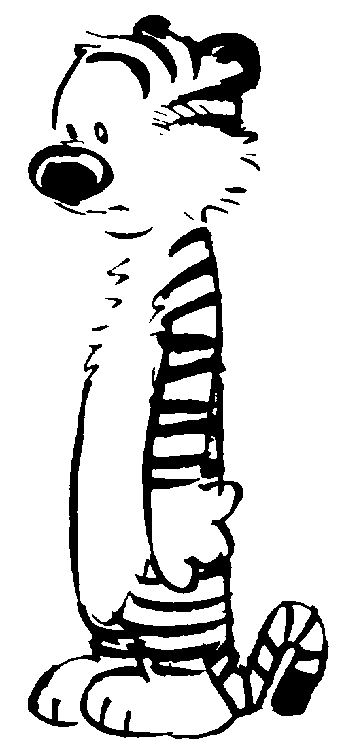
Image of Hobbes via this collection. (On the topic of this post, check out this fan comic, inspired by the Calvin and Hobbes scene shown here.)
 I recently read Thomas Pink's book, Free Will: A Very Short Introduction (from the excellent Very Short Introduction series put out by OUP) - and so I now fancy myself knowledgeable enough to connect my own casual ponderings with the great web of philosophy.
The position Mike took in his article is known as scepticism (in the context of free will, a combination of incompatibilism and a belief in causal determinism - not to be confused with other, more general forms of scepticism).
Guess who Pink identifies as the first compatibilist? Here's a quote:
A FREE-MAN, is he, that ... is not hindred to doe what he has a will to ... from the use of the word Free-will, no Liberty can be inferred of the will, desire or inclination, but the Liberty of the man; which consisteth in this, that he finds no stop, in doing what he has the will, desire, or inclination to doe.The quote is from p65 of Pink's book, and it's by 17th-century English philosopher Thomas Hobbes.
I wouldn't go so far as to call myself a Hobbesian - he wrote about more than just this, and I don't know if the whole of his philosophy would appeal to me. But I tend to agree with this quote.
Note that this passage makes no claims about what it means for someone to "have a will to do" something. One thing I like about compatibilism is that it does not rely on a particular model (deterministic, non-deterministic, etc) of the universe.
See also:
Wikipedia article on Free Will.
Image credit:
Image of Hobbes via this collection. (On the topic of this post, check out this fan comic, inspired by the Calvin and Hobbes scene shown here.)
Sunday, 20 December 2009
Is Saint Andrew's Day controversial?
 A few weeks late, I have come across this exchange on the merits of celebrating Saint Andrew's Day on the 30th of November as a national day for Scotland. Saint Andrew was said to have been crucified on an 'X'-shaped cross, which gives us the saltire in the modern Scottish flag (pictured above). His apparent connection with Scotland is that some of his relics were brought here after his death, and so he is considered the patron saint of Scotland.
In the article from the Herald, Gordon Ross (treasurer for the Humanist Society of Scotland) argues that (a) Andrew has no demonstrable connection to Scotland (he's patron saint of many other places as well), (b) it is primarily a religious tradition, which implicitly excludes the many non-Christian people in Scotland, and (c) we have plenty of other days with more genuine merit, to celebrate Scotland as a nation.
Opposing him is Azeem Ibrahim, who argues that religion isn't a serious part of Scottish Saint Andrews Day celebrations, and that the inclusive celebration of Scottish awesomeness is what the day is about.
This seems to me like a microcosm of the perennial Christmas debates in the atheist community. Is it a problem to celebrate on a day that has been connected to beliefs or values that you reject? As someone who grew up with essentially religion-free Christmases, I just can't get worried about it. (For us, it was about family, food, gifts, and games.) I've never seen evidence that celebrating a secular Christmas somehow lends credence to the non-secular version of it.*
I tend to agree with Ibrahim - the same goes for Saint Andrew's Day. While I am aware of the legend behind it, I've never felt that the religious side was particularly important. It's about celebrating this wonderful little nation of (currently) five million people, who have produced so much.** (Including, I should point out, many of the central historical figures and cultural traditions celebrated in my homeland, Canada.)
Humanists and atheists often chastise religious people for being too sensitive about their beliefs. I think this is a great opportunity to show that we mean it. Saint Andrew's Day does not exclude us; it does not demean us. So let's set aside the historical religious basis of the day and enjoy it for what it is now.***
Lang may your lum reek!
Footnotes:
* I feel I should point out this post by Cath, in which I learned that even very conservative Christians don't necessarily observe Christmas. This doesn't change the fact that it's historically a religiously-motivated festival, but it does somewhat derail the assumption that Christianity and Christmas necessarily go together.
** I should also acknowledge that Saint Andrew's Day is not a huge thing, even in Scotland. In fact, my main experience of it is the free admission to the castle, and perhaps token acknowledgement in the media. So it's a very different issue in many ways from Christmas. But the parallels are intriguing.
*** Also, I should acknowledge a certain personal bias: Saint Andrew's Day is also my birthday. It's quite nice to be offered free admission to national monuments on your birthday.
Image credit:
Saltire from Wikimedia Commons. Public domain.
Friday, 18 December 2009
Why should humanists be in chaplaincy?
Humanitie, the quarterly magazine of the Humanist Society of Scotland, has a new issue out. Once again, Mike and I present our rather different perspectives - this time, on the relationship between humanists and chaplaincy. Don't forget to read Mike's column over at his blog.
I was recently asked a question about the place of humanists in chaplaincy life. In a chaplaincy, even an inclusive multi-faith chaplaincy, most people are religious. To what extent is it worthwhile and appropriate for humanists and other non-religious people to seek a place in chaplaincy?
The answer is obvious to me. Clearly, though, some religious people and even many humanists don't see things as I do. So here is my take on it.
First, some background. Our university chaplaincy is very deliberately open to students and staff of "all faiths and none".
My earliest experience with the chaplaincy was when I was first learning and reading about humanism, and coming to realize that it reflected a deep part of my identity. I started looking for like-minded people, for a community to connect with. I had heard of the chaplaincy and its openness to people of no religion. I visited the chaplain and asked if she knew of any humanist groups at the university. She didn't, but she thought it would be wonderful if there were a group. She also pointed me to the Humanist Society of Scotland (HSS), which has an Edinburgh group.
There is a whole story following on from that - of attending an HSS philosophy book group, of meeting another humanist student, of forming a student group with him that has become far more active and successful than I expected - but for now let's look at that first move on my part. Why did I go to the chaplaincy in search of humanists?
First, there was my awareness that the chaplaincy branded itself as inclusive - they reach out not only to religious folks, but to folks like me. Second, for all that some humanists like to distance themselves from religious believers, there is a crucial feature that we share. Humanism is a framework for seeking meaning, for defining an ethical stance, and for sharing inspiration and expressing awe. For most religious people I've talked to, their religion does just the same: it provides meaning, defines ethics, and it is the lens through which inspiration and awe are experienced and shared. Also, perhaps even more importantly, both humanism and religions are identities around which human communities gather. So humanism is to me as religion is to religious folks. Even then, new as I was to humanism, I could see that.
So it seemed obvious that the chaplaincy - a place for religious folks to meet like-minded people, a place for people to go for spiritual counselling, and a place that explicitly included non-religious people in its remit - was the right place to look for humanist groups at the university.
And of course, that answers the question I opened with too. If chaplaincy is an obvious place for a lone humanist to go in search of kindred spirits, then chaplaincy is an obvious place for a humanist group to be connected with so that those lone humanists can find us.
Yes, there is the Internet. Yes, there are other avenues for us to find one another. But that's no reason to shut such an obvious means of connection. Besides, the sort of personal bond that people visiting the chaplaincy tend to seek is not something that can be transmitted through a computer screen.
Of course, there is more to the chaplaincy than just finding folks like yourself. There is also the inter-faith element*. The idea of people of different backgrounds coming together to discover common ground. And I think that's incredibly valuable. It's something that's lacking from a lot of the "culture war" discussions that get headlines. It's important that humanists are involved in that as well.
True, I may think that the other guy's god is imaginary. True, he may think that I'm destined for hell if I don't come to believe as he does. But equally true is the fact that we both value compassion. We both try to buy products whose production doesn't exploit the vulnerable. We both try to act in ways that will preserve the planet for the next generation. We both strongly believe in each other's right to believe as we will.
In my experience, there is no place like a multi-faith chaplaincy for bringing people of different backgrounds together and helping us to realize how much we share. Not just superficial stuff. Deep stuff. Important stuff.**
Stuff we can draw on to make the world a better place, together.
That's why humanists should be involved in chaplaincy, and in other inter-faith endeavours.
Footnotes (not included in the print version):
* Yes, I know, the term inter-faith is problematic for people like us, who consciously set ourselves apart from religious faith. It is also often used in a manner that really does exclude us. But until you can come up with a better term for a meeting of religious and non-religious worldviews, and show that other people will use and understand it, it's better than nothing.
** A Unitarian church may do the same, but I don't have enough experience at one yet to say for sure.
I was recently asked a question about the place of humanists in chaplaincy life. In a chaplaincy, even an inclusive multi-faith chaplaincy, most people are religious. To what extent is it worthwhile and appropriate for humanists and other non-religious people to seek a place in chaplaincy?
The answer is obvious to me. Clearly, though, some religious people and even many humanists don't see things as I do. So here is my take on it.
First, some background. Our university chaplaincy is very deliberately open to students and staff of "all faiths and none".
My earliest experience with the chaplaincy was when I was first learning and reading about humanism, and coming to realize that it reflected a deep part of my identity. I started looking for like-minded people, for a community to connect with. I had heard of the chaplaincy and its openness to people of no religion. I visited the chaplain and asked if she knew of any humanist groups at the university. She didn't, but she thought it would be wonderful if there were a group. She also pointed me to the Humanist Society of Scotland (HSS), which has an Edinburgh group.
There is a whole story following on from that - of attending an HSS philosophy book group, of meeting another humanist student, of forming a student group with him that has become far more active and successful than I expected - but for now let's look at that first move on my part. Why did I go to the chaplaincy in search of humanists?
First, there was my awareness that the chaplaincy branded itself as inclusive - they reach out not only to religious folks, but to folks like me. Second, for all that some humanists like to distance themselves from religious believers, there is a crucial feature that we share. Humanism is a framework for seeking meaning, for defining an ethical stance, and for sharing inspiration and expressing awe. For most religious people I've talked to, their religion does just the same: it provides meaning, defines ethics, and it is the lens through which inspiration and awe are experienced and shared. Also, perhaps even more importantly, both humanism and religions are identities around which human communities gather. So humanism is to me as religion is to religious folks. Even then, new as I was to humanism, I could see that.
So it seemed obvious that the chaplaincy - a place for religious folks to meet like-minded people, a place for people to go for spiritual counselling, and a place that explicitly included non-religious people in its remit - was the right place to look for humanist groups at the university.
And of course, that answers the question I opened with too. If chaplaincy is an obvious place for a lone humanist to go in search of kindred spirits, then chaplaincy is an obvious place for a humanist group to be connected with so that those lone humanists can find us.
Yes, there is the Internet. Yes, there are other avenues for us to find one another. But that's no reason to shut such an obvious means of connection. Besides, the sort of personal bond that people visiting the chaplaincy tend to seek is not something that can be transmitted through a computer screen.
Of course, there is more to the chaplaincy than just finding folks like yourself. There is also the inter-faith element*. The idea of people of different backgrounds coming together to discover common ground. And I think that's incredibly valuable. It's something that's lacking from a lot of the "culture war" discussions that get headlines. It's important that humanists are involved in that as well.
True, I may think that the other guy's god is imaginary. True, he may think that I'm destined for hell if I don't come to believe as he does. But equally true is the fact that we both value compassion. We both try to buy products whose production doesn't exploit the vulnerable. We both try to act in ways that will preserve the planet for the next generation. We both strongly believe in each other's right to believe as we will.
In my experience, there is no place like a multi-faith chaplaincy for bringing people of different backgrounds together and helping us to realize how much we share. Not just superficial stuff. Deep stuff. Important stuff.**
Stuff we can draw on to make the world a better place, together.
That's why humanists should be involved in chaplaincy, and in other inter-faith endeavours.
Footnotes (not included in the print version):
* Yes, I know, the term inter-faith is problematic for people like us, who consciously set ourselves apart from religious faith. It is also often used in a manner that really does exclude us. But until you can come up with a better term for a meeting of religious and non-religious worldviews, and show that other people will use and understand it, it's better than nothing.
** A Unitarian church may do the same, but I don't have enough experience at one yet to say for sure.
Thursday, 17 December 2009
Cosmic Advent
It's that time of year again, when the Cosmic Calendar brings almost daily events to reflect on. Today we see the Cambrian Explosion (about 540 million years ago), and the first vertebrates (around 534 million years ago). See the list of upcoming events in the sidebar on the right for the next 5, or go to the Google Calendar for the whole schedule.
I'm still working out, for myself and my family, how to integrate the Cosmic Calendar into personal holiday traditions. I like the idea of building some sort of advent calendar around these last couple of weeks. How would you go about that? Would you used biologically-themed sweets? Toys? Snappy passages from The Ancestor's Tale?
I'd also like to fill in the blank days - the 20th, 24th, 25th, and 29th. I'm sure things were happening during these periods - every day represents about 37.5 million years of time, after all. But the big-ticket events like the first amphibians, the first birds, etc just haven't happened to fall on those days.
Would you like to participate? Do you have any thoughts for things to include in the Cosmic Calendar? Corrections on the dates I'm using? Other ideas? Please let me know!
I'm still working out, for myself and my family, how to integrate the Cosmic Calendar into personal holiday traditions. I like the idea of building some sort of advent calendar around these last couple of weeks. How would you go about that? Would you used biologically-themed sweets? Toys? Snappy passages from The Ancestor's Tale?
I'd also like to fill in the blank days - the 20th, 24th, 25th, and 29th. I'm sure things were happening during these periods - every day represents about 37.5 million years of time, after all. But the big-ticket events like the first amphibians, the first birds, etc just haven't happened to fall on those days.
Would you like to participate? Do you have any thoughts for things to include in the Cosmic Calendar? Corrections on the dates I'm using? Other ideas? Please let me know!
Tuesday, 15 December 2009
Confession of a born essentialist
We have an innate tendency to psychological essentialism. Bruce Hood articulates this tendency well (see his book Supersense). His most vivid example is the serial-killer's shirt. If you are given a nice shirt - one that fits well and suits your style and wardrobe - and told that it once belonged to a serial killer, how will you react? Most people will avoid the shirt - even avoid touching it. Of course, the shirt contains no "serial-killer essence", but the association sparks something deep our psychology: we want to avoid objects that are associated with bad things.
This was probably hugely adaptive in our evolutionary history: if you avoid touching things that have been handled by, say, a seriously ill person, you are less likely to become infected yourself. It doesn't matter if the reason you avoid them is rooted in an accurate knowledge of the germ theory of disease or an improbable metaphysical notion of guilt-by-association - if it saves your life and is affected by your genes, it will give you a selective advantage over people without the trait, or with a weaker version of the same trait.
Essentialist psychology provides a compelling explanation for why people would believe in certain immaterial properties of matter even if the universe is completely material. Which leads some philosophical naturalists (humanists, atheists, etc) to smugly think that we've risen above the illusion: we see through the illusory sense that our instincts push us into. We aren't tricked into god-belief or imagining a life after death.
Well, it's not that easy.
I was playing with Kaia (my 2-year-old daughter), and she told me that her doll needed a nappy change*. As an expert, I was invited to conduct the procedure. I used a nose tissue to wipe the doll's bottom.
When I went to put the tissue back in my pocket (for future use), I was momentarily overcome by my inner essentialist. I had a strong sense that the tissue was unclean. All simply because of an act of imagination!
I quickly realized what was happening, and put the tissue in my pocket anyway. In fact, once I became conscious of the illusion, it quickly dissipated. Thank goodness for skepticism. I wonder if I would have recovered as quickly if I had not, a few years ago, attended a talk here in Edinburgh given by Bruce Hood.
Have you ever had a "silly essentialist" moment like this? How did you react? How did you feel once you realized what was going on?
* I feel I should point out that this wasn't one of those modern imagination-free dolls that actually produce wet nappies.
This was probably hugely adaptive in our evolutionary history: if you avoid touching things that have been handled by, say, a seriously ill person, you are less likely to become infected yourself. It doesn't matter if the reason you avoid them is rooted in an accurate knowledge of the germ theory of disease or an improbable metaphysical notion of guilt-by-association - if it saves your life and is affected by your genes, it will give you a selective advantage over people without the trait, or with a weaker version of the same trait.
Essentialist psychology provides a compelling explanation for why people would believe in certain immaterial properties of matter even if the universe is completely material. Which leads some philosophical naturalists (humanists, atheists, etc) to smugly think that we've risen above the illusion: we see through the illusory sense that our instincts push us into. We aren't tricked into god-belief or imagining a life after death.
Well, it's not that easy.
I was playing with Kaia (my 2-year-old daughter), and she told me that her doll needed a nappy change*. As an expert, I was invited to conduct the procedure. I used a nose tissue to wipe the doll's bottom.
When I went to put the tissue back in my pocket (for future use), I was momentarily overcome by my inner essentialist. I had a strong sense that the tissue was unclean. All simply because of an act of imagination!
I quickly realized what was happening, and put the tissue in my pocket anyway. In fact, once I became conscious of the illusion, it quickly dissipated. Thank goodness for skepticism. I wonder if I would have recovered as quickly if I had not, a few years ago, attended a talk here in Edinburgh given by Bruce Hood.
Have you ever had a "silly essentialist" moment like this? How did you react? How did you feel once you realized what was going on?
* I feel I should point out that this wasn't one of those modern imagination-free dolls that actually produce wet nappies.
Saturday, 12 December 2009
DIY spirituality
I think I've mentioned once or twice about humanist spirituality. And I know I've talked about Unitarians a few times. Well, I just read an interesting article, The DIY Spiritual Practice, by Doug Muder, in the UU World magazine. In it, he describes a spiritual practice that he and his wife have evolved over the years. (It was linked from his blog here, so go there to drop him a comment if you like - or dislike - what he says.)
What do you think?
It's not that I don't have a discipline. I do, but it's like so much of what Unitarian Universalists do—my wife Deb and I have cobbled it together for ourselves over a couple of decades.For those hard-nosed skeptics among you who think that "spiritual practice" is simply a euphemism for rituals reinforcing supernatural beliefs, with no real effect on anything, I strongly recommend you give his article a read. You may not decide to try out his solution, but at least you'll get an idea of a very humanist approach to spirituality and spiritual practice.
So what is this do-it-yourself discipline my wife and I have been practicing for 21 years? The heart of it is very mundane: We talk to each other.I don't know if Doug and his wife are "religious" (in the sense of believing in some supernatural reality). But the practice that he describes sounds to me like a well-grounded, practical, and enjoyable way to deal with the emotional (and other) issues that arise in daily life, and to appreciate life's events as they come.
What do you think?
Tuesday, 8 December 2009
To what must we aspire, and why?
Well, Marc has done it again. Talking along, making all sort of sense - even wisdom (but don't tell him I said so) - and then completely losing me as he finishes:
But my even temper is not based on a belief in predestiny, in all things coming from a common source. It is simply based on the observation that level-headedness is the most powerful frame of mind from which to advance my understanding and improve my lot and that of my fellow humans.
Anyway, I continue to enjoy my discourse with Marc. We usually agree, and even when we don't we have some fun exploring why not. (I don't think that I've ever changed his mind, but that's not the point.)
Postscript: I have discussed this with Darren, the mutual acquaintance who introduced me to Marc. Darren has spent more time with Marc and his crowd, and was able to cast the "one source" stuff in a light that I find easier to get on board with. I hope to discuss this (or perhaps invite Darren to tell you himself) in the not-too-distant future.
Expressions that were once current have gone out of use nowadays. Names, too, that were formerly household words are virtually archaisms today; Camillus, Caeso, Volesus, Dentatus; or a little later, Scipio and Cato; Augustus too, and even Hadrian and Antoninus. All things fade into the storied past, and in a little while are shrouded in oblivion. Even to men whose lives were a blaze of glory this comes to pass; as for the rest, the breath is hardly out of them before, in Homer's words, they are 'lost to sight alike and hearsay'. What, after all, is immortal fame? An empty, hollow thing. To what, then, must we aspire? This, and this alone: the just thought, the unselfish act, the tongue that utters no falsehood, the temper that greets each passing event as something predestined, expected, and emanating from the One source and origin. (Meditations, book 4, paragraph 33)Okay, I understand that the whole "One source" bit is consistent with the rest - he's not doing a U-turn at the end. But it's unnecessary. Yes, fame and recognition are fleeting. Yes, living for eternal glory is a futile pursuit. Yes, it is enough to aspire to think clearly, do good, and speak truth. And an even temper is certainly something worth cultivating.
But my even temper is not based on a belief in predestiny, in all things coming from a common source. It is simply based on the observation that level-headedness is the most powerful frame of mind from which to advance my understanding and improve my lot and that of my fellow humans.
Anyway, I continue to enjoy my discourse with Marc. We usually agree, and even when we don't we have some fun exploring why not. (I don't think that I've ever changed his mind, but that's not the point.)
Postscript: I have discussed this with Darren, the mutual acquaintance who introduced me to Marc. Darren has spent more time with Marc and his crowd, and was able to cast the "one source" stuff in a light that I find easier to get on board with. I hope to discuss this (or perhaps invite Darren to tell you himself) in the not-too-distant future.
Friday, 4 December 2009
Defending Dawkins (2)
This is a further entry in a back-and-forth between me and bettynoirbettyblanc (henceforth "Betty"), on evolution and Richard Dawkins. It began in this post of hers, to which I responded here. She followed up with a response here. The following will make more sense if you have read those posts first.
Betty, I can certainly understand your dislike of Richard Dawkins. He often neglects to soften his critique of religious ideas (individually and collectively), and it is natural that many religious people feel that he misrepresents them. Some of their complaints - your complaints - are justified.
However, I feel that your response ignores or misses many of the key points I was trying to convey, and exaggerates Dawkins' faults beyond reason.
First, I did not accuse you of denying evolution. You will notice, if you look again at my post, that I direct my criticisms on that point at creationists.The language of your original post leaves plenty of room for people to assume that you are more sympathetic to the creationist perspective than the scientific perspective, but I was (and continue to be) careful not to pigeonhole you unjustly.
You say "I would guard against listening to anyone who claims they are an expert on something just because they have a few ladybird guides on their shelf." You certainly shouldn't believe me, just because I've read some popular science books on evolution. Nor should you even take an expert's opinion as incontrovertible fact. As I said:
In that same article (I encourage you to read it, so that you can see the context for yourself), Dawkins explains his use of the Holocaust-denier comparison - a comparison that you, Betty, seem particularly offended by. You ask, in your response post, "The Friendly Humanist says this [is] accurate, but says he would not use this analogy himself. Why not? Could it be that comparing creationists to Holocaust deniers is grossly offensive?"
First, you are right: the reason I would not use the analogy is because it is offensive. Holocaust-denial is associated with more than just a denial of historical facts; it is associated (rightly) with an evil political and social ideology. Here is what I said in defense of his analogy:
You also suggest that supporters of evolution harbour "smug assumptions which lurk not too far from the surface: ‘we are smart, they are not’ followed by ‘we are European and sophisticated, they are American and primitive’ or ‘we are Western and progressive, they are Middle Eastern or Oriental, and barbaric’."
I can only respond that I have never come across this attitude, either explicitly or implicitly. As I said in my post, the biologists I've read point to the evidence, explain how it was interpreted, and draw their conclusions. The claim, then, is "we have followed the evidence, they have not". Is this smug? Perhaps, but only to the extent that anyone is smug who defends one position based on the evidence, in the knowledge that some people sincerely hold another.
I realize that you are not interested in getting into a debate over evolution, and I don't intend to engage you in one. I am not a biologist, after all, just a fan of science.
For all that I sometimes disagree with the tone (and occasionally the content) of his writings, I feel that you have misrepresented Dawkins in your posts, Betty. He is not a diplomat, but he is not the mean, attention-mongering anti-theist that you make him out to be. He works together with religious people on causes of common interest (as noted in the aforementioned excerpt from his new book). He acknowledges the literary value of the Bible (in The God Delusion). He objected to the title of his BBC documentary, The Root of all Evil, because he recognizes that religion is not the root of all evil.
Of course, he remains an atheist. He has reasons for his position, and he shares them in books and articles. He makes money from his writing. You are free to continue to dislike him for this or any reason. You are even free to be skeptical of evolution if you are so inclined. But I implore you, if you do read anything he writes, to do so with a more sympathetic eye. Give him the benefit of the doubt. He may disappoint you in places, but I think it will be far less frequently than you expect.
Betty, I can certainly understand your dislike of Richard Dawkins. He often neglects to soften his critique of religious ideas (individually and collectively), and it is natural that many religious people feel that he misrepresents them. Some of their complaints - your complaints - are justified.
However, I feel that your response ignores or misses many of the key points I was trying to convey, and exaggerates Dawkins' faults beyond reason.
First, I did not accuse you of denying evolution. You will notice, if you look again at my post, that I direct my criticisms on that point at creationists.The language of your original post leaves plenty of room for people to assume that you are more sympathetic to the creationist perspective than the scientific perspective, but I was (and continue to be) careful not to pigeonhole you unjustly.
You say "I would guard against listening to anyone who claims they are an expert on something just because they have a few ladybird guides on their shelf." You certainly shouldn't believe me, just because I've read some popular science books on evolution. Nor should you even take an expert's opinion as incontrovertible fact. As I said:
These outreach biologists (Dawkins, Gould, Wilson, etc) don't make arguments of the form "I believe this, and I'm and expert so just take my word for it." They make arguments of the form "Here's some evidence. Here's why it supports evolution." With plenty of references to original research so that you can independently verify their claims if you don't trust them.As for Dawkins' "obsession" with religion - you make a valid point. Much of his online presence seems to be centred around religion. I offered a possible explanation, which is supported by an excerpt from Dawkins' new book - an explanation which you seem to have ignored. I'll reiterate it here, as I think it is important. Dawkins is a biologist, and studies evolution. One of the greatest forces opposing science education is the creationist movement, which undermines the teaching of evolution in schools. By far the most common motivation for this opposition is a particular literal take on the Abramic creation story. Thus, Dawkins is well-motivated to oppose this particular version of religion. He recognizes that it is not the whole of religion. Here are his own words (talking about his new book):
The Archbishop of Canterbury has no problem with evolution, nor does the Pope (give or take the odd wobble over the precise palaeontological juncture when the human soul was injected), nor do educated priests and professors of theology. The Greatest Show on Earth is a book about the positive evidence that evolution is a fact. It is not intended as an anti-religious book. I’ve done that, it’s another T-shirt, this is not the place to wear it again. Bishops and theologians who have attended to the evidence for evolution have given up the struggle against it. Some may do so reluctantly, some, like Richard Harries, enthusiastically, but all except the woefully uninformed are forced to accept the fact of evolution.Note that he's explicitly stepping out of his role as a critic of religion in this book.
In that same article (I encourage you to read it, so that you can see the context for yourself), Dawkins explains his use of the Holocaust-denier comparison - a comparison that you, Betty, seem particularly offended by. You ask, in your response post, "The Friendly Humanist says this [is] accurate, but says he would not use this analogy himself. Why not? Could it be that comparing creationists to Holocaust deniers is grossly offensive?"
First, you are right: the reason I would not use the analogy is because it is offensive. Holocaust-denial is associated with more than just a denial of historical facts; it is associated (rightly) with an evil political and social ideology. Here is what I said in defense of his analogy:
First, it is accurate inasmuch as both holocaust-deniers and evolution-deniers reject the overwhelming preponderance of evidence in favour of a position that is based entirely on ideology.A better analogy, which shares this important characteristic while not being so offensive, might be to moon-hoaxers - people who believe that humans have never stepped on the Moon, and that the Apollo landings were an elaborate deceit.
You also suggest that supporters of evolution harbour "smug assumptions which lurk not too far from the surface: ‘we are smart, they are not’ followed by ‘we are European and sophisticated, they are American and primitive’ or ‘we are Western and progressive, they are Middle Eastern or Oriental, and barbaric’."
I can only respond that I have never come across this attitude, either explicitly or implicitly. As I said in my post, the biologists I've read point to the evidence, explain how it was interpreted, and draw their conclusions. The claim, then, is "we have followed the evidence, they have not". Is this smug? Perhaps, but only to the extent that anyone is smug who defends one position based on the evidence, in the knowledge that some people sincerely hold another.
I realize that you are not interested in getting into a debate over evolution, and I don't intend to engage you in one. I am not a biologist, after all, just a fan of science.
For all that I sometimes disagree with the tone (and occasionally the content) of his writings, I feel that you have misrepresented Dawkins in your posts, Betty. He is not a diplomat, but he is not the mean, attention-mongering anti-theist that you make him out to be. He works together with religious people on causes of common interest (as noted in the aforementioned excerpt from his new book). He acknowledges the literary value of the Bible (in The God Delusion). He objected to the title of his BBC documentary, The Root of all Evil, because he recognizes that religion is not the root of all evil.
Of course, he remains an atheist. He has reasons for his position, and he shares them in books and articles. He makes money from his writing. You are free to continue to dislike him for this or any reason. You are even free to be skeptical of evolution if you are so inclined. But I implore you, if you do read anything he writes, to do so with a more sympathetic eye. Give him the benefit of the doubt. He may disappoint you in places, but I think it will be far less frequently than you expect.
Wednesday, 2 December 2009
Homeopathy at Boots: an open letter
In a move reminiscent of the very successful Australian Skeptics open letter to pharmacists, the Merseyside Skeptics Society has issued an open letter to Boots pharmacies.
This is in the wake of a parliamentary subcommittee meeting on the status and labelling of homeopathic remedies sold in pharmacies ("chemists" in this country). If you have time, check out the transcript here - a long but interesting read. (Thanks to Mike for the heads-up.) Here's Ben Goldacre's summary, as one of the people who gave evidence at the meeting.
Boots sells homeopathic products. By association, it lends medical authority to these products - which have been demonstrated, so far as good research is able to demonstrate, to be medically indistinguishable from placebos. That is, they are not real medicine, and do not replace real medicine. The will not protect you from malaria; they will not protect you from H1N1. They won't even cure your headache. If your headache does get better after homeopathy, there are three much more likely explanations: (1) it was a random coincidence (unsatisfying, but sometimes the world works that way), (2) it was going to get better anyway (you can't tell this from a single case, but a large study of many people could), or (3) your belief in the treatment had a real effect on your malady (a very cool possibility - see Ben Goldacre's book Bad Science for more, or go read his blog).
Though they sell them, the Boots representative who spoke to the committee admitted that homeopathic treatments have no good evidence supporting their effectiveness in dealing with any health complaint. His best argument for selling homeopathy comes out in this excerpt from the start of the transcript:
I include the open letter below. I will also be contacting Boots. If you are interested in this issue, I encourage you to do the same.
This is in the wake of a parliamentary subcommittee meeting on the status and labelling of homeopathic remedies sold in pharmacies ("chemists" in this country). If you have time, check out the transcript here - a long but interesting read. (Thanks to Mike for the heads-up.) Here's Ben Goldacre's summary, as one of the people who gave evidence at the meeting.

Boots sells homeopathic products. By association, it lends medical authority to these products - which have been demonstrated, so far as good research is able to demonstrate, to be medically indistinguishable from placebos. That is, they are not real medicine, and do not replace real medicine. The will not protect you from malaria; they will not protect you from H1N1. They won't even cure your headache. If your headache does get better after homeopathy, there are three much more likely explanations: (1) it was a random coincidence (unsatisfying, but sometimes the world works that way), (2) it was going to get better anyway (you can't tell this from a single case, but a large study of many people could), or (3) your belief in the treatment had a real effect on your malady (a very cool possibility - see Ben Goldacre's book Bad Science for more, or go read his blog).
Though they sell them, the Boots representative who spoke to the committee admitted that homeopathic treatments have no good evidence supporting their effectiveness in dealing with any health complaint. His best argument for selling homeopathy comes out in this excerpt from the start of the transcript:
They don't have good evidence that they work, but people want to spend money on them. This is a disgustingly cynical attitude toward the public, and toward Boots pharmacists' own responsibility as front-line dispensers of medicine.Mr Bennett: We do indeed sell them and there is certainly a consumer demand for those products.
Q4 Chairman: I did not ask you that question. I said do they work beyond the placebo effect?
Mr Bennett: I have no evidence before me to suggest that they are efficacious, and we look very much for the evidence to support that, and so I am unable to give you a yes or no answer to that question.
Q5 Chairman: You sell them but you do not believe they are efficacious?
Mr Bennett: It is about consumer choice for us. A large number of our consumers actually do believe they are efficacious, but they are licensed medicinal products and, therefore, we believe it is right to make them available.
Q6 Chairman: But as a company you do not believe that they necessarily are?
Mr Bennett: We do not disbelieve either. It is an evidence issue.
I include the open letter below. I will also be contacting Boots. If you are interested in this issue, I encourage you to do the same.
An Open Letter to Alliance Boots
The Boots brand is synonymous with health care in the United Kingdom. Your website speaks proudly about your role as a health care provider and your commitment to deliver exceptional patient care. For many people, you are their first resource for medical advice; and their chosen dispensary for prescription and non-prescription medicines. The British public trusts Boots.
However, in evidence given recently to the Commons Science and Technology Committee, you admitted that you do not believe homeopathy to be efficacious. Despite this, homeopathic products are offered for sale in Boots pharmacies – many of them bearing the trusted Boots brand.
Not only is this two-hundred-year-old pseudo-therapy implausible, it is scientifically absurd. The purported mechanisms of action fly in the face of our understanding of chemistry, physics, pharmacology and physiology. As you are aware, the best and most rigorous scientific research concludes that homeopathy offers no therapeutic effect beyond placebo, but you continue to sell these products regardless because “customers believe they work”. Is this the standard you set for yourselves?
The majority of people do not have the time or inclination to check whether the scientific literature supports the claims of efficacy made by products such as homeopathy. We trust brands such as Boots to check the facts for us, to provide sound medical advice that is in our interest and supply only those products with a demonstrable medical benefit.
We don’t expect to find products on the shelf at our local pharmacy which do not work.
Not only are these products ineffective, they can also be dangerous. Patients may delay seeking proper medical assistance because they believe homeopathy can treat their condition. Until recently, the Boots website even went so far as to tell patients that “after taking a homeopathic medicine your symptoms may become slightly worse,” and that this is “a sign that the body’s natural energies have started to counteract the illness”. Advice such as this directly encourages patients to wait before seeking real medical attention, even when their condition deteriorates.
We call upon Boots to withdraw all homeopathic products from your shelves. You should not be involved in the sale of ineffective products, because your customers trust you to do what is right for their health. Surely you agree that your commitment to excellent patient care is better served by supplying only those products whose claims can be substantiated by rigorous scientific research? Or do you really believe that Boots should be in the business of selling placebos to the sick and the injured?
The support lent by Boots to this quack therapy contributes directly to its acceptance as a valid medical treatment by the British public, acceptance it does not warrant and support it does not deserve. Please do the right thing, and remove this bogus therapy from your shelves.
Yours sincerely,
Merseyside Skeptics Society
-----
Other blogs and websites have noted this, including Skepchick, The Not Quite So Friendly Humanist, Bruce Hood, Bad Science, A Glasgow Skeptic, RichardDawkins.net, Bad Homeopathy, and New Humanist.
Also, various newspapers have picked up on Boots' strange position: The Telegraph, Daily Express, Daily Mail, Guardian (and Ben Goldacre again, and their liveblog of the meeting), Times, and Mirror.
Feel free to comment and link to any I've missed.
Tuesday, 1 December 2009
Secular double entendre
(Note to my religious readers: The following is not intended as an attack on religious belief, but I can foresee some sensitivities being nettled nevertheless. If you'd rather avoid being offended, feel free to stop reading now.)
I was just watching a video at the Friendly Atheist, promoting the Secular Student Alliance (SSA). It's the American version of our National Federation of Atheist, Humanist and Secular Student Societies (AHS) - a nationwide organization aimed at building communities of secular students (atheists, agnostics, etc) at universities, colleges, and schools. Here's the video:
Now, I know this will reveal my linguistic geekiness in its fullest degree, but the line that stuck out most to me was this:
The one that was intended could be paraphrased as so:
Oh, and hooray for SSA and AHS - go check them out if you're a student!
* It is worth noting that this all uses the meaning of "faith" used by most humanists, which could most succinctly be expressed as "belief that does not rely on evidence". Many religious people use different definitions. I think I may need to add another post to my series on definitions.
I was just watching a video at the Friendly Atheist, promoting the Secular Student Alliance (SSA). It's the American version of our National Federation of Atheist, Humanist and Secular Student Societies (AHS) - a nationwide organization aimed at building communities of secular students (atheists, agnostics, etc) at universities, colleges, and schools. Here's the video:
[We believe] that science and reason lead to more reliable knowledge than faith.Why, you ask? Syntacticians in the audience will already see where I'm going. There are, in fact, two high-probability, grammatical ways to parse this sentence in English.
The one that was intended could be paraphrased as so:
We believe that science and reason lead to more reliable knowledge than faith does.Here's the alternative reading:
We believe that science and reason lead to more reliable knowledge than to faith.Okay, so the second reading doesn't works quite so well. But, both readings are consistent with the general outlook of atheists and humanists. We trust science and reason above faith* as paths to reliable knowledge, and we think that science and reason lead us to knowledge rather than leading us to faith.
Oh, and hooray for SSA and AHS - go check them out if you're a student!
-----
* It is worth noting that this all uses the meaning of "faith" used by most humanists, which could most succinctly be expressed as "belief that does not rely on evidence". Many religious people use different definitions. I think I may need to add another post to my series on definitions.
Sunday, 29 November 2009
Miscellaneous
Several things have come through my blog reader that I want to comment on, but none require a post of their own. So here you are:
Celebrating Darwin. Still? Again? It doesn't really matter. Here's a well-produced video giving the history of life in brief, narrated by David Attenborough. Delightful to watch.
(Thanks to Mike, the Not Quite So Friendly Humanist, for sharing this video.)
Solar System on one page. Also along the lines of enjoying the natural world. Or, in this case, worlds: a webpage where you can see all the planets (plus Pluto). They are to scale for size, but also for mean distance from the Sun. Try it out.
If you're having difficulty finding the planets in all the black, here's a little trick: after the "/" at the end of the URL, add "#mars", or "#neptune", and it'll zoom to that planet. But that does kind of defeat the purpose: you're supposed to become aware of the vast, vast spaces between the planets.
(Thanks to Phil, the Bad Astronomer, for the link.)
Abolish the Canadian monarch? Here's Canadian humanist and activist Justin Trottier with his take on the fact that the nominal Canadian head of state is not Canadian, and is also the head of one particular religious sect. I tend to agree with him - there is no good reason to retain the monarchy, though perhaps not yet sufficient reason against it to go to the trouble of writing them out of our laws.
Beautiful impermanence. I close this grab-bag with a delightful "sermon" from Daylight Atheism, in which we are encouraged to reflect upon impermanence as autumn surrounds us*. He contrasts the humanist acceptance of our impermanence with the inborn yearning we all have - reflected so frequently in religious beliefs - to deny our own deaths. While I'm not generally interested in contrasting humanism with religious beliefs, I think the contrast here is poignant. Particularly as the humanist position, in following the evidence of the world around us, draws us away from our primitive desires for immortality. It encourages us, in a real sense, to grow up.
Okay, this one could have used its own post. For now, I refer you to this pair of posts (in that order) by Dale McGowan, about discussing mortality with his kids. And this more recent one, about the problem of awesome people being mortal too.
[Edit to add link to the Daylight Atheism post, which I unaccountably forgot to do at first.]
* Excluding Canada and other northern regions, where winter has already firmly displaced fall, and the whole southern hemisphere, being on the other side of the seasonal see-saw.
Celebrating Darwin. Still? Again? It doesn't really matter. Here's a well-produced video giving the history of life in brief, narrated by David Attenborough. Delightful to watch.
(Thanks to Mike, the Not Quite So Friendly Humanist, for sharing this video.)
Solar System on one page. Also along the lines of enjoying the natural world. Or, in this case, worlds: a webpage where you can see all the planets (plus Pluto). They are to scale for size, but also for mean distance from the Sun. Try it out.
If you're having difficulty finding the planets in all the black, here's a little trick: after the "/" at the end of the URL, add "#mars", or "#neptune", and it'll zoom to that planet. But that does kind of defeat the purpose: you're supposed to become aware of the vast, vast spaces between the planets.
(Thanks to Phil, the Bad Astronomer, for the link.)
Abolish the Canadian monarch? Here's Canadian humanist and activist Justin Trottier with his take on the fact that the nominal Canadian head of state is not Canadian, and is also the head of one particular religious sect. I tend to agree with him - there is no good reason to retain the monarchy, though perhaps not yet sufficient reason against it to go to the trouble of writing them out of our laws.
Beautiful impermanence. I close this grab-bag with a delightful "sermon" from Daylight Atheism, in which we are encouraged to reflect upon impermanence as autumn surrounds us*. He contrasts the humanist acceptance of our impermanence with the inborn yearning we all have - reflected so frequently in religious beliefs - to deny our own deaths. While I'm not generally interested in contrasting humanism with religious beliefs, I think the contrast here is poignant. Particularly as the humanist position, in following the evidence of the world around us, draws us away from our primitive desires for immortality. It encourages us, in a real sense, to grow up.
Okay, this one could have used its own post. For now, I refer you to this pair of posts (in that order) by Dale McGowan, about discussing mortality with his kids. And this more recent one, about the problem of awesome people being mortal too.
[Edit to add link to the Daylight Atheism post, which I unaccountably forgot to do at first.]
-----
* Excluding Canada and other northern regions, where winter has already firmly displaced fall, and the whole southern hemisphere, being on the other side of the seasonal see-saw.
Thursday, 26 November 2009
Hero
 I would like to introduce you to a hero of mine. His name is Robert Lang.
Robert Lang folds paper. He folds paper into birds. He folds paper into insects. He folds paper into insanely complex and improbably forms.
And that is enough to earn him my admiration (as an amateur folder myself).
But what really rockets him into the ranks of hero is his polymath tendencies. What he has done with his origami outside the traditional world of paper folding.
He has developed mathematical models of origami. His scientific approach has advanced the art to the point that most of the new forms created today would have been impossible half a century ago. But more than that, he has consulted on scientific and engineering projects, bringing the art of folding into space telescopes, car safety, and other areas.
He has given a TED talk; he has been featured in National Geographic.
Robert Lang inspires me. Not only is he an excellent origami artist - something I aspire to in a vague and occasional way. He has also managed to combine various interests of his into a unified and revolutionary whole - something I yearn for in an definite, persistent way.
As someone with a variety of disparate interests (experimental phonetics, computer programming, writing, parenting, humanist spirituality), I would love to bring some of them together, so that I am not always forced to choose to spend time on one at the expense of others.
So much for why I admire Robert Lang. But what does it mean for someone to be a hero?
Robert Lang has at least two attributes that make him a hero for me: he does something I would like to be able to do myself, and he inspires me to actually try to achieve it.
 It's not necessarily origami - as I said, origami is an interest of mine, but not necessarily a passion. (Though I do have Lang's book, Origami Design Secrets, from which I hope to learn how to design my own origami figures.) I don't mean to emulate him completely. But he inspires me to try my own brand of originality, my own synthesis of disparate interests. For the moment, it's an attempt to bring my programming interest into my academic phonetic research. I also have a project on the go bringing programming and humanist spirituality together (stay tuned).
Related to this, being my hero does not mean Lang seems infallible, or even super-human, to me. Of course he is just another person. But that's part of the inspiration: there is no great divide between the kind of person I am and the kind of person he is. I can do amazing things, just like he does.
I suppose that I might more accurately call Lang a role-model. But that has a slightly antiseptic ring to me. A role model sounds like someone your parents expose you to in an attempt to influence you.
A hero - that's someone you choose for yourself.
Photo credits:
Portrait of Lang with life-sized origami people from Lang's website.
Image of origami unicorns by Timothy Mills. Models folded by me, from a design in Origami Step by Step, by Robert Hardin, who credits it to Patricia Crawford.
Tuesday, 24 November 2009
On Friendliness and Humanism
I am very self-conscious. When I read an atheist talking about "accommodationists" (for example, here), I get the feeling they would include me in that group, because I'm the Friendly Humanist - that is, I make some effort to get along with folks whose worldview diverges from my own. And when I read a theist talking about atheist dogmatism (for example, here), I feel that they're attacking my position, because I'm an atheist too.
Of course, most such passages are written by people who have never heard of me personally, so I know it's not personal. And it's possible that if the authors read my blog they would assert that I clearly don't fall into the category of weak-willed accommodationist on the one hand and dogmatic atheist on the other. Nevertheless, I often feel a bit like a mule - neither horses nor donkeys feel that I'm quite one of them. Ah well, I can live with that.
I brand myself as the Friendly Humanist for several reasons. It's an effort to counterbalance a tendency among some humanists to take cheap potshots at easy targets, often with no good purpose in mind and with very counterproductive effects. It's a reminder to myself not to use this blog simply as a platform for rants.
And it's an olive branch to those who are often placed in opposition to humanists: committed believers in a god or gods, or in some undefined "other" beyond the physical world, or in non-scientific, "alternative" medicine. I want to tell them, through the blog name and also through my writing, that I will listen to them and try to understand their position.
But the blog is called the Friendly Humanist, and so I also strive to uphold humanist values in my writing. I do not shy away from criticizing harmful actions - whether they are motivated by harmful intent or not, and whether they are based in religious belief or not. There is often a right answer and a wrong answer to questions about how the world is, and finding the right answer is a valuable endeavour.
I don't think these two goals - being friendly and being a humanist - are incompatible. But there are times when, in order to act with integrity, I must risk being perceived as unfriendly.
I suspect that my recent series on John Blanchard's book Does God Believe in Atheists? (beginning here) was such a case (on the basis of the only comment anyone posted to it). I stand by my review, but I invite anyone's thoughts if they think there's a way I could have put the case without being as dismissive of Blanchard.
There have been other times, and I'm sure there will be more in the future.
I am curious: do you, faithful readers, feel that I live up to my self-chosen title? Am I really all that friendly? Am I true to the principles of Humanism?
Of course, most such passages are written by people who have never heard of me personally, so I know it's not personal. And it's possible that if the authors read my blog they would assert that I clearly don't fall into the category of weak-willed accommodationist on the one hand and dogmatic atheist on the other. Nevertheless, I often feel a bit like a mule - neither horses nor donkeys feel that I'm quite one of them. Ah well, I can live with that.
I brand myself as the Friendly Humanist for several reasons. It's an effort to counterbalance a tendency among some humanists to take cheap potshots at easy targets, often with no good purpose in mind and with very counterproductive effects. It's a reminder to myself not to use this blog simply as a platform for rants.
And it's an olive branch to those who are often placed in opposition to humanists: committed believers in a god or gods, or in some undefined "other" beyond the physical world, or in non-scientific, "alternative" medicine. I want to tell them, through the blog name and also through my writing, that I will listen to them and try to understand their position.
But the blog is called the Friendly Humanist, and so I also strive to uphold humanist values in my writing. I do not shy away from criticizing harmful actions - whether they are motivated by harmful intent or not, and whether they are based in religious belief or not. There is often a right answer and a wrong answer to questions about how the world is, and finding the right answer is a valuable endeavour.
I don't think these two goals - being friendly and being a humanist - are incompatible. But there are times when, in order to act with integrity, I must risk being perceived as unfriendly.
I suspect that my recent series on John Blanchard's book Does God Believe in Atheists? (beginning here) was such a case (on the basis of the only comment anyone posted to it). I stand by my review, but I invite anyone's thoughts if they think there's a way I could have put the case without being as dismissive of Blanchard.
There have been other times, and I'm sure there will be more in the future.
I am curious: do you, faithful readers, feel that I live up to my self-chosen title? Am I really all that friendly? Am I true to the principles of Humanism?
Friday, 20 November 2009
Christians against sectarianism
I wrote just the other day about the new humanist ad campaign - this time directed at combating sectarianism.
I'm delighted to report that the campaign is drawing support not only from other humanists, but also from religious people. The Evangelical Alliance has put out a press release in support of the ads' message:
Why don't we all help spread the word? Let's make it clear that this is an issue that can and does resonate with many segments of society, not just with the nonreligious.
I'm delighted to report that the campaign is drawing support not only from other humanists, but also from religious people. The Evangelical Alliance has put out a press release in support of the ads' message:
Justin Thacker, Head of Theology at the Evangelical Alliance said: "It is great to see that the Humanists are now agreeing that children have to make their own decisions about faith.Thanks to Dale for pointing out this welcome source of agreement with the humanist campaign. Like him, I was unable to find any mainstream media noting this support - only religious publications like Christianity Today and Ekklesia. Not to demean those publications - I simply mean to point out that, in the interest of controversy, the mainstream media has once again missed an important part of the story: they seem to have latched onto the frothing and uninformed reaction of a fundamentalist Irish minister, who doesn't seem to have read the ads, and certainly hasn't read the background information.
"Evangelicals do not believe that God has any grandchildren, only children. You are not a Christian simply because your parents are. Every child or adult has to make up their own minds about the reality of God.
Why don't we all help spread the word? Let's make it clear that this is an issue that can and does resonate with many segments of society, not just with the nonreligious.
Some science news
In a recent issue of Psychological Science (to which I am subscribed), three of the five research articles were on topics that I thought would be interesting to a general audience.
(I'm afraid the links are only to abstracts - you need to be an APS member or browse from a university which has a subscription in order to see the full article. If you think this is unfair, or contrary to the scientific spirit of open inquiry, I agree. See here or here for some discussion of the issue of open-access academic publishing.)
I should open with a warning: none of these articles is in my field of expertise, so my interpretation of the results and their applicability to life in general may be inaccurate. But I think some extrapolation is warranted.
Passersby
First, there's an article examining how we decide which side we'll go on when we approach an oncoming pedestrian on the sidewalk. Apparently, we use the direction their looking in as a cue to which side they'll go on, and we choose the other side. Not life-changing, I know, but interesting.
Now for the caveat: this is a single scientific study, and as such was very limited scope. Gaze direction was the only cue they looked at. Body language, social conventions (such as "always pass on the left"), and other factors may also influence how such encounters are resolved.
Nevertheless, next time I'm unsure which side to pass someone on, I'll consciously fix my gaze on one side and go that way, to see if that helps avoid that awkward mambo of mutual indecision.
Affirmation and persuasion
Second, there's one about how self-affirmation affects our attention to persuasive messages. Moderate drinkers who participated in a self-affirmation exercise (in this case, writing about one of their best traits) were more likely than the control group to attend to threatening aspects of an article about the dangers of moderate to heavy drinking.
They did not find the same effect in heavy drinkers. Also, they just measured attention. That is, they did not follow up to see if the affirmation group changed their behaviour as a result of their increased attention.
However, I can remember several times when I've tuned out a message because it seemed mainly to be trying to persuade me out of some belief or activity I was attached to. Perhaps if I were to engage in some sort of affirmation, I would be more able and willing to hear such messages through. If the message contains a good reason to change, then my increased attention might enable me to take that reason on board. If not, then I'll still be free to reject the message - but I'll do it because of the content and not because it's threatening to me.
Self-restraint and Impulsive Behaviour
Third, there's an article examining the connection between perceived self-restraint and actual impulsive behaviour. Briefly, if we think that we have great self-restraint, then we are more likely to put ourselves in situations which will test us, and ultimately we are more likely to engage in impulsive behaviour.
I'm not sure how broadly this can be extrapolated, but the "moral" that I draw from this study is that I should try to avoid overconfidence when it comes to my vices. The most pernicious of these, for me, is a desire to remain connected to the Internet. If I need to pay attention to something else (parenting, say, or dealing with bills), then an open laptop on the table is a bad idea.
I love science. I love cosmology, biology, physics, chemistry - the whole bunch. Every science I've come across has something to inspire awe, wonder, and delight. But nothing beats psychology for churning out knowledge with direct relevance to the way we live our lives.
Deena and I recently bought Richard Wiseman's new book, 59 Seconds, which promises to be a delicious exploration of just this sort of thing. A science-based self-help book. Awesome.
(I'm afraid the links are only to abstracts - you need to be an APS member or browse from a university which has a subscription in order to see the full article. If you think this is unfair, or contrary to the scientific spirit of open inquiry, I agree. See here or here for some discussion of the issue of open-access academic publishing.)
I should open with a warning: none of these articles is in my field of expertise, so my interpretation of the results and their applicability to life in general may be inaccurate. But I think some extrapolation is warranted.
Passersby
First, there's an article examining how we decide which side we'll go on when we approach an oncoming pedestrian on the sidewalk. Apparently, we use the direction their looking in as a cue to which side they'll go on, and we choose the other side. Not life-changing, I know, but interesting.
Now for the caveat: this is a single scientific study, and as such was very limited scope. Gaze direction was the only cue they looked at. Body language, social conventions (such as "always pass on the left"), and other factors may also influence how such encounters are resolved.
Nevertheless, next time I'm unsure which side to pass someone on, I'll consciously fix my gaze on one side and go that way, to see if that helps avoid that awkward mambo of mutual indecision.
Affirmation and persuasion
Second, there's one about how self-affirmation affects our attention to persuasive messages. Moderate drinkers who participated in a self-affirmation exercise (in this case, writing about one of their best traits) were more likely than the control group to attend to threatening aspects of an article about the dangers of moderate to heavy drinking.
They did not find the same effect in heavy drinkers. Also, they just measured attention. That is, they did not follow up to see if the affirmation group changed their behaviour as a result of their increased attention.
However, I can remember several times when I've tuned out a message because it seemed mainly to be trying to persuade me out of some belief or activity I was attached to. Perhaps if I were to engage in some sort of affirmation, I would be more able and willing to hear such messages through. If the message contains a good reason to change, then my increased attention might enable me to take that reason on board. If not, then I'll still be free to reject the message - but I'll do it because of the content and not because it's threatening to me.
Self-restraint and Impulsive Behaviour
Third, there's an article examining the connection between perceived self-restraint and actual impulsive behaviour. Briefly, if we think that we have great self-restraint, then we are more likely to put ourselves in situations which will test us, and ultimately we are more likely to engage in impulsive behaviour.
I'm not sure how broadly this can be extrapolated, but the "moral" that I draw from this study is that I should try to avoid overconfidence when it comes to my vices. The most pernicious of these, for me, is a desire to remain connected to the Internet. If I need to pay attention to something else (parenting, say, or dealing with bills), then an open laptop on the table is a bad idea.
----
I love science. I love cosmology, biology, physics, chemistry - the whole bunch. Every science I've come across has something to inspire awe, wonder, and delight. But nothing beats psychology for churning out knowledge with direct relevance to the way we live our lives.
Deena and I recently bought Richard Wiseman's new book, 59 Seconds, which promises to be a delicious exploration of just this sort of thing. A science-based self-help book. Awesome.
Wednesday, 18 November 2009
Campaign against sectarianism
I recently shared some brief thoughts about sectarian education ("faith schools") in the UK. I've now learned of a follow-up to the hugely popular atheist bus campaign.
The British Humanist Association is launching the "Atheist Billboard Campaign". An interesting twist is that (contrary to what many kneejerk commentators are likely to declare), the billboards do not promote atheism at all.
 Accompanying a picture of two unbearably cute kids jumping joyfully (left) is the text:
"Please don't label me. Let me grow up and choose for myself."
Another version (right) says:
"No faith schools. Yes you can donate today."
Yes, I suppose "No faith schools" may sound, to some ears, like a promotion of atheism, or at least an attack on religion. It's not - and the campaign is clear in that it's against sectarianism, not against religion in general. However you feel about it, the idea appears to enjoy popular support. A poll by Accord reports that 57% of people in the UK feel that faith schools undermine community cohesion. A four-year-old poll reported in the Guardian reports '64% agreeing that "the government should not be funding faith schools of any kind".'
Now look at the text in the background of the ad (it's clearest in the big version, which I've included at the bottom of this post). Clearly among the labels that we should avoid (according to the ad) are "agnostic child", "atheist child", and "humanist child".
If you agree with this message - that children should not be labelled according to the beliefs of their parents, and that faith schools should not be publicly funded, go donate to the campaign here or here. If you disagree, or aren't sure, go learn more.
And, as always, please let me know what you think.

The British Humanist Association is launching the "Atheist Billboard Campaign". An interesting twist is that (contrary to what many kneejerk commentators are likely to declare), the billboards do not promote atheism at all.
 Accompanying a picture of two unbearably cute kids jumping joyfully (left) is the text:
"Please don't label me. Let me grow up and choose for myself."

Another version (right) says:
"No faith schools. Yes you can donate today."
Yes, I suppose "No faith schools" may sound, to some ears, like a promotion of atheism, or at least an attack on religion. It's not - and the campaign is clear in that it's against sectarianism, not against religion in general. However you feel about it, the idea appears to enjoy popular support. A poll by Accord reports that 57% of people in the UK feel that faith schools undermine community cohesion. A four-year-old poll reported in the Guardian reports '64% agreeing that "the government should not be funding faith schools of any kind".'
Now look at the text in the background of the ad (it's clearest in the big version, which I've included at the bottom of this post). Clearly among the labels that we should avoid (according to the ad) are "agnostic child", "atheist child", and "humanist child".
If you agree with this message - that children should not be labelled according to the beliefs of their parents, and that faith schools should not be publicly funded, go donate to the campaign here or here. If you disagree, or aren't sure, go learn more.
And, as always, please let me know what you think.

Subscribe to:
Posts (Atom)